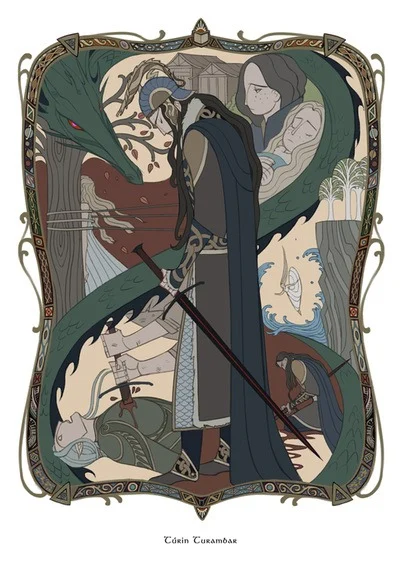
Wavesheep’s framed Túrin Turambar illustration, with a long green dragon curling around the standing swordsman and several smaller story scenes.
Modern fan illustration of Túrin and Glaurung, published by Deutsche Tolkien Gesellschaft in 2017.
Overview
Middle-earth's dragons are powerful, cunning monsters whose abilities vary between individuals and kinds. Smaug is a winged fire-breather, whereas Glaurung moves on four legs without wings; the histories also mention cold-drakes. Flight and fire therefore should not be assigned indiscriminately to every dragon. Their intelligence is as dangerous as their bodies. Smaug uses conversation to unsettle Bilbo and infer where his enemies come from, while his occupation of Erebor turns stolen wealth into the foundation of a ruined regional economy. His armour is not perfectly invulnerable: the vulnerability discovered through Bilbo's observation becomes useful to Bard. This connects a seemingly minor exchange with the later destruction of the hoard's possessor.
The First Age accounts give dragons a military role under Morgoth, with Glaurung's attacks and deceptions shaping the fall of Nargothrond and the tragedy of Túrin and Nienor. His power over perception and memory is a particular, consequential capacity rather than a universal rule inferred from Smaug's persuasive speech. Winged dragons appear as a later terror during the War of Wrath, so the family also changes within the narrated history. This profile combines those distinct examples to explain the range of Tolkien's conception, without inventing a complete breeding mechanism. The Silmarillion is a posthumously edited synthesis, and surviving drafts can differ in chronology or detail. The northern dragon traditions and the later Hobbit story supply complementary narrative contexts; they do not make every treasure-guarding dragon in folklore or another franchise the same creature.
First appearances & development
This profile uses 1937 novel and 1977 edited First Age narrative as its selected publication context. The bibliography identifies particular published narratives, poems, manuscript histories or an explicitly named adaptation. Publication dates describe those works, not a claim that all the underlying texts were composed then. Posthumous editorial syntheses and earlier draft versions are kept distinct from Tolkien's lifetime novels.
Canon & continuity
Tolkien Gateway is an independent, citation-bearing reference rather than an official publisher source. Its named textual references support the bounded identification and scene comparison here. Public article and MediaWiki API reads were used for the creature accounts. The bibliography directs readers to the primary works; no complete reread of every cited volume or manuscript is claimed.
Selected bibliography
Documented works and useful reading. This is not a list of every appearance.
- 01
The Hobbit
Inside Information and Fire and Water: Smaug's conversation, armour and destruction.
- 02
The Silmarillion
Glaurung, Nargothrond and the later winged dragons in the edited First Age account.
Family & connections
A source-supported family tree or inspiration record has not yet been compiled for this profile. Related reading below indicates a connection in subject matter, not a proven lineage or creative influence.
References
Sources supporting this profile. Linked pages have their own scope and editorial standards.
- ReferenceDragon (Middle-earth) — reference guideResearch access: 2026-10-05
- ReferenceSmaug — Tolkien GatewayResearch access: 2026-10-05
- ReferenceGlaurung — Tolkien GatewayResearch access: 2026-10-05
Image credits
Modern fan illustration of a specific Middle-earth story sceneWavesheep’s framed Túrin Turambar illustration, with a long green dragon curling around the standing swordsman and several smaller story scenes.
Modern fan illustration of Túrin and Glaurung, published by Deutsche Tolkien Gesellschaft in 2017.