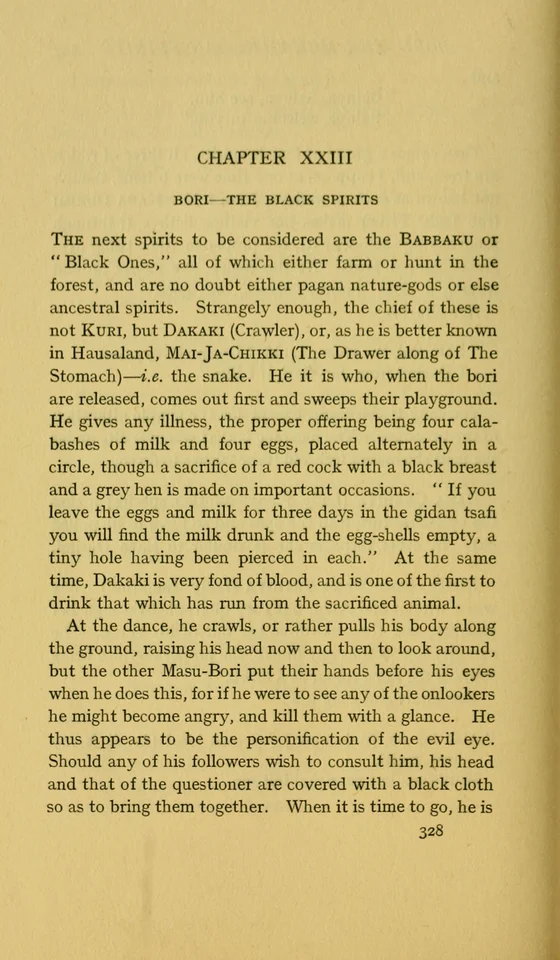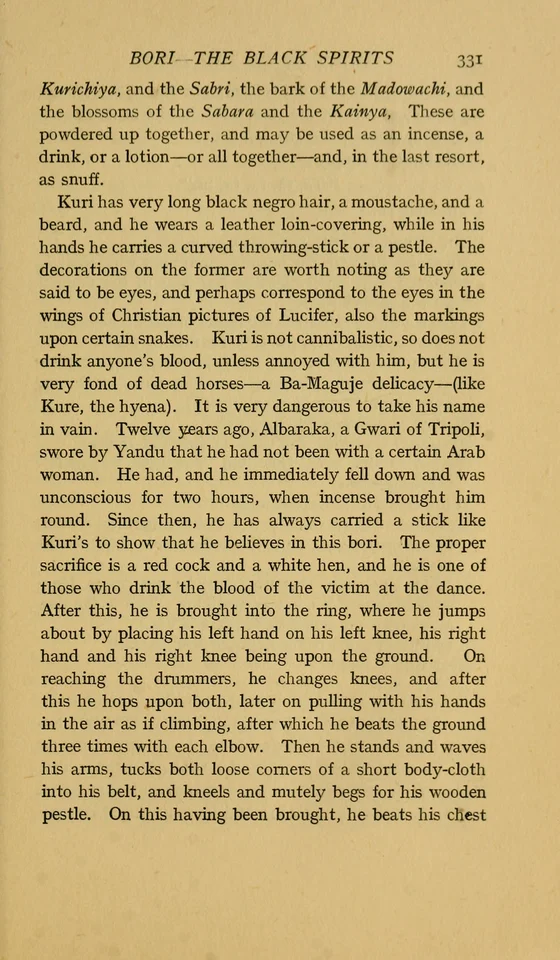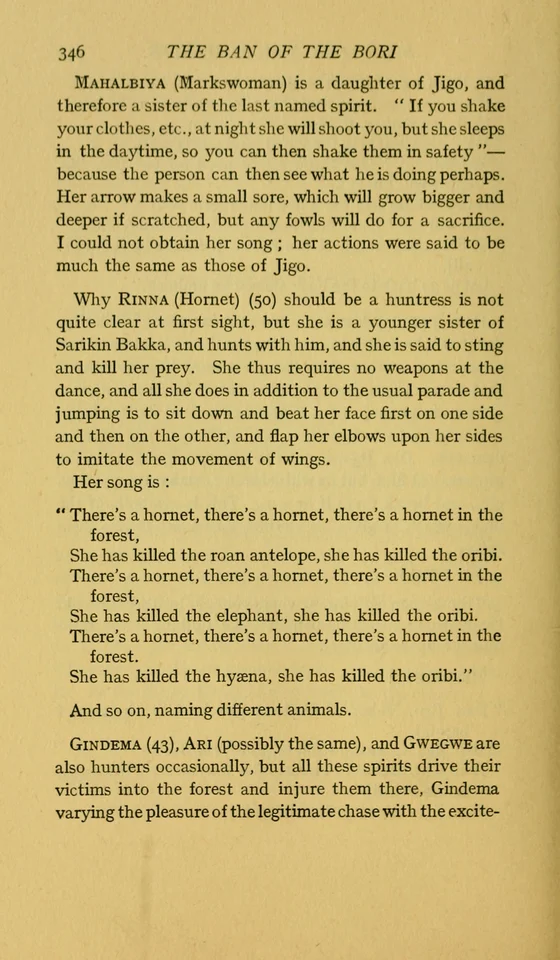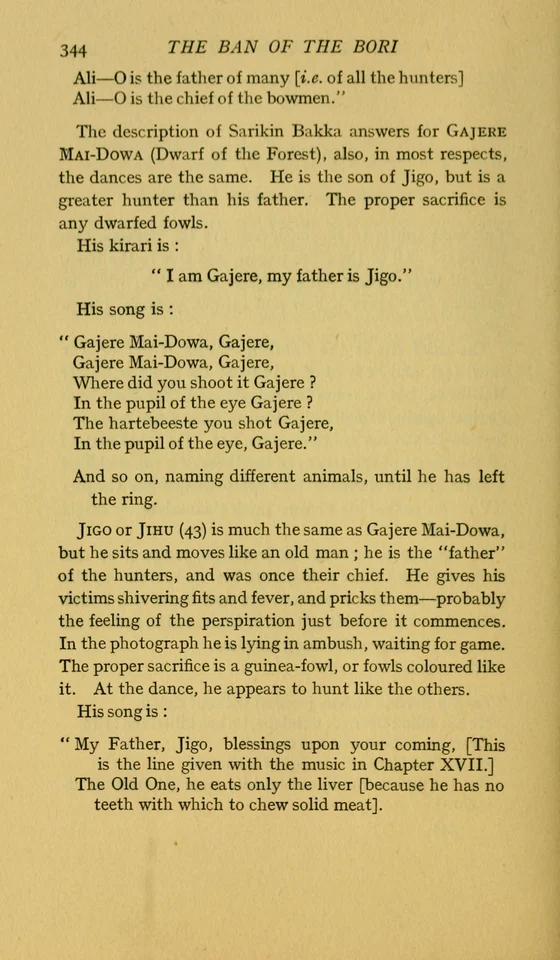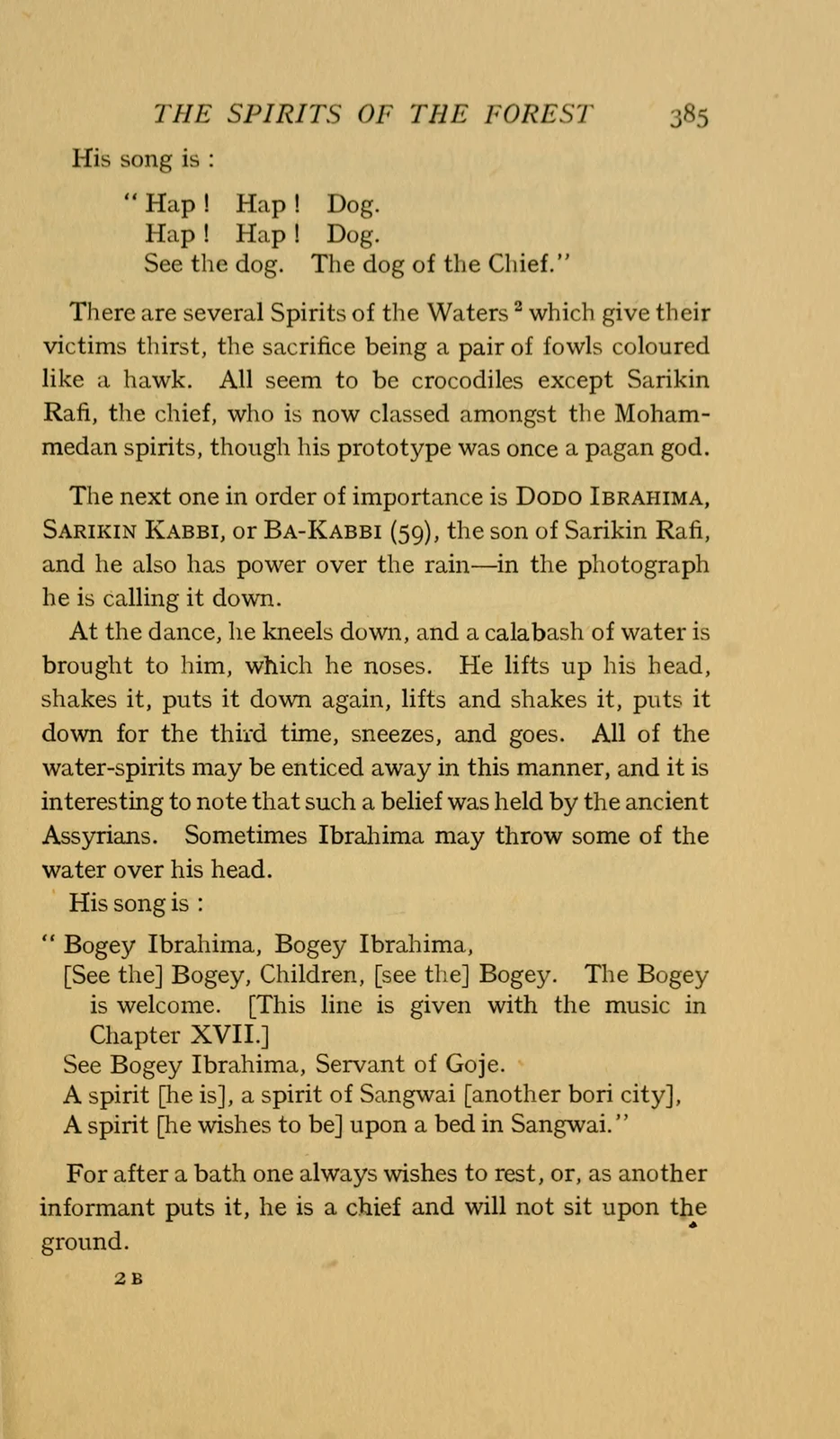
Dodo Ibrahima,1914 historical printed text witness, page385; documentary source-page facsimile
Documentary text facsimile naming Dodo Ibrahima and describing ritual/narrative attributes; not a photograph of a spirit or creature artwork. Colonial observer terminology and interpretations belong to the original1914 text.
Overview
Dodo Ibrahima is also named Sarikin Kabbi and Ba-Kabbi in Tremearne’s water-spirit account. He is a son of Sarikin Rafi and is credited with power over rain; the printed caption describes him calling it down. He ranks next after the water chief, while his own son Dubabi must obtain permission before dancing in front of him and must cover his head with a cloth. The distinct young female Ba-Kabba is Dubabi’s sister, not automatically another spelling of Ibrahima’s title.
His performance kneels beside a calabash of water and noses it. He raises and shakes the head, lowers it, repeats this and puts it down a third time before sneezing and departing. Sometimes he throws water over his head. Tremearne says other water spirits can also be enticed away by this method, but the shared technique does not by itself establish that all their names belong to one being.
The song welcomes Bogey Ibrahima, calls him servant of Goje and places him at the spirit city Sangwai, wishing to be on a bed there. One explanation associates the desire for a bed with rest after a bath; another says a chief will not sit on the ground. Nearby Kadda and Baddo notices are said to be practically the same in function, but their precise identities and the direction of Baddo’s water-lily naming remain unresolved. Those comparisons are retained beside Ibrahima’s own names and performed water sequence.
Origins & earliest records
Tremearne’s historical collection combines accounts and ritual observations in Hausa-associated North African communities and northern Nigeria. Its evolutionary and comparative origin theories are not adopted.
Records & interpretation
The Ban of the Bori, pp 385–386. Ritual movements describe human mounts representing spirits; translated songs and attributed powers are evidence of the recorded representation, not proof of medical causation or uniform contemporary community practice.
Selected bibliography
Documented works and useful reading. This is not a list of every appearance.
- 01
The Ban of the Bori
Selected witness pp 385–386; colonial collection with uneven narrator attribution.
Family, evolution & connections
Named water-spirit generations in Tremearne
Tremearne’s selected 1914 historical Bori notices, pp. 385–386.
Scroll sideways to see all branches. With a keyboard, focus the tree and use the arrow keys.
Prose states Sarikin Rafi → Dodo Ibrahima → Dubabi; Ba-Kabba is expressly Dubabi’s full-sister. Ba-Kabba’s paternal branch follows the explicit full-sibling relation; no mother is named. Kadda and Baddo similarity is not converted into extra children. Rain and crocodile associations are performance/belief context, not zoological ancestry. These are attributed historical religious relationships, not biological phylogeny or a universal contemporary doctrine.
Dubabi
Dubabi is expressly a son of Dodo Ibrahima. The rule requiring his father’s permission to dance in front of him reinforces the source’s particular family relationship, without supplying a universal water-spirit genealogy.
References
Sources supporting this profile. Linked pages have their own scope and editorial standards.
- Historical ritual observation and translated songsThe Ban of the Bori — Dodo IbrahimaResearch access: 2026-10-05
Image credits
Historical text facsimileDodo Ibrahima,1914 historical printed text witness, page385; documentary source-page facsimile
Documentary text facsimile naming Dodo Ibrahima and describing ritual/narrative attributes; not a photograph of a spirit or creature artwork. Colonial observer terminology and interpretations belong to the original1914 text.