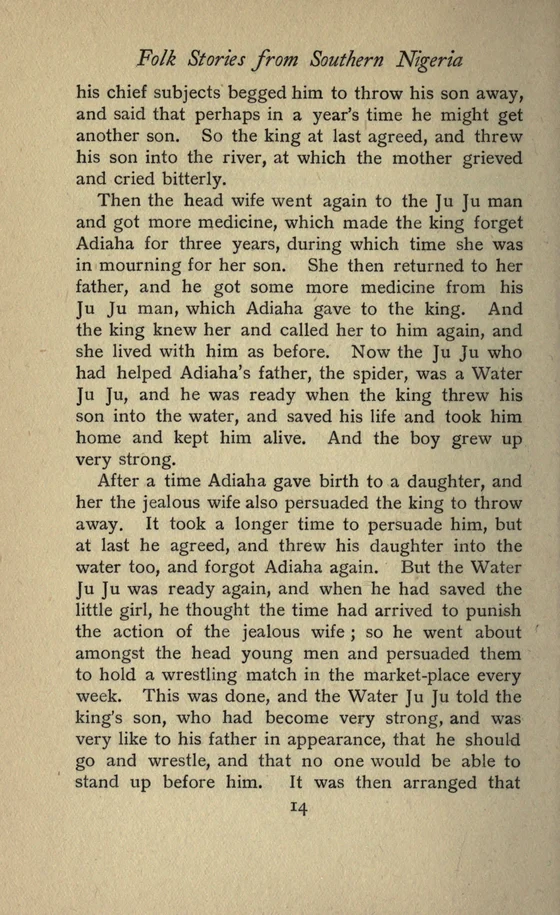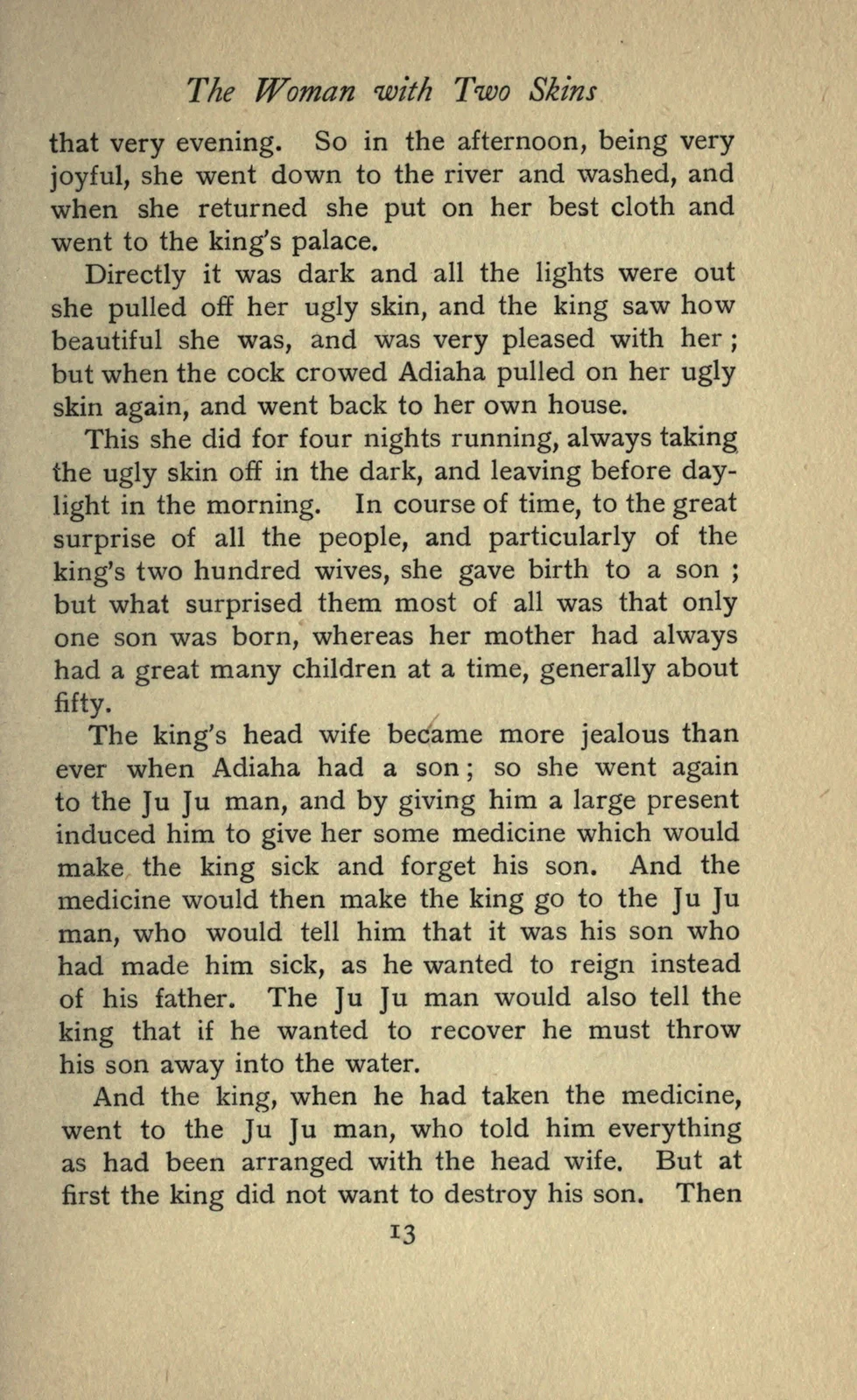
Adiaha (Woman with Two Skins),1910 historical printed text witness, page13; documentary source-page facsimile
Documentary text facsimile of the exact named tale/being, not creature artwork. Printed page13 of the1910 collection. Original historical terminology remains in the source.
Overview
Adiaha, a spider’s daughter, enters King Eyamba’s household because his subjects hope that her family’s exceptional fertility will provide an heir. The tale contrasts her mother’s numerous offspring with Adiaha’s eventual single births. Her outer covering makes her appear unattractive to the king and his other wives, who exclude her from their residence. A separate house protects neither her dignity nor her place in the marriage. Her mother’s promise requires the second skin to remain on except at night, until a later appointed time. The jealous head wife knows the hidden beauty and obtains a practitioner’s potion that makes the king forget Adiaha altogether.
After four months of neglect Adiaha returns to her parents. Her spider father consults a different practitioner, whose divination identifies the interference and whose counter-medicine she serves to the king. Recognition returns immediately. That evening she visits him, takes off the outer skin after darkness and replaces it at cockcrow. She repeats these night visits for four successive nights, and later gives birth to a son. Another hostile medicine makes the king sick and enables a false diagnosis blaming that baby. Royal advisers persuade him to throw the child into the river. Further spells produce three years of forgetting before another restoration of the marriage, followed by a daughter who is similarly cast away.
The children have survived under the care of the benevolent Water Ju Ju. When the grown son wins a public wrestling contest, his resemblance to the king begins the exposure of the deception. His protector sends him to tell his mother who he is and instructs Adiaha to appear at the trial without her outer skin: the period of compulsory covering has ended. She is reunited with both children, and the son publicly explains the head wife’s actions. The king acknowledges Adiaha as his queen. The tale closes with new compounds for mother and children, and the son’s eventual succession. The skin change is Adiaha’s attested bodily distinction; the children’s water rescue and the prince’s wrestling power are interventions by their separate protector.
Origins & earliest records
Selected narrative in Elphinstone Dayrell’s Folk Stories from Southern Nigeria (1910), collected through a colonial district commissioner.
Records & interpretation
Complete tale III, pp. 11–19, independently reread; appearance, separate agents and full conclusion checked against the digitized edition.
In the literature
“she was born with two skins”
III: The Woman with Two Skins; paragraph beginning “This king had two hundred wives, but none of them had borne a son to him. His subjects, se…”
Adiaha must wear an ugly skin by day; a queen’s potion makes the king forget her until a counter-remedy restores recognition.
Selected bibliography
Documented works and useful reading. This is not a list of every appearance.
- 01
Folk Stories from Southern Nigeria, West Africa
III. The Woman with Two Skins, pp. 11–19.
Family, evolution & connections
Textual family: Adiaha in The Woman with Two Skins
Adiaha’s stated parents and her one son in tale III.
Scroll sideways to see all branches. With a keyboard, focus the tree and use the arrow keys.
- Unnamed spider father and Adiaha’s mother (joint parents)
- Unnamed son (father: Eyamba)
Explicit parentage in the named collected tale. The descendant line follows the mother. Eyamba is the child’s separately stated father, not an additional child of Adiaha’s parents. Unnamed members stay unnamed. These are narrative relationships in Dayrell’s mediated collection, not natural species ancestry or verified historical households.
Water Ju Ju (Adiaha tale)
In Dayrell’s Woman with Two Skins, the Water Ju Ju saves Adiaha’s son and daughter when the king throws them into the water. He then arranges the wrestling episode that restores their position. This is a documented protective relationship within the collected narrative, not parentage, animal ecology, or proof that every water spirit has the same role.
Lion in a Woman’s Skin (Southern African tale)
Adiaha’s removable outer skin conceals her beauty; Honey’s lion wears a killed woman’s skin to enter her household as an impostor. Both stories use a skin to disrupt recognition, but their protagonists and moral situations differ sharply. This comparison concerns a narrative device in these printed versions, without claiming shared ancestry, identical transformation rules, or borrowing between the traditions.
The unnamed spider father (Dayrell III)
The text identifies Adiaha’s father as the spider who takes her to seek help. No personal name is supplied.
Adiaha’s unnamed mother (Dayrell III)
The tale identifies Adiaha’s mother, her earlier multiple births, and the promise concerning her daughter’s skin. It supplies no personal name.
Adiaha’s unnamed son with Eyamba (Dayrell III)
The son is born to Adiaha and repeatedly called Eyamba’s son. Later danger and rescue do not introduce a different biological child.
Eyamba I (husband in Dayrell III)
Adiaha is one of Eyamba’s wives in this narrated household. The tale’s king name alone does not verify the extraordinary events as historical biography.
Located primary passages
Specific passages supporting details in this entry, grouped by their published witness.
Folk Stories from Southern Nigeria, West Africa
London: Longmans, Green and Co.,1910. Project Gutenberg34655 produced from Internet Archive/American Libraries images; title-page edition checked.
- Adiaha must wear an ugly skin by day; a queen’s potion makes the king forget her until a counter-remedy restores recognition.
- Removing the ugly skin at night reveals her beauty; she replaces it at cockcrow.
- Her restored son instructs her to reveal her beauty at the hearing; he exposes the queen and the king recognizes the family.
Selected historical collected English tale, not individually credited original-language transcript or universal belief. Colonial commentary and depicted punishments are historical text, not endorsements. Narrative bodies distinguished from Lang introduction.
References
Sources supporting this profile. Linked pages have their own scope and editorial standards.
- Historical collected taleThe Woman with Two SkinsResearch access: 2026-10-05
Image credits
Historical text facsimileAdiaha (Woman with Two Skins),1910 historical printed text witness, page13; documentary source-page facsimile
Documentary text facsimile of the exact named tale/being, not creature artwork. Printed page13 of the1910 collection. Original historical terminology remains in the source.