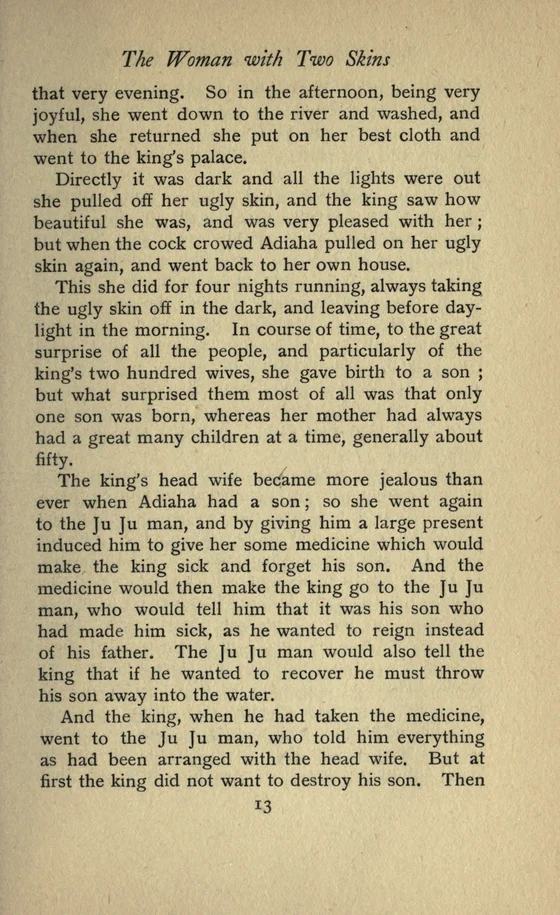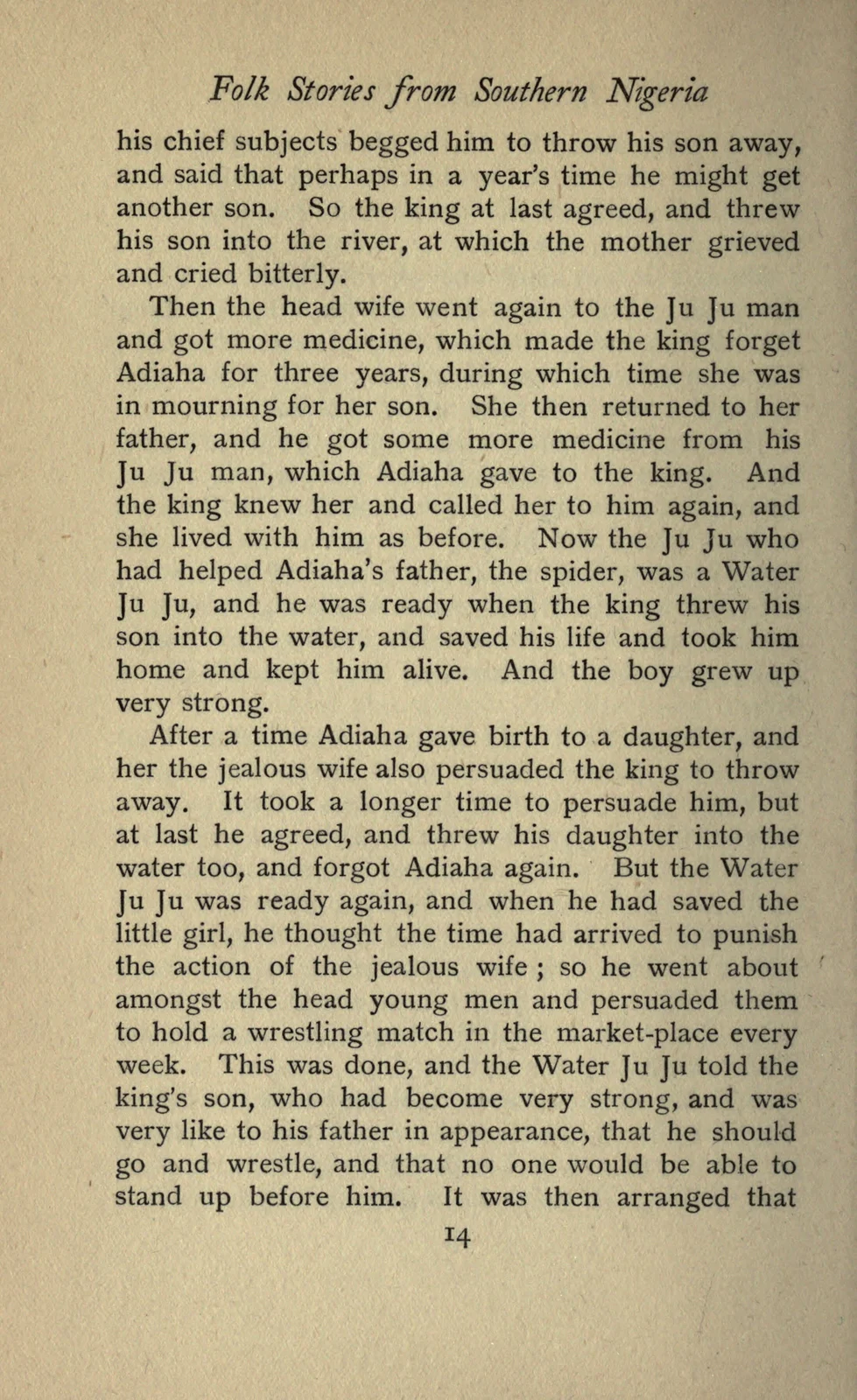
Water Ju Ju (Adiaha tale),1910 historical printed text witness, page14; documentary source-page facsimile
Documentary text facsimile of the exact named tale/being, not creature artwork. Printed page14 of the1910 collection. Original historical terminology remains in the source.
Overview
The Water Ju Ju is first encountered as a practitioner consulted by Adiaha’s spider father. Through spells and divination he discovers why King Eyamba no longer recognises his wife: the jealous head wife has used another practitioner’s medicine against her. He prepares the counter-medicine that Adiaha carries into the palace in food. His identity as a Water Ju Ju is stated later, when the narration explains how he was ready to catch the king’s infant son after a manipulated diagnosis induced the king to throw the baby into the river. He takes the child home and keeps him alive.
He is ready again when the royal daughter is cast into the water. After this second rescue he sets a plan in motion by approaching leading young men and encouraging weekly wrestling in the market-place. His adopted charge has grown strong and resembles his father, but remains unknown to the court. For a grand contest, the protector assures the prince that his Ju Ju power will overcome every opponent. The boy defeats the strongest assembled wrestlers, wins cloth and money and receives an invitation to dinner. There the same head wife who arranged his attempted destruction is attracted to him without knowing his identity.
When the boy reports the evening, the Water Ju Ju directs him to ask the king for a public hearing and then to reveal himself to Adiaha. He also announces that the time has arrived for her to discard the outer skin at that gathering. Thus his help moves from preservation of life to organised recognition of the separated family. The prince presents mother and sister to the assembled community and recounts both rescues; the king recognises his children and restores Adiaha’s position. The published conclusion includes the head wife’s brutal punishment, which belongs to the tale’s historical judicial framing. No described fish tail, snake body or underwater palace is supplied for this particular protector: his recorded characteristics are medicine, water rescue, guardianship and strategic counsel.
Origins & earliest records
Selected narrative in Elphinstone Dayrell’s Folk Stories from Southern Nigeria (1910), collected through a colonial district commissioner.
Records & interpretation
Complete tale III, pp. 11–19, independently reread; appearance, separate agents and full conclusion checked against the digitized edition.
In the literature
“saved his life and took him home and kept him alive.”
III: The Woman with Two Skins; paragraph beginning “Then the head wife went again to the Ju Ju man and got more medicine, which made the king …”
Water Ju Ju saves the discarded son from the river and rears him; he also saves the daughter.
Selected bibliography
Documented works and useful reading. This is not a list of every appearance.
- 01
Folk Stories from Southern Nigeria, West Africa
III. The Woman with Two Skins, pp. 11–19.
Family & connections
A source-supported family tree or inspiration record has not yet been compiled for this profile. Related reading below indicates a connection in subject matter, not a proven lineage or creative influence.
Located primary passages
Specific passages supporting details in this entry, grouped by their published witness.
Folk Stories from Southern Nigeria, West Africa
London: Longmans, Green and Co.,1910. Project Gutenberg34655 produced from Internet Archive/American Libraries images; title-page edition checked.
- Water Ju Ju saves the discarded son from the river and rears him; he also saves the daughter.
- He organizes wrestling matches and empowers the son to win, leading to the public hearing that exposes the queen.
Selected historical collected English tale, not individually credited original-language transcript or universal belief. Colonial commentary and depicted punishments are historical text, not endorsements. Narrative bodies distinguished from Lang introduction.
References
Sources supporting this profile. Linked pages have their own scope and editorial standards.
- Historical collected taleThe Woman with Two SkinsResearch access: 2026-10-05
Image credits
Historical text facsimileWater Ju Ju (Adiaha tale),1910 historical printed text witness, page14; documentary source-page facsimile
Documentary text facsimile of the exact named tale/being, not creature artwork. Printed page14 of the1910 collection. Original historical terminology remains in the source.