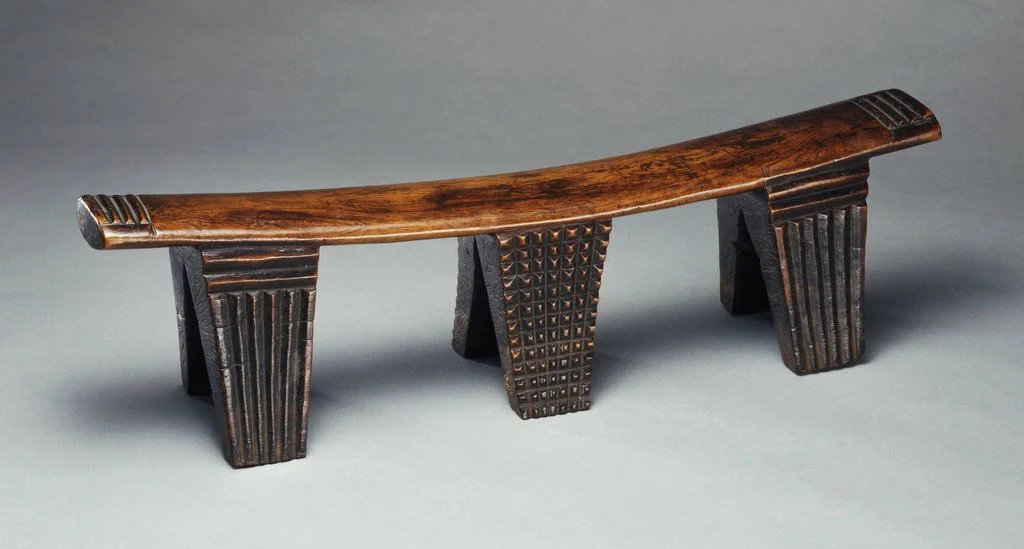
Wooden Zulu headrest from South Africa, late nineteenth to twentieth century, with three carved supports, Princeton University Art Museum 1998-538
This wooden headrest is attributed to an unrecorded Zulu artist in South Africa and dated to the late nineteenth or twentieth century. Its long, gently curved upper surface rests on carved supports. The photograph shows a particular historical furnishing, rather than the appearance or everyday practices of all contemporary Zulu communities.
Overview
Zulu communities are represented here through a deliberately local set of language, literary and institutional witnesses. Stephanie Inge Rudwick's 2006 doctoral research focuses on isiZulu-speaking residents of Umlazi township, rather than treating all speakers as a uniform population. The university repository abstract describes quantitative and qualitative methods examining how residents negotiate identity through language. It argues that isiZulu can be both a cultural resource and a means of identification across social divisions, while English has particular economic significance. Those are the study's attributed findings at its own time and scale; language use is not made an automatic test of every person's ethnic identity.
The University of KwaZulu-Natal's language-office account documents institutional efforts to expand isiZulu's domains of use. It dates approval of a university language policy to September 2006 and its revision to November 2014. The office describes objectives involving administration, teaching, research, technical terminology, translation and interpreting. Development of an isiZulu corpus and terminology bank is also among its stated aims. These are the responsibilities and purposes described by a university unit, distinct from a report that every objective has been achieved. They show one setting in which language work reaches beyond conversation into academic and professional activity.
A May 2026 university report by Lee Rondganger describes Professor Nompumelelo Zondi's appointment to the Mazisi Kunene Research Chair. It connects the chair with Kunene's literary legacy and a partnership with his foundation concerned with preserving his archive and widening access. Zondi identifies storytelling, cultural identity, language innovation, gender and mentorship among her priorities. She also sets out prospective collaborations with artists, historians and community participants. This named scholar's plans contribute a contemporary perspective on language and cultural memory; they are neither the voice of all Zulu people nor a verified record of every promised research or preservation outcome.
A different organisational witness comes from the Gcinamasiko Arts and Heritage Trust's public partner account. It describes collaboration with the Mazisi Kunene Foundation, whose work promotes writing in African languages and honours Kunene's isiZulu work through a museum and arts events. The organisations report supporting one another with content and practical arrangements. The same page connects literacy work with publishers, book-distribution partners and storytelling initiatives. This account identifies a network through which literary memory and access to reading are pursued. Its undated roles and older future plans are not treated as current appointments, and the museum's manuscripts or published books were not inspected here.
History & identity
Contemporary local and institutional scope; study and policy dates do not date the origin of Zulu communities.
Sources & representation
A bounded thesis abstract, public university accounts and a cultural organisation partner account.
Selected bibliography
Documented works and useful reading. This is not a list of every appearance.
- 01
Language, identity and ethnicity: Umlazi township community
Complete repository abstract read; full thesis not read.
- 02
University Language Planning and Development Office: About us
Complete public body read; policy dates and objectives.
- 03
Professor Nompumelelo Zondi Appointed Mazisi Kunene Research Chair
Complete 29 May report read; named priorities and partnership.
- 04
Gcinamasiko: Our Partners
Complete public partner body read; undated roles not asserted current.
Language & cultural connections
Source-supported language and cultural connections have not yet been compiled for this profile.
References
Sources supporting this profile. Linked pages have their own scope and editorial standards.
- University research abstractLanguage, identity and ethnicity: Umlazi township communityResearch access: 2026-10-05
- University institutional accountUniversity Language Planning and Development Office: About usResearch access: 2026-10-05
- University institutional accountProfessor Nompumelelo Zondi Appointed Mazisi Kunene Research ChairResearch access: 2026-10-05
- Cultural organisation self-descriptionGcinamasiko: Our PartnersResearch access: 2026-10-05
Image credits
Contextual cultural object photographWooden Zulu headrest from South Africa, late nineteenth to twentieth century, with three carved supports, Princeton University Art Museum 1998-538
This wooden headrest is attributed to an unrecorded Zulu artist in South Africa and dated to the late nineteenth or twentieth century. Its long, gently curved upper surface rests on carved supports. The photograph shows a particular historical furnishing, rather than the appearance or everyday practices of all contemporary Zulu communities.