Māori
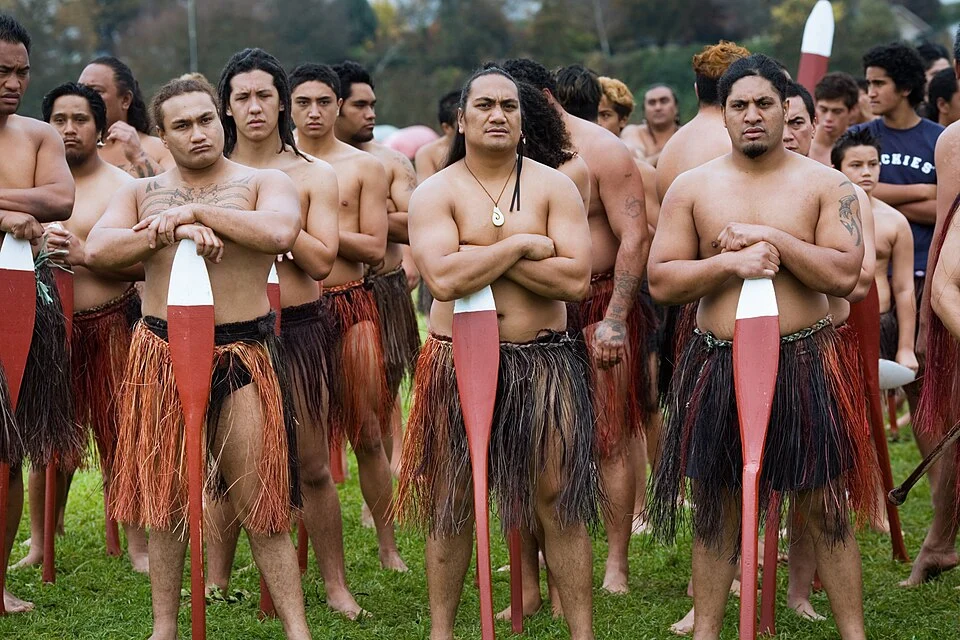
Image associated with the exact linked encyclopedia article; consult credited file description for its interpretation.
Overview
Māori society encompasses numerous iwi and hapū with distinct histories, places and relationships. Whakapapa connects people with ancestors and with the wider world; it informs belonging without reducing identity to a biological category. Te reo Māori, carving, weaving, performance and oral traditions continue through families, marae, education and public life. These practices vary between communities and change through the work of living practitioners.
The settlement of Aotearoa belongs within the wider history of Polynesian voyaging. Navigators travelled deliberately across the Pacific using environmental knowledge, bringing plants and animals as well as social traditions. Later encounters with Europeans, colonisation and Māori political action reshaped communities. Māori life today includes urban and rural experiences, language revitalisation and many ways of maintaining ancestral relationships.
Te Kōhanga Reo provides a specific example of collective language work. The National Trust describes a movement centred on whānau development and the transmission of language, knowledge and cultural practice to children. Its historical account places the first kōhanga reo at Pukeatua in Wainuiomata in April 1982, following discussion among Māori leaders and a government-supported pilot. Daily immersion in te reo Māori is joined by whānau responsibility for decisions, management and accountability. The account also describes training that extends adults’ language and organisational skills. This is a particular educational movement with its own history, not a claim that all Māori families have followed one educational path.
Iwi-led heritage work likewise preserves specific histories. In 2017, Rongowhakaata brought taonga from its five marae to Te Papa for an exhibition and residency developed with the iwi. The museum’s announcement recounts the forcible removal of the carved meeting house Te Hau ki Tūranga in 1867, subsequent museum alterations and the Crown’s 2012 acknowledgement that the whare belongs to Rongowhakaata. It describes restoration as a plan at the time of writing. The report is evidence for that collaboration and its historical context; it does not establish that every announced restoration was completed or describe a single experience shared by all iwi.
Modern literature offers authored interpretations as well as historical documentation. Witi Ihimaera’s The Whale Rider centres on Kahu, a girl whose relationship with whales challenges expectations of leadership in the story’s Whāngārā community. The selected Penguin/Raupo record documents the 2008 paperback edition and supplies the publisher’s synopsis. Its narrative is a work of fiction drawing on cultural relationships and ancestral storytelling, not a universal statement of Māori succession rules. A publisher description identifies a relevant book, but cannot replace reading its full text or the separate histories of the communities it evokes.
History & identity
Archaeological research places initial Polynesian settlement of Aotearoa approximately in the late thirteenth century. That date concerns settlement, not the beginning of Māori ancestry or a fixed moment when every present identity appeared. Community histories preserve particular voyaging and genealogical traditions, while the collective label Māori developed in the context of encounters with Europeans.
Sources & representation
Archaeological sites, radiocarbon dating, introduced species, language relationships and navigational histories provide complementary evidence for settlement. Whakapapa and iwi traditions supply perspectives that archaeological chronologies cannot replace. Te Ara presents a national synthesis; it cannot stand in for the authority of individual iwi or describe every community's interpretation.
Selected bibliography
Documented works and useful reading. This is not a list of every appearance.
- 01
History – Māori arrival and settlement
Selected historical reference; community histories and scholarship are much broader.
- 02
Te Orokohanganga / History
Complete English historical overview read; separate detailed timeline only partly inspected. Exact-day inconsistencies and changing current counts not imported.
- 03
Rongowhakaata welcomed as Te Papa iwi in residence
Complete dated announcement read; future restoration and exhibition plans retained as plans.
- 04
The Whale Rider
Publisher synopsis and edition record only; novel not newly read. ISBN 9780143011392; this is not an asserted first-publication date.
Language & cultural connections
These connections link languages or specific cultural works and institutions; they do not establish biological ancestry or ethnic identity.
Shared human classification
Shared species classification of the human members of this community: Homo sapiens. This cultural identity is not a biological taxon, race, subspecies or separate evolutionary branch.
Encyclopedia background
An additional attributed reference, separate from the editorial profile above.
Read the open encyclopedia overview
Māori are the indigenous Polynesian people of mainland New Zealand. Māori are descended from East Polynesian settlers who arrived in New Zealand in several waves of canoe voyages between roughly 1320 and 1350. Over several centuries in isolation, these settlers developed a distinct culture, whose language, mythology, crafts, and performing arts evolved independently from those of other eastern Polynesian cultures. Some Polynesians moved to the Chatham Islands from the New Zealand mainland, where their descendants became New Zealand's other indigenous Polynesian ethnic group, the Moriori.
Early contact between Māori and Europeans, starting in the 18th century, ranged from beneficial trade to lethal violence; Māori actively adopted many technologies from the newcomers. With the signing of the Treaty of Waitangi in 1840, the two cultures coexisted for a generation. Rising tensions over disputed land sales led to conflict in the 1860s, and subsequent land confiscations, which Māori resisted fiercely. After the Treaty was declared a legal nullity in 1877, Māori were forced to assimilate into many aspects of Western culture. Social upheaval and epidemics of introduced disease took a devastating toll on the Māori population, which fell dramatically, but began to recover by the beginning of the 20th century. The March 2023 New Zealand census gives the number of people of Māori descent as 978,246 (19.6% of the total population), up from 18.5% in 2018. Of those identifying as Māori at the 2023 census, 366,015 people (41.2%) identified as of sole Māori ethnicity while 409,401 people (46.1%) identified as of both European and Māori ethnicity.
Efforts have been made, centring on the Treaty of Waitangi, to increase the standing of Māori in wider New Zealand society and achieve social justice. Traditional Māori culture has enjoyed a significant revival, which was further bolstered by a Māori protest movement that emerged in the 1960s. However, disproportionate numbers of Māori face significant economic and social obstacles, and generally have lower life expectancies and incomes than other New Zealand ethnic groups. They suffer higher levels of crime, health problems, imprisonment, poverty, and educational under-achievement. A number of socio-economic initiatives have been instigated with the aim of "closing the gaps" between Māori and other New Zealanders. Political and economic redress for historical grievances is also ongoing (see Treaty of Waitangi claims and settlements).
Māori are the second-largest ethnic group in New Zealand, after European New Zealanders (commonly known by the Māori name Pākehā). In addition, more than 170,000 Māori live in Australia. The Māori language is spoken to some extent by about a fifth of all Māori, representing three per cent of the total population. Māori are active in all spheres of New Zealand culture and society, with independent representation in areas such as media, politics, and sport.
Text from Wikipedia contributors, “Māori people”. CC BY-SA 4.0. Extracted introduction; formatting changed. Retrieved 5 October 2026. The source article may have changed since retrieval.
References
Sources supporting this profile. Linked pages have their own scope and editorial standards.
- ReferenceHistory – Māori arrival and settlementResearch access: 2026-10-05
- Community educational institutionTe Kōhanga Reo: institutional historyResearch access: 2026-10-05
- MuseumRongowhakaata residency: dated museum accountResearch access: 2026-10-05
- PublisherThe Whale Rider: edition and synopsisResearch access: 2026-10-05
Image credits
Reference illustrationMāori
Image associated with the exact linked encyclopedia article; consult credited file description for its interpretation.