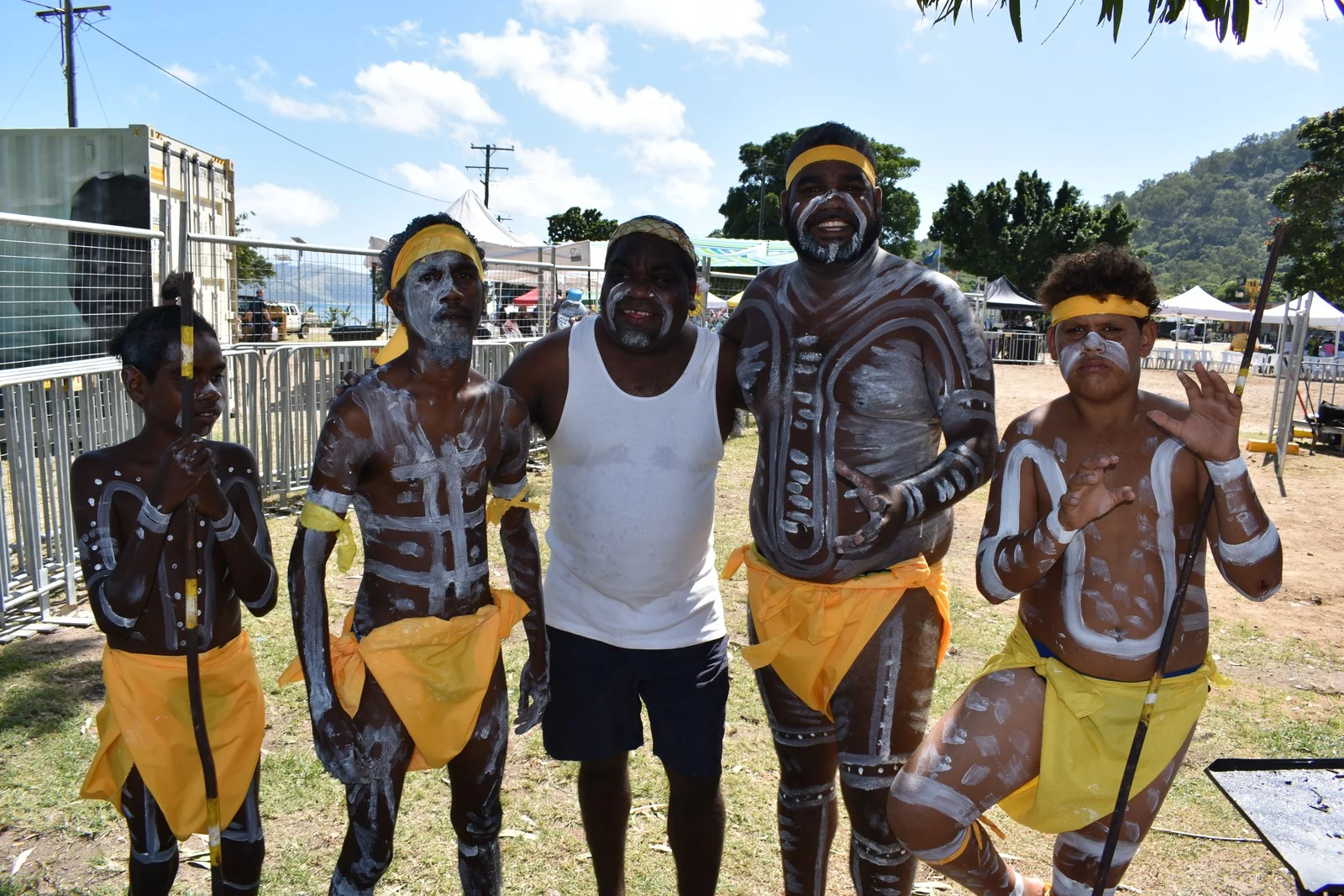
Bwgcolman dancers and a festival participant at Palm Island’s Deadly Didge ’n’ Dance Festival, April 2018
Alf Wilson photographed Bwgcolman dancers at Palm Island’s centenary festival in April 2018. This specific Queensland community event illustrates contemporary cultural participation; the people, dress and painted designs pictured do not represent every Aboriginal nation or community in Australia.
Overview
Australia's Aboriginal peoples include numerous nations with particular Countries, histories, languages and systems of knowledge. Country can involve relationships among land, waters, ancestors, living things and responsibilities; meanings and practices vary between communities. Examples named by AIATSIS include Gunditjmara, Gadigal and Yawuru, each with its own context. An introductory overview cannot stand in for the authority of these or other nations.
Aboriginal life encompasses cultural continuity, contemporary arts, education, political institutions and urban as well as regional communities. Colonisation brought dispossession and policies that disrupted families and language transmission; communities continue to pursue rights and cultural renewal. Aboriginal and Torres Strait Islander peoples are distinct broad categories, each containing substantial diversity. Identity concerns community, ancestry and self-identification, and should never be assigned from appearance or treated as a biological racial branch.
The Gunditjmara’s Budj Bim Cultural Landscape provides a specific example of relations between engineering, ecology and continuing cultural knowledge. Its public heritage account describes stone channels, dams and weirs used to manage water and trap, hold and harvest kooyang, the short-finned eel. The account places the development of this system over at least 6,600 years and identifies Tae Rak, Kurtonitj and Tyrendarra among its connected places. It also records the restoration of water flows through a cultural weir in 2010 after twentieth-century drainage. These histories belong to Gunditjmara Country and should not be assigned indiscriminately to other Aboriginal nations.
Gambay illustrates community direction over public language information. First Languages Australia developed the interactive map using contributions from regional language centres and programmes working with communities. Custodians can influence how their languages are represented, and public place-name resources link to community maps so the contributing groups retain control of their data. The project also shares accounts from language workers and teaching resources. Gambay’s coverage includes both Aboriginal and Torres Strait Islander languages, which remain distinct within the project. A language map is a tool for communication and learning; its groupings should not be treated as a biological classification of people.
Sally Morgan’s My Place supplies a particular family account. The authorised excerpt identifies Morgan as Palyku, from Western Australia’s Pilbara region, and records the book’s first publication in 1987 and the selected edition in 2025. Fremantle Press describes a 1982 journey to her grandmother’s birthplace and a search for family history that draws in her mother’s and grandmother’s accounts. The work brings personal recollection into the wider bibliography without making one family’s experiences representative of every Aboriginal community. Its publisher synopsis and excerpt front matter have been inspected here; this profile does not claim a new full reading of the memoir.
History & identity
Archaeological evidence documents a very long history of human occupation in Australia, while nations maintain their own accounts of relationships with Country. An early archaeological date concerns occupation, not the founding date of every present identity. Colonial umbrella names and modern recognition frameworks are separate from the histories of particular peoples.
Sources & representation
AIATSIS explains the diversity of Australia's First Peoples and provides examples of distinct nations. Archaeological research, languages, oral histories and community knowledge contribute complementary evidence, but cannot be collapsed into a single cultural narrative. Images and descriptions require attention to community protocols, including sensitivities concerning deceased persons and knowledge not intended for general publication.
In the literature
“I was a grubby five-year-old in an alien environment.”
The hospital, printed9 / publisher extractPDF7
The five-year-old narrator describes her discomfort while visiting her father in hospital.
Selected bibliography
Documented works and useful reading. This is not a list of every appearance.
- 01
First Peoples of Australia
Selected institutional introduction; nation-specific sources and community protocols remain essential.
- 02
World Heritage Listing: Budj Bim Cultural Landscape
Complete public written heritage account read; nomination video not watched. Local engineering and restoration described; current legal status not independently assessed.
- 03
Gambay: Australian First Languages Map
Complete project explanation read; underlying map dataset and videos not exhaustively examined.
- 04
My Place
Publisher synopsis and authorised excerpt front matter inspected; ISBN9781760996185. Full memoir not newly read. Reading scope of any separately located excerpt is stated with that excerpt.
- 05
My Place — The hospital
Fremantle Press 2025 edition; first published1987. Publisher-supplied fourteen-page extract, including complete opening chapter “The hospital,” printed9–16.
Language & cultural connections
These connections link languages or specific cultural works and institutions; they do not establish biological ancestry or ethnic identity.
Shared human classification
Shared species classification of the human members of this community: Homo sapiens. This cultural identity is not a biological taxon, race, subspecies or separate evolutionary branch.
Located primary passages
Specific passages supporting details in this entry, grouped by their published witness.
My Place — The hospital
Fremantle Press 2025 edition; first published1987. Publisher-supplied fourteen-page extract, including complete opening chapter “The hospital,” printed9–16.
- Morgan narrates a childhood hospital visit to her father through discomfort and fear. Memories of her grandmother’s garden interrupt the visit; the child’s emotional perspective shapes the account rather than an explanatory national history.
The hospital, printed9–16 / extractPDF7–14; copyright leafPDF4
Only the supplied extract read, not the whole memoir. One author’s family recollection is not presented as representative of all Aboriginal peoples. No cultural protocol or national-origin claim derived.
Encyclopedia background
An additional attributed reference, separate from the editorial profile above.
Read the open encyclopedia overview
Aboriginal Australians are the various indigenous peoples of the Australian mainland and many of its islands, excluding the ethnically distinct people of the Torres Strait Islands.
Humans first migrated to Australia 50,000 to 65,000 years ago, and over time formed as many as 500 linguistic and territorial groups. Aboriginal people once lived across large areas of the continental shelf that were later inundated by postglacial sea-level rise at the start of the Holocene inter-glacial period, reshaping coastal landscapes and separating Tasmania from the mainland. Aboriginal people maintained extensive networks within the continent and certain groups maintained relationships with Torres Strait Islanders and the Makassar people of modern-day Indonesia.
Over the millennia, Aboriginal people developed complex trade networks, inter-cultural relationships, law and religions, which make up some of the oldest continuous cultures in the world. At the time of European colonisation of Australia, the Aboriginal people spoke more than 250 different languages, possessed varying degrees of technology, and lived in various types of settlements. Languages (or dialects) and language-associated groups of people are connected with stretches of territory known as "Country", with which they have a profound spiritual connection.
Contemporary Aboriginal beliefs are shaped by traditional beliefs, the disruption of colonisation, religions brought to the continent by later migrants, and contemporary issues. Just over half hold secular or other spiritual beliefs or no religious affiliation; about 40% are Christian; and about 1% adhere to a traditional Aboriginal religion. Traditional cultural beliefs are passed down and shared through dancing, stories, songlines, and art that collectively weave an ontology of modern daily life and ancient creation known as the Dreaming.
Studies of Aboriginal groups' genetic makeup are ongoing, but evidence suggests that they have genetic inheritance from ancient Asian peoples. Aboriginal Australians and Papuans shared the same paleocontinent Sahul, although they became genetically distinct about 37,000 years ago. Aboriginal Australians have a broadly shared, complex genetic history, but only in the last 200 years have they been defined by others as, and started to self-identify as, a single group. Aboriginal identity has changed over time and place, with family lineage, self-identification, and community acceptance all of varying importance.
The 2021 census shows that there were 944,171 Aboriginal people, comprising 3.7% of Australia's population. Over 80% of Aboriginal people today speak English at home, and about 77,000 speak an Indigenous language at home. Aboriginal people, along with Torres Strait Islander people, suffer a number of severe health and economic deprivations in comparison with the wider Australian community.
Text from Wikipedia contributors, “Aboriginal Australians”. CC BY-SA 4.0. Extracted introduction; formatting changed. Retrieved 5 October 2026. The source article may have changed since retrieval.
References
Sources supporting this profile. Linked pages have their own scope and editorial standards.
- ResearchFirst Peoples of AustraliaResearch access: 2026-10-05
- Community cultural organisationBudj Bim: public heritage accountResearch access: 2026-10-05
- Language organisationGambay: community-directed language projectResearch access: 2026-10-05
- PublisherMy Place: publisher synopsis and editionResearch access: 2026-10-05
- Primary literary excerptMy Place: authorised 2025 excerpt and front matterResearch access: 2026-10-05
Image credits
Contextual community photographBwgcolman dancers and a festival participant at Palm Island’s Deadly Didge ’n’ Dance Festival, April 2018
Alf Wilson photographed Bwgcolman dancers at Palm Island’s centenary festival in April 2018. This specific Queensland community event illustrates contemporary cultural participation; the people, dress and painted designs pictured do not represent every Aboriginal nation or community in Australia.