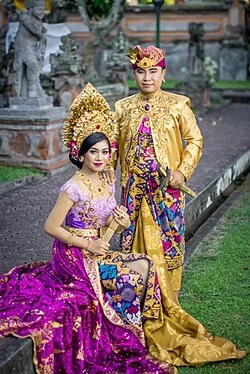
Balinese
Image associated with the exact linked encyclopedia article; consult credited file description for its interpretation.
Overview
Balinese cultural histories include agriculture, temples, performance, visual arts and community organisation shaped by exchanges within Indonesia and beyond. Religious and artistic practices vary across places and circumstances; the island's internationally prominent traditions should not erase minority communities or contemporary diversity. People living in cities or outside Bali contribute to cultural life alongside agricultural and village settings.
The subak system coordinates irrigation through cooperative institutions and water temples. UNESCO's account connects its cultural landscape with Tri Hita Karana, a philosophy addressing relationships among spiritual life, people and the environment. Canals, weirs and rice terraces show how practical infrastructure and cultural institutions can develop together. This example is especially useful because it concerns documented places and organisations, while leaving room for wider histories that cannot be represented by one landscape or heritage designation.
Performance supplies another documented cultural field. UNESCO’s 2015 inscription account distinguishes sacred, semi-sacred and wider community-entertainment genres of Balinese dance. It describes male and female performers combining bodily movements, changing pace, facial expression and eye movements with gamelan accompaniment. Children commonly learn informally in groups, beginning with basic positions and progressing toward more complex sequences. This account concerns the transmission of selected dance traditions, rather than a claim that all performances have the same ritual purpose or that every Balinese person is a dancer.
Digital language work connects heritage with contemporary participation. UNESCO’s 2019 account of BASAbali Wiki describes a collaboration among scholars, artists, government and community members, recognised by that year’s Confucius Prize for Literacy. The project combines a Balinese–Indonesian–English dictionary, encyclopedia and virtual library. Contributors can submit material and translations, while specialists help with relevance, editing and quality. Outreach includes young people and families, with offline access described for people beyond reliable connectivity. These are a dated account of a programme and its aims; they do not by themselves measure the long-term vitality of the language.
Oka Rusmini’s Earth Dance offers an authored literary exploration of social expectations. The Lontar Foundation’s synopsis follows four generations of Balinese women and the narrator Telaga’s decision to marry a commoner against her mother’s wishes. The English edition, translated by Rani Ambyo and Thomas M. Hunter, is documented by the publishing partner as a 162-page December 2011 paperback. Its conflicts around caste, desire and family belong to a novel with a particular narrative perspective. They should not be treated as a universal account of Balinese women’s wishes. The full novel has not been newly read for this profile.
History & identity
Bali's histories involve successive settlements, political formations, religious developments and exchanges across maritime Asia. Documentary evidence for subak institutions extends back many centuries, but does not date the origin of Balinese people as a whole. The modern World Heritage designation is a recognition of selected landscapes, not the beginning of their traditions.
Sources & representation
UNESCO documents selected subak landscapes and their cultural interpretation, supporting claims about cooperative irrigation and water temples. Heritage accounts necessarily select particular places and themes. Archaeology, local histories and community perspectives are needed for a broader account, and neither religious affiliation nor agricultural occupation should be assumed for every Balinese person.
Selected bibliography
Documented works and useful reading. This is not a list of every appearance.
- 01
Cultural Landscape of Bali Province: the Subak System as a Manifestation of the Tri Hita Karana Philosophy
Selected World Heritage property account; 2012 is the inscription year, not a complete bibliographic history.
- 02
Three genres of traditional dance in Bali
Complete public inscription description read; nomination dossier and videos not newly reviewed.
- 03
Programme from Indonesia promoting linguistic diversity wins UNESCO literacy prize
Complete article read; updated20April2023. Reported programme design and aspirations distinguished from independent impact measurement.
- 04
Earth Dance: Novel
Publisher synopsis and author/translator metadata read; full novel unread. December2011 edition corroborated by UH Press, ISBN9789798083822.
Language & cultural connections
These connections link languages or specific cultural works and institutions; they do not establish biological ancestry or ethnic identity.
Shared human classification
Shared species classification of the human members of this community: Homo sapiens. This cultural identity is not a biological taxon, race, subspecies or separate evolutionary branch.
Encyclopedia background
An additional attributed reference, separate from the editorial profile above.
Read the open encyclopedia overview
The Balinese (Balinese: ᬳᬦᬓ᭄ᬩᬮᬶ, romanized: Anak Bali (in the ketah register), ᬯᭀᬂᬩᬮᬶ, Wong Bali (in the madia register), ᬓ᭄ᬭᬫᬩᬮᬶ, Krama Bali (in the singgih register); Indonesian: Orang Bali) are an Austronesian ethnic group native to the Indonesian island of Bali and the surrounding islands. The Balinese population of 4.2 million (1.7% of Indonesia's population) live mostly on the island of Bali, making up 85% of the island's population. The Balinese are distinctive amongst the ethnic groups of Indonesia for their adherence to Balinese Hinduism rather than Abrahamic religions such as Islam or Christianity.
There are also significant populations on the island of Lombok and in the easternmost regions of Java (e.g. Banyuwangi Regency), most of them are descendants of Balinese since the kingdoms era who once controlled the region. Some Balinese can also be found in Balinese migrant areas such as Lampung and Sulawesi regions, mainly due to the migration following the eruption of Mount Agung in 1963 as well as the transmigration program enacted by the Indonesian government.
The Balinese stand out within modern-day Indonesia because they continue to follow Balinese Hinduism rather than the Abrahamic religions that predominate elsewhere in the country. This situation emerged in part because the Dutch colonial administration restricted both Islamisation and Christian missionary activity on the island in order to preserve the already present religious traditions, and in part because the Balinese themselves maintained a strong commitment to their inherited cultural and religious practices. Earlier Hindu–Buddhist traditions had long been predominant in the region. The Orientalist colonial policy that sought to protect and codify Balinese customs later became known as Baliseering (Balinization).
Text from Wikipedia contributors, “Balinese people”. CC BY-SA 4.0. Extracted introduction; formatting changed. Retrieved 5 October 2026. The source article may have changed since retrieval.
References
Sources supporting this profile. Linked pages have their own scope and editorial standards.
- ReferenceCultural Landscape of Bali Province: the Subak System as a Manifestation of the Tri Hita Karana PhilosophyResearch access: 2026-10-05
- Heritage institutionBalinese dance: inscription accountResearch access: 2026-10-05
- Cultural institutionBASAbali Wiki: dated literacy accountResearch access: 2026-10-05
- PublisherEarth Dance: publisher accountResearch access: 2026-10-05
- Publishing partnerEarth Dance: English edition recordResearch access: 2026-10-05
Image credits
Reference illustrationBalinese
Image associated with the exact linked encyclopedia article; consult credited file description for its interpretation.