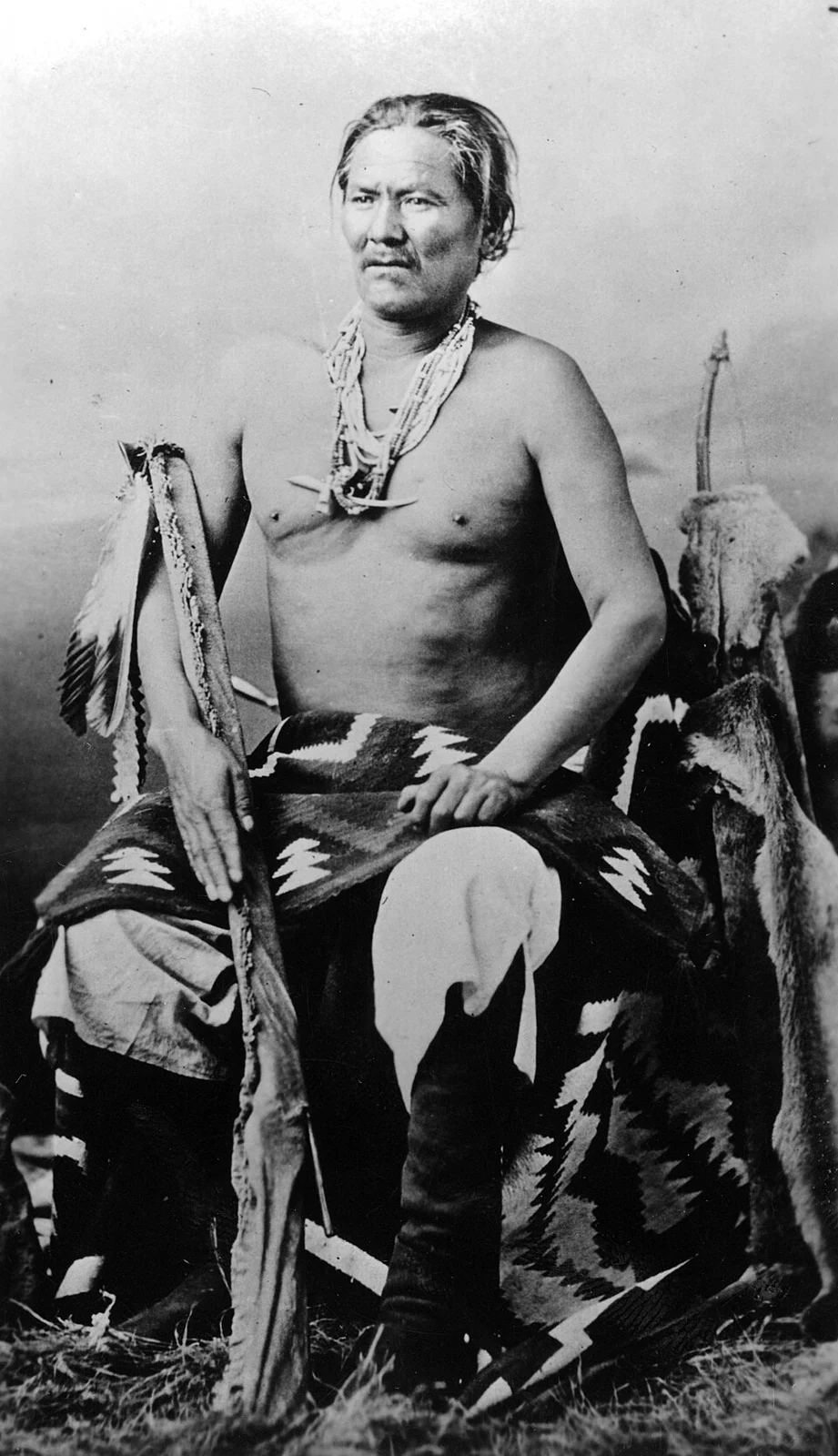
Diné (Navajo)
Image associated with the exact linked encyclopedia article; consult credited file description for its interpretation.
Overview
The Navajo Nation extends across parts of Arizona, New Mexico and Utah, within a homeland often called Diné Bikéyah. Diné histories and relationships with place are expressed through oral traditions, language and community life. Weaving, silverwork, agriculture and pastoral practices are significant cultural activities, but none describes every individual. Contemporary Diné people live both within and outside the Nation and participate in many professions and artistic forms.
The Nation maintains governmental and judicial institutions alongside cultural knowledge and approaches to justice. Its official history describes twentieth-century political developments and the contributions of Navajo code talkers during the Second World War. These histories sit alongside the consequences of forced removal and other colonial policies. A respectful account recognises sovereignty and current voices rather than treating Diné life as a surviving fragment of a vanished past.
The Navajo judiciary’s account of peacemaking records both continuity and institutional change. Judges established a Peacemaker Court in 1982 to support approaches rooted in Diné knowledge and customary dispute resolution. The account also criticises the effects of imposing conventional courtroom rules, which could narrow the practice toward settlement and weaken its teaching and relational aspects. It describes the later removal of the word court and the replacement of rules with guidelines. This is an institution’s historical reflection on how a practice was reshaped, not evidence of an unchanged procedure followed everywhere or advice about any present legal case.
Diné College supplies another concrete institutional history. Founded as Navajo Community College in 1968, it sought to place postsecondary education under tribal direction. The college records accreditation in 1976 and its first baccalaureate degrees in 1998 through a teacher-education partnership with Arizona State University. These milestones document changing educational provision and the Nation’s efforts to meet its own needs. The historical webpage also contains older programme descriptions, so it should not be treated as a complete current course catalogue. Educational institutions form part of contemporary Diné life alongside family, community and cultural learning.
Luci Tapahonso’s Sáanii Dahataal/The Women Are Singing is a selected example of contemporary Diné literature. The University of Arizona Press identifies it as a collection of poems and stories, published in paperback in January 1993, with an ebook edition following in 2016. Its account describes writing grounded in memories of Shiprock, family relationships and everyday occasions, using English and Navajo. Memoir and fiction are both part of the collection’s presentation. This bibliography records the publisher’s description and edition details; it does not claim a new complete reading or treat one writer’s experiences as a test of cultural identity.
History & identity
Diné origin traditions describe relationships, places and responsibilities in terms that should be represented on their own terms. Archaeological and linguistic research examines historical movements and interactions, but cannot supply a single founding date for a living identity. The establishment of modern governmental structures is a separate history from the people's origins.
Sources & representation
Official Navajo Nation and judicial sources document institutional history and explain the continuing relevance of Diné principles. These sources support a contemporary overview, although they cannot represent every family or community. Older ethnographies require attention to translation, collection circumstances and colonial assumptions, especially when discussing restricted ceremonial knowledge.
Selected bibliography
Documented works and useful reading. This is not a list of every appearance.
- 01
History
Selected official national history; not a complete ethnographic bibliography.
- 02
Institutional History of hózh̨óji naat’aah
Complete institutional-history section read, including its criticism of court-style procedure; current legal advice is outside this profile.
- 03
Diné College History
Complete historical webpage read through the web source; local archival fetch timed out. Historical milestones kept distinct from current programme offerings.
- 04
Sáanii Dahataal/The Women Are Singing: Poems and Stories
Publisher account and edition metadata inspected; full collection not newly read. No passages reproduced.
Language & cultural connections
These connections link languages or specific cultural works and institutions; they do not establish biological ancestry or ethnic identity.
Shared human classification
Shared species classification of the human members of this community: Homo sapiens. This cultural identity is not a biological taxon, race, subspecies or separate evolutionary branch.
Navajo Nation executive language policy
Executive Order 01-2025 directs executive offices to incorporate Diné Bizaad into documents and develop staff learning opportunities. This records the Nation’s January 2025 policy direction, not proof that every implementation requirement was completed or a language-fluency test for identity.
Encyclopedia background
An additional attributed reference, separate from the editorial profile above.
Read the open encyclopedia overview
The Navajo are an Indigenous People of the Southwestern United States. The Navajo term for themselves is Diné. Their language is Navajo (Navajo: Diné bizaad), a Southern Athabaskan language. The states with the largest Diné populations are Arizona (140,263) and New Mexico (108,305). More than three-quarters of the Diné population resides in these two states.
The overwhelming majority of Diné are enrolled in the Navajo Nation. Some Diné are enrolled in the Colorado River Indian Tribes, another federally recognized tribe. Historic achievements of the Navajo and related tribes include the Pueblo architecture as well as the taming of the horse after European colonization. The Navajo have a rich artistic tradition in beadwork and colorful styles in painting and dress.
With more than 399,494 enrolled tribal citizens as of 2021, the Navajo Nation is the second largest federally recognized tribe in the United States. The Navajo Nation has the largest reservation in the country. The reservation straddles the Four Corners region and covers more than 27,325 square miles (70,770 square kilometers) of land in Arizona, Utah, and New Mexico. The Navajo Reservation is slightly larger than the state of West Virginia.
Text from Wikipedia contributors, “Navajo”. CC BY-SA 4.0. Extracted introduction; formatting changed. Retrieved 5 October 2026. The source article may have changed since retrieval.
References
Sources supporting this profile. Linked pages have their own scope and editorial standards.
- CommunityHistoryResearch access: 2026-10-05
- Community judicial institutionPeacemaking: judiciary’s institutional historyResearch access: 2026-10-05
- Community educational institutionDiné College: institutional historyResearch access: 2026-10-05
- PublisherSáanii Dahataal: publisher accountResearch access: 2026-10-05
Image credits
Reference illustrationDiné (Navajo)
Image associated with the exact linked encyclopedia article; consult credited file description for its interpretation.