Quechua peoples
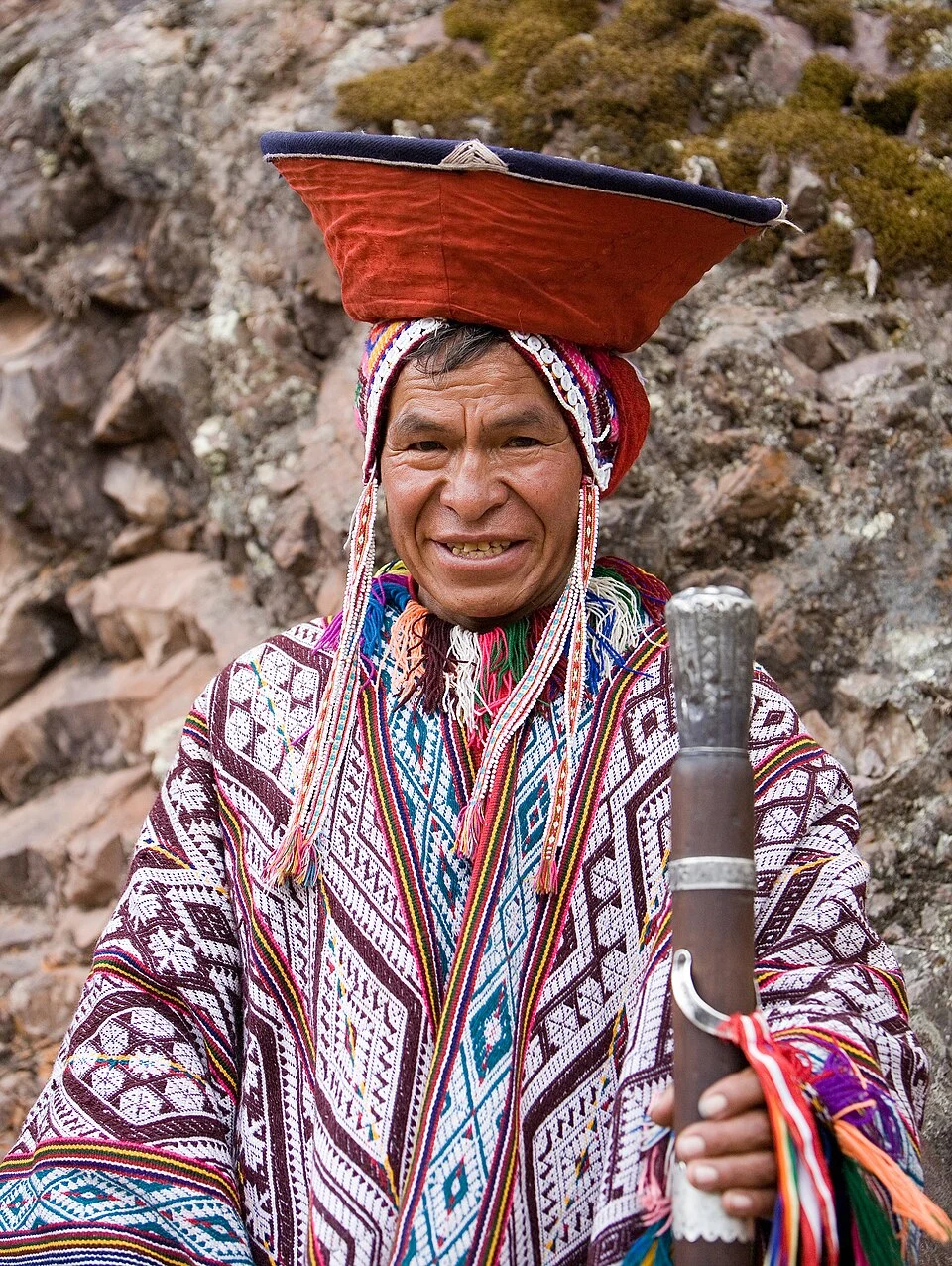
Image associated with the exact linked encyclopedia article; consult credited file description for its interpretation.
Overview
Quechua is a family of related language varieties, and communities using these languages have distinct local identities and histories. Agriculture, weaving, oral storytelling and relationships with Andean landscapes are important in many settings, while cities and diaspora communities form other parts of contemporary life. The historical Inka state made extensive use of Quechua, but the language and present peoples should not be treated as interchangeable with that empire.
Smithsonian accounts of Quechua weavers and educators show cultural transmission through current practice. Textile knowledge develops through family and community learning, creative decisions and changing markets. Storytelling can connect language teaching with radio, song, dance or theatre. These examples describe particular practitioners rather than a uniform culture, and they demonstrate why living Andean communities need to be represented as participants in the present.
The Centro de Textiles Tradicionales del Cusco records a community-led history of textile renewal. Its account begins with women in Chinchero gathering to spin and weave in the 1970s, and describes Nilda Callañaupa and fellow weavers founding the association in 1996, followed by official registration in 1998. Early partners included Chinchero, Chahuaytire and Pitumarca. Elders helped recover designs, techniques and dye knowledge, while community weaving centres provided shared working space. Young Weavers Groups connect children with experienced practitioners. The organisation’s history concerns these Cusco-region partnerships, whose styles remain locally distinctive, rather than a single textile tradition shared unchanged across the Andes.
The 2008 bilingual collection Desde nuestros mayores / Ñawpa willanakuy preserves another kind of named cultural work. CHIRAPAQ’s catalogue connects its introduction with Pujas oral tradition and lists eighteen narratives in Spanish and Quechua. It credits Tarcila Rivera Zea as editor, Edwin Cconislla Aramburu for oral collection, and Leo Casas Ballón for transcription, translation and editing. Named narrators include Aurelina Najarro Quispe and Víctor Soto Chuchón. These separate roles matter: a translated published collection is a collaboration involving tellers, collectors and editors. The catalogue and contents were inspected here; the individual tales have not been newly read.
José María Arguedas’s Deep Rivers offers a different literary form. Waveland’s English-edition account follows Ernesto, a child raised by Indigenous servants who enters a Catholic boarding school at fourteen. The narrative places tensions between Indigenous and Spanish-speaking social worlds within his memories and experience of the Peruvian Andes. Frances Horning Barraclough is credited as translator. The publisher also identifies the challenge of rendering Arguedas’s combination of Indigenous syntax and Spanish vocabulary. This is a novel with a particular narrator, documented here through its publisher’s synopsis, not direct testimony representing all Quechua-speaking communities.
History & identity
Andean language histories, archaeological societies and the rise of the Inka state concern overlapping but different subjects. No single imperial founding date establishes the origin of all Quechua peoples. Local histories and identities developed before, during and after Inka rule, Spanish colonisation and the formation of modern states, with continuing changes through migration and community life.
Sources & representation
Language research, archaeology, historical documents and community knowledge contribute different evidence. Smithsonian material documents specific Quechua practitioners and cultural activities, providing concrete examples rather than comprehensive coverage. Generalisations from one Peruvian community should not automatically be extended to every Quechua-speaking region or to people whose preferred identity uses a more local name.
Selected bibliography
Documented works and useful reading. This is not a list of every appearance.
- 01
Andean Storytelling with Julia Garcia (Quechua)
Selected record of a cultural practitioner; not a general ethnography of all Quechua peoples.
- 02
Our story
Complete institutional history read. Foundation and registration distinguished; changing participation counts omitted.
- 03
Desde nuestros mayores / Ñawpa willanakuy: Narrativa andina
Complete publisher catalogue, contents and contributor roles read; full bilingual collection not newly read.
- 04
Deep Rivers
Complete publisher synopsis and edition metadata read via web; native archival fetch returned406. ISBN9781577662440. Copyright date is not asserted as this reprint’s publication date; full novel unread.
Language & cultural connections
These connections link languages or specific cultural works and institutions; they do not establish biological ancestry or ethnic identity.
Shared human classification
Shared species classification of the human members of this community: Homo sapiens. This cultural identity is not a biological taxon, race, subspecies or separate evolutionary branch.
Encyclopedia background
An additional attributed reference, separate from the editorial profile above.
Read the open encyclopedia overview
The Quechua people (, US also ; Spanish: [ˈketʃwa] ) , Quichua people or Kichwa people are indigenous peoples of South America who speak the Quechuan languages, which originated among the Indigenous people of Peru. Although most Quechua speakers are native to Peru, there are some significant populations in Ecuador, Bolivia, Chile, Colombia, and Argentina.
Text from Wikipedia contributors, “Quechua people”. CC BY-SA 4.0. Extracted introduction; formatting changed. Retrieved 5 October 2026. The source article may have changed since retrieval.
References
Sources supporting this profile. Linked pages have their own scope and editorial standards.
- MuseumAndean Storytelling with Julia Garcia (Quechua)Research access: 2026-10-05
- Community cultural institutionCusco textile centre: institutional historyResearch access: 2026-10-05
- Indigenous publisher and archiveÑawpa willanakuy: publisher catalogueResearch access: 2026-10-05
- PublisherDeep Rivers: English-edition accountResearch access: 2026-10-05
Image credits
Reference illustrationQuechua peoples
Image associated with the exact linked encyclopedia article; consult credited file description for its interpretation.