Yale
Image associated with the exact linked encyclopedia article; consult credited file description for its interpretation.
Overview
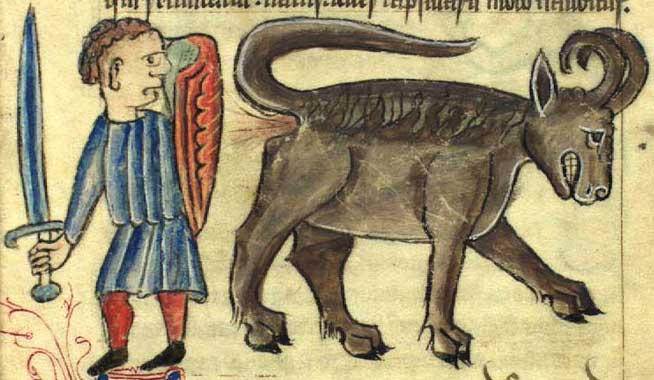
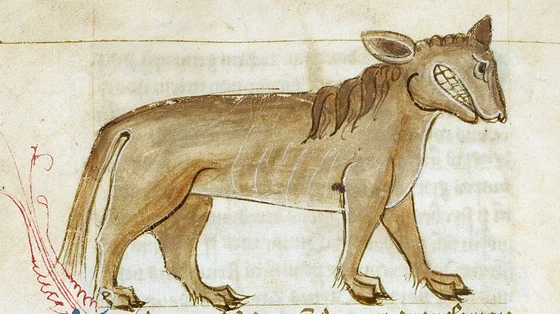
The yale’s body is assembled from familiar comparisons: an elephant’s tail, a boar’s jaws and the size of a horse. The extraordinary feature is its long, movable horns. It advances one for a fight and folds the other back, bringing the second into use if the first point is damaged. The account therefore explains its equipment through a sequence of actions, rather than merely listing an unusual silhouette.
The surviving text calls the creature eale. Yale is used here as the familiar name, while the source spelling remains visible in the work title. This is one creature under different spellings, not two catalog entries. The selected folio supplies no personal name, quest or speaking role; modern narratives should not be silently inserted to fill those gaps. Its defensive behaviour is enough to distinguish it from an ordinary horned animal.
Pliny supplies an earlier description under the name eale. In Book VIII chapter30 of the Bostock–Riley translation, it appears among animals assigned to Ethiopia. Its size is compared with the river-horse, or hippopotamus, rather than the horse of the Aberdeen passage. It is black or tawny, with an elephant-like tail and boar-like jaws. Horns longer than a cubit can be presented alternately or obliquely as fighting requires. This account supports a comparison in movable-horn imagery without making the two descriptions identical in size, colour or detail.
The animals immediately before and after the eale in Pliny are separate subjects. The voice-imitating leucrocotta precedes it, and especially fierce wild bulls follow it. The bulls’ tough hide and other attributes should not be transferred to the eale simply because the passages are adjacent. The nineteenth-century editorial note suggests a two-horned rhinoceros as a possible identification. Its tentative wording matters: it is an editor’s hypothesis, not a specimen-based confirmation or a claim that modern rhinoceros horns swivel like the legendary equipment.
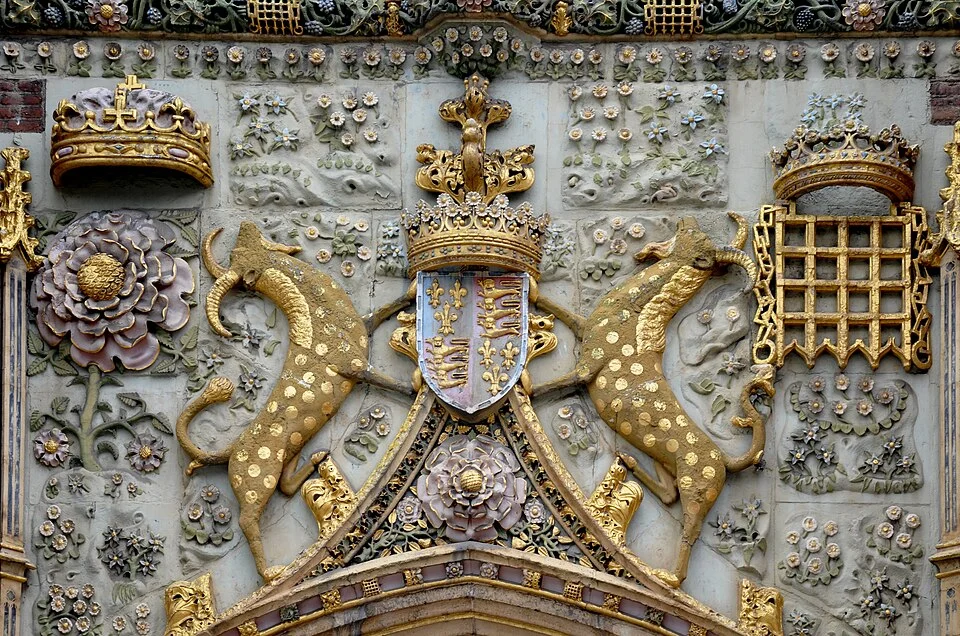
Later heraldry gives the yale another documented setting. Historic Royal Palaces identifies a Silver Yale of Beaufort with an antelope-like body, boar tusks, lion-like tail and swivelling horns. Its account traces Beaufort use to John Beaufort in 1443 and records adoption by Margaret Beaufort, HenryVII and HenryVIII. The emblem expresses martial ability and defence. Those family associations describe human ownership and political symbolism; they do not form a genealogy of individual yale creatures.
The same institution explains that the eight wooden beasts in Chapel Court at Hampton Court were recreated in 2009. The displayed yale therefore documents a modern recreation of heraldic tradition, not an untouched medieval carving. Its composite appearance also differs from both Pliny and Aberdeen. A source-led entry can retain all three without inventing a single canonical body shared by every period.
Origins & earliest records
The selected witness is Aberdeen MS24, folio16v, from an English manuscript made around1200. Its description belongs to medieval transmission of earlier animal lore. This date identifies the inspected manuscript, not the yale’s earliest account or oral origin, and the spelling eale is retained as part of its textual history. The comparison now includes Pliny’s earlier eale and the documented Beaufort heraldic reception. These textual and institutional witnesses support a history of representation, without proving a direct chain between every surviving object.
Records & interpretation
The university edition presents the Latin wording and translation of the same surviving passage, together with its painted depiction. These support the composite body and alternating horns as medieval representations. They do not independently confirm a species with freely movable horns, and a modern animal resemblance is not proof of identity. Complete Pliny VIII.30 and editorial note 1719 read in the1855 Bostock–Riley volume II. Aberdeen16v complete yale text and commentary reread. Historic Royal Palaces’ introductory context and complete Silver Yale section read; its object/history descriptions are attributed institutional evidence, not a new physical inspection of the sculptures.
Selected bibliography
Documented works and useful reading. This is not a list of every appearance.
- 01
Aberdeen Bestiary, University Library MS24, 16v
Selected surviving folios inspected; text and image are treated as distinct evidence.
- 02
Natural History — Book VIII, chapter30
Complete chapter and note 1719; adjacent leucrocotta and wild bulls remain separate.1855 dates this translation.
Family & connections
A source-supported family tree or inspiration record has not yet been compiled for this profile. Related reading below indicates a connection in subject matter, not a proven lineage or creative influence.
References
Sources supporting this profile. Linked pages have their own scope and editorial standards.
- Primary textUniversity of Aberdeen, MS24 folio16vResearch access: 2026-10-05
- ReferenceUniversity of Manchester, Aberdeen Bestiary project and manuscript datingResearch access: 2026-10-05
- Primary ancient text and separately attributed editorial hypothesisPliny/Bostock–Riley 1855: VIII.30, eale; note 1719Research access: 2026-10-05
- Custodial interpretation of heraldry and the 2009 recreationHistoric Royal Palaces: Hampton Court Beasts, Silver Yale of BeaufortResearch access: 2026-10-05
Image credits
Reference illustrationYale
Image associated with the exact linked encyclopedia article; consult credited file description for its interpretation.