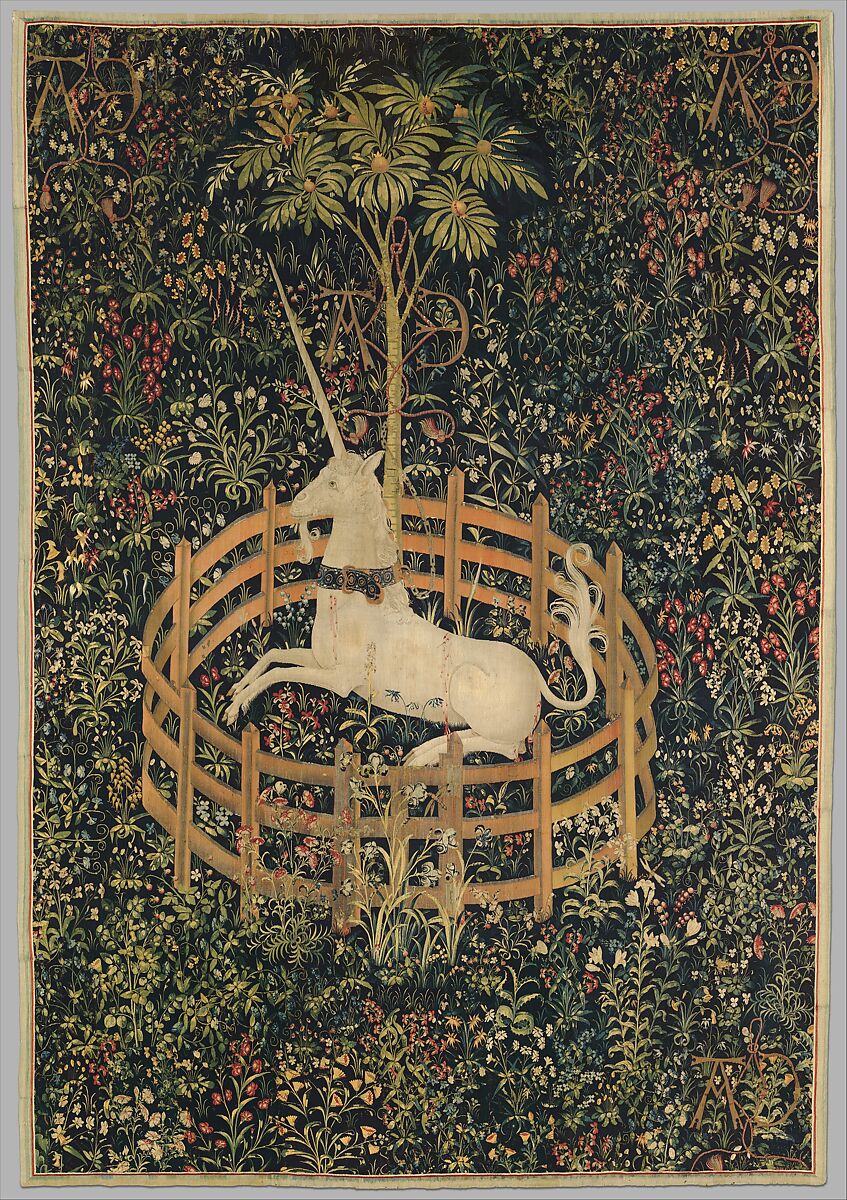
The Unicorn Rests in a Garden, tapestry of a collared one-horned creature within a flower-filled enclosure, 1495–1505
The long horn, beard, collar and tether belong to this late medieval representation. The low enclosure and plants support the Met’s interpretation of love, marriage and fertility; these readings do not determine the anatomy described by ancient writers.
Overview
The western unicorn gathers several distinct one-horned animals and symbolic treatments. Medieval bestiary and artistic forms can have a beard or divided hooves, rather than the anatomy of an ordinary white horse. The familiar maiden-capture motif belongs to one strand of this history; ancient descriptions of formidable wild beasts have different bodies, behaviours and settings. Similarity alone does not establish that all these writers intended exactly the same creature.
Ctesias’s Indica, transmitted through Photius’s later summary, describes Indian wild asses as large as horses, with white bodies, dark-red heads, blue eyes and a horn coloured white, black and red in successive sections. They gather speed as they run. Adults defend their young against mounted hunters, using horn, teeth and feet, and cannot be taken alive. The hunters seek horns and knucklebones rather than the bitter flesh. The reported protective powers of drinking vessels made from the horn are assertions within this transmitted account.
Pliny’s Natural History VIII.31 instead describes the monoceros through a composite anatomy: a horse-like body, stag’s head, elephant’s feet and boar’s tail. It bellows deeply and carries a black forehead horn, given as two cubits in Bostock and Riley’s translation. Again, capture alive is said to be impossible. This particular passage supplies neither a maiden who subdues it nor a gentle equine temperament. Its vivid comparisons document an ancient description without identifying a verified animal matching the entire combination.
Aberdeen MS24, folio 15r, preserves a medieval monoceros account with a horse’s body, elephant’s feet, a deer-like tail and a four-foot piercing horn. It can be killed but cannot be captured alive. The university’s illustration commentary, however, describes a stag’s head and boar’s tail in the picture. That distinction between the translated prose and commentary is retained here rather than silently harmonized. This surviving folio is a specific monoceros witness; it should not be cited as if it supplied the separate maiden-capture episode.
Philostratus’s Life of Apollonius III.2 adds scepticism to the horn-vessel tradition. In this literary biography, Apollonius reportedly sees a horned wild ass but questions the cup’s supposed protection: a king drinking from it daily should then be immortal. Aelian’s On Animals III.41 and IV.52 also transmit horned horse or ass reports and protective-vessel claims. These are additional located literary appearances, not independent demonstrations of those properties.
The Met’s The Unicorn Rests in a Garden, dated 1495–1505, is a surviving woven witness with several interpretive possibilities. The museum suggests it may have been an independent image rather than another episode in the hunting series. Its chain and low fence would allow escape, supporting a reading of willingly restrained love. The museum relates the pomegranates and other plants to fertility and marriage, and interprets the flank’s red marks as dripping fruit juice rather than wounds. These are museum interpretations of a particular textile, not one demonstrated intention shared by every unicorn image.
Material objects offer a different connection with real animals. The Met identifies its eight-foot object N.A.2015.18 as a narwhal tusk and explains the historical collection of such tusks as unicorn horns. Science Museum object A676045 is likewise catalogued as a narwhal tusk, dated broadly 1701–1930, with no provenance details. Its accompanying interpretation discusses their claimed medicinal uses. These specimens support a history of objects and attribution; neither record authenticates a unicorn or proves that narwhal tusks explain every ancient one-horned story. Qilin and other traditions therefore retain their own identities and evidence.
Origins & earliest records
The selected antique witness is Ctesias’s fourth-century BCE account as summarized by Photius in the ninth century, rather than an extant original manuscript by Ctesias. Pliny’s monoceros and subsequent Greek and medieval accounts broaden the record without establishing a single observed species. Physiologus remains relevant to medieval Christian interpretation, but no complete version of that work has been newly inspected for this expansion. The surviving Aberdeen folio and late medieval tapestry are dated witnesses, not proofs of a worldwide first origin.
Records & interpretation
Ancient accounts and the manuscript attest written representations, while the tapestry provides material evidence of late medieval iconography. The museums identify the separately catalogued tusks as narwhal material. Their histories document beliefs about unicorn horns, not anatomical proof of a unicorn or verified efficacy of horn-based remedies. Historical animal names, artistic bodies and modern species identifications require separate evidence.
In the literature
“a single black horn, two cubits in length, standing out in the middle of its forehead.”
Chapter XXIX, “The Unicorn”, opening paragraph
Bulfinch quotes a rendering of Pliny’s description; this is Bulfinch’s wording, not an independently verified translation of Pliny.
“it makes a deep lowing noise”
Natural History VIII.31, VolumeII, printed p.281; complete chapter · John Bostock and H.T.Riley
Pliny’s monoceros combines stag head, elephant feet, boar tail and horse-like body, with a black horn of two cubits and a lowing voice. He reports that it cannot be taken alive; this composite differs from the wholly equine Ctesias account.
Selected bibliography
Documented works and useful reading. This is not a list of every appearance.
- 01
Physiologus
Selected relevant literary or collected witness. The linked source below is separate museum or reference interpretation; bibliography is not exhaustive.
- 02
Indica, preserved in Photius,Bibliotheca72: one-horned wild asses
Located excerpt in Photius72 inspected; Ctesias’s original is mediated by the later summary.
- 03
Natural History VIII.31, The Terrestrial Animals of India
Complete selected chapter; monoceros paragraph and historical units retained.
- 04
On Animals III.41 and IV.52
Located translated excerpts inspected, not the complete work.
- 05
Life of Apollonius of Tyana III.2
Located translated excerpt inspected; the cup challenge is speech within the literary biography.
- 06
Aberdeen Bestiary, University Library MS24, folio 15r: De monocero
Monoceros passage and institutional image commentary; distinct textual and pictorial tail descriptions.
- 07
Bulfinch’s Mythology: The Age of Fable (revised by E. E. Hale)
Exact contiguous excerpt checked against the linked primary e-text on 2026-10-05; only whitespace normalized. Work first published 1855; date of the Hale revision used by this e-text is not specified.
Family, evolution & connections
Narwhal
The Smithsonian describes narwhal tusks circulating as supposed unicorn horns, while the museum tapestry preserves the separate image of a terrestrial unicorn. This documents a historical material and naming connection. It does not prove that the narwhal created all unicorn stories, and the real tusk is a tooth rather than the horn depicted on the legendary animal.
Located primary passages
Specific passages supporting details in this entry, grouped by their published witness.
Bulfinch’s Mythology: The Age of Fable (revised by E. E. Hale)
Exact contiguous excerpt checked against the linked primary e-text on 2026-10-05; only whitespace normalized. Work first published 1855; date of the Hale revision used by this e-text is not specified.
- Bulfinch quotes a rendering of Pliny’s description; this is Bulfinch’s wording, not an independently verified translation of Pliny.
Literary witness only. Bulfinch is a nineteenth-century reteller rather than the ancient origin text. Matching is limited to the specified profile and does not cross franchise, culture or animal-species boundaries.
Indica, preserved in Photius,Bibliotheca72: one-horned wild asses
Theoi-hosted located excerpt credited Freese; translation edition year not independently established here. Ancient fragment mediated by Byzantine summary.
- Photius’s summary of Ctesias gives large white wild asses, red heads, blue eyes and tricoloured horns. Protective drinking cups and defensive fighting for foals are reported beliefs. The source chain survives through Photius, not a complete independently read Ctesias text.
Ctesias, Indica, via Photius Myriobiblon72; Freese translation excerpt
Selected passage only; complete work review, medical efficacy and exact earliest attestation not claimed. Root-owned bibliography is not duplicated.
Indica, preserved in Photius,Bibliotheca72: one-horned wild asses
Theoi-hosted located excerpt credited Scholfield; publication year not established on this inspected page.
- Aelian distinguishes one-horned horses and asses, reporting their horns as drinking vessels believed to resist poisoning. This is a reported claim, not a demonstrated antidote.
Selected passage only; complete work review, medical efficacy and exact earliest attestation not claimed. Root-owned bibliography is not duplicated.
Indica, preserved in Photius,Bibliotheca72: one-horned wild asses
Theoi-hosted located translation excerpt; nearby III.41 credits Scholfield, but a separate IV.52 edition is not guessed.
- The longer account explicitly invokes Ctesias, describes multicoloured horns and claims medicinal cups. Adults protect foals against hunters and cannot be captured alive. These dependent details are not treated as independent anatomical observations.
Selected passage only; complete work review, medical efficacy and exact earliest attestation not claimed. Root-owned bibliography is not duplicated.
Indica, preserved in Photius,Bibliotheca72: one-horned wild asses
Theoi-hosted located excerpt credited Conybeare; selected passage only, not complete biography.
- Horn cups are reserved for royalty and credited with extraordinary protection. Apollonius’s reply tests the belief against the king’s mortality, preserving scepticism within the literary account.
Philostratus, Life of Apollonius of Tyana III.2; Conybeare translation excerpt
Selected passage only; complete work review, medical efficacy and exact earliest attestation not claimed. Root-owned bibliography is not duplicated.
Aberdeen Bestiary, University Library MS24, folio 15r: De monocero
University of Aberdeen digital Latin transcription and modern translation/commentary; modern translator date not established here, no copied rendering.
- The manuscript text describes a horse-bodied, elephant-footed creature, a deer-like tail and four-foot horn. The illustration commentary instead describes a boar-like tail and stag head. Text and modern image commentary are kept distinct, alongside the claim that it can be killed but not captured.
Aberdeen Bestiary MS24, f.15r, De monocero; Latin text, translation and separate commentary
Selected passage only; complete work review, medical efficacy and exact earliest attestation not claimed. Root-owned bibliography is not duplicated.
Primary source witness
John Bostock and H.T.Riley translation, The Natural History of Pliny, VolumeII, London: HenryG.Bohn1855; complete VIII.31 and printed-page marker independently read.
- Pliny’s monoceros combines stag head, elephant feet, boar tail and horse-like body, with a black horn of two cubits and a lowing voice. He reports that it cannot be taken alive; this composite differs from the wholly equine Ctesias account.
Natural History VIII.31, VolumeII, printed p.281; complete chapter
Reported ancient natural history, not a zoological identification; root-owned work retained without duplicate.
Encyclopedia background
An additional attributed reference, separate from the editorial profile above.
Read the open encyclopedia overview
The unicorn is a legendary creature that has been described since antiquity as a beast with a single large, pointed, spiraling horn projecting from its forehead.
In European literature and art, the unicorn has, for the last thousand years or so, been depicted as a white horse- or goat-like animal with a long, straight horn with spiraling grooves, cloven hooves, and sometimes a goat's beard. In the Middle Ages and Renaissance, it was commonly described as an extremely wild woodland creature, a symbol of purity and grace, which could be captured only by a virgin. In encyclopedias, its horn was described as having the power to render poisoned water potable and to heal sickness. In medieval and Renaissance times, the tusk of the narwhal was sometimes sold as a unicorn horn.
A bovine type unicorn is thought by some scholars to have been depicted on seals of the Bronze Age Indus Valley civilization—an interpretation that remains controversial. An equine form of the unicorn was mentioned by the ancient Greeks in accounts of natural history by various writers, including Ctesias, Strabo, Pliny the Younger, Aelian, and Cosmas Indicopleustes. Some versions of re'em, a word appearing in the Hebrew Bible (in, e.g., Psalm 92:11 and Deuteronomy 33:17), are rendered as unicorn.
The unicorn continues to hold a place in popular culture. It is often used as a symbol of fantasy or rarity. In the 21st century, it has become an LGBTQ symbol.
Text from Wikipedia contributors, “Unicorn”. CC BY-SA 4.0. Extracted introduction; formatting changed. Retrieved 5 October 2026. The source article may have changed since retrieval.
References
Sources supporting this profile. Linked pages have their own scope and editorial standards.
- MuseumThe Metropolitan Museum of Art: The Unicorn Rests in a GardenResearch access: 2026-10-05
- Primary textLocated Ctesias/Photius, Aelian and Philostratus excerptsResearch access: 2026-10-05
- Primary textPliny, Natural History VIII.31, Bostock and Riley 1855Research access: 2026-10-05
- Primary text and manuscript commentaryUniversity of Aberdeen MS24, folio15r: monoceros text and image commentaryResearch access: 2026-10-05
- Museum object recordMetropolitan Museum: Narwhal Tusk, N.A.2015.18Research access: 2026-10-05
- Museum object recordScience Museum Group: Narwhal tusk A676045, 1701–1930Research access: 2026-10-05
Image credits
Historical illustrationThe Unicorn Rests in a Garden, tapestry of a collared one-horned creature within a flower-filled enclosure, 1495–1505
The long horn, beard, collar and tether belong to this late medieval representation. The low enclosure and plants support the Met’s interpretation of love, marriage and fertility; these readings do not determine the anatomy described by ancient writers.