Griffin
Image associated with the exact linked encyclopedia article; consult credited file description for its interpretation.
Overview
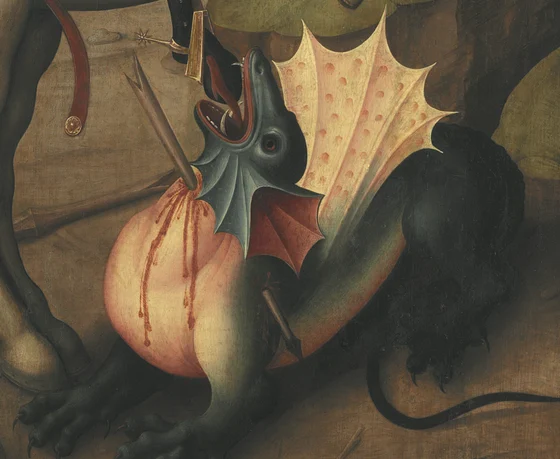
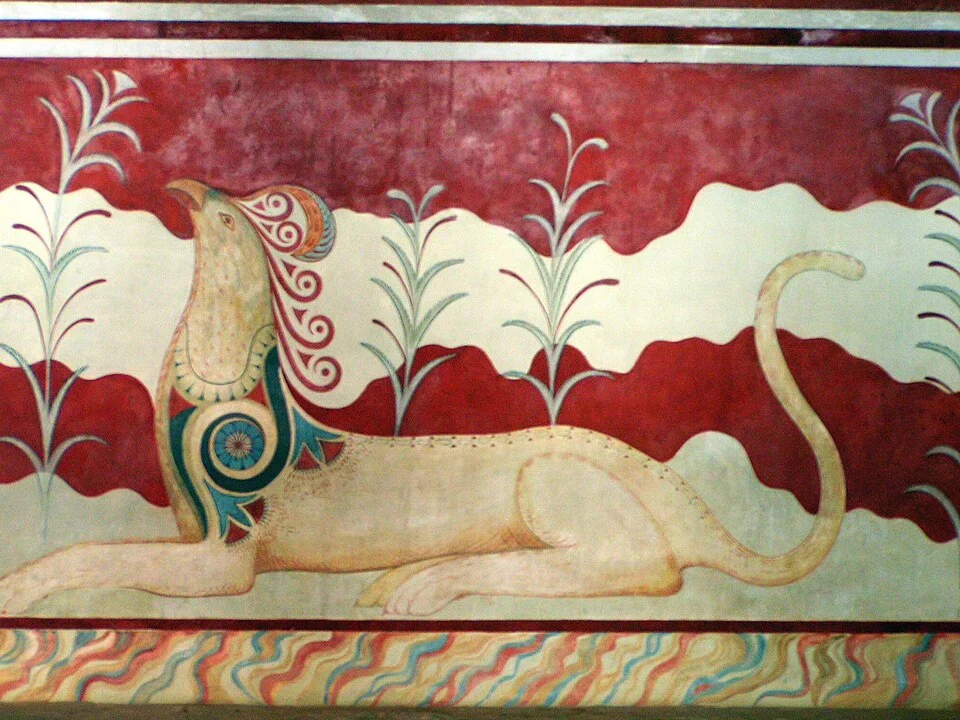
Griffins are composite beings, most commonly represented with a lion’s body and an eagle’s head and wings. The combination brings together animals associated with force on land and in the sky. Ancient images and literary notices vary, however, and a heraldic griffin is not an exact replica of every earlier Near Eastern or Mediterranean form.
Herodotus preserves several distinct settings for griffins. In III.116 he reports that northern gold is taken from them by one-eyed Arimaspians, while admitting uncertainty about its acquisition and doubting the account of one-eyed humans. In IV.13 he attributes a sequence of remote peoples and gold-guarding griffins to the verses of Aristeas. IV.27 makes the chain of transmission explicit: Issedonians, then Scythians, then Greek hearers. These are reported accounts with named intermediaries, not his own observations of an animal.
The same history also mentions griffins as manufactured images. IV.79 places white-stone griffins and sphinxes around the house of the Scythian king Skyles. IV.152 describes a bronze vessel with projecting griffin heads dedicated by Samians at Hera’s sanctuary after a profitable voyage. Literary descriptions of represented creatures can therefore coexist with stories of living monsters without supplying the same kind of evidence.
Prometheus Bound, traditionally attributed to Aeschylus, places griffins among the dangers in Io’s predicted journey. In Augusta Webster’s 1866 translation, Prometheus describes them as Zeus’s sharp-beaked, silent hounds and warns her away from them and the one-eyed Arimaspian horsemen near a gold-bearing river. This is a dramatic warning within a mythic itinerary, not a naturalist’s habitat survey.
Dated objects give the imagery a history independent of those Greek accounts. The Heraklion Archaeological Museum identifies a griffin facing a papyrus flower on a painted chest larnax from Palaikastro, dated 1370–1300 BCE, and interprets it within Minoan religious and funerary symbolism. The Metropolitan Museum’s bronze protome 2025.320 dates from about the mid-seventh to early sixth century BCE. It was an attachment for a cauldron; its reported Spanish findspot and possible manufacture by immigrant Greek craftsmen remain qualified possibilities in the catalogue.
The Met’s Byzantine marble panel 2000.81, dated 1250–1300, places a griffin in a circular frame with crosses on the surrounding border. The catalogue interprets griffins of this setting as guardians and signs of authority. A tomb origin is possible, while the audio transcript also allows architectural use. Its religious setting and proposed function belong to this object; they do not establish one unchanging meaning for all griffin images.
The Grimm tale The Griffin gives a particular creature a household and dangerous knowledge. In Margaret Hunt’s 1884 translation, Hans must obtain a feather from its tail. The griffin’s wife hides him beneath the bed, helps him pluck the feather and obtains answers to three questions: a lost key lies beneath a log, an ailing girl can recover when her hair is taken from a toad’s nest, and a lake carrier can end his service by abandoning a passenger midway. Hans uses the answers successfully. His misleading account of freely bestowed riches sends the king toward the griffin, but the carrier drowns the king before he arrives. The wife’s assistance, the creature’s ability to smell a Christian and its threatened appetite belong to this tale, not every classical or heraldic griffin.
Origins & earliest records
The selected material witnesses here begin with the Palaikastro painted larnax, dated 1370–1300 BCE, before the surviving fifth-century BCE Greek accounts. This is an earlier verified example within this article, not a claim to the worldwide first griffin image. Herodotus reports Aristeas’s earlier verses and transmitted northern accounts; he did not originate the whole tradition. Similar composite forms across regions do not by themselves demonstrate a single documented route of transmission.
Records & interpretation
Reliefs, painted objects and written reports document a long history of griffin representations. Herodotus preserves hearsay within a historical inquiry; his wording should not be converted into an eyewitness zoological report. Modern proposals connecting griffins with fossil discoveries are interpretations requiring independent evidence, not established origins supplied by the ancient text.
In the literature
“The Griffin is a monster with the body of a lion, the head and wings of an eagle”
Chapter X, “The Griffin, or Gryphon”, opening paragraph
Descriptive excerpt from Bulfinch’s later retelling; the sentence continues with feathered back.
Selected bibliography
Documented works and useful reading. This is not a list of every appearance.
- 01
Histories — III.116; IV.13,27,79,152
Ancient fifth-century BCE work; selected 1890 English edition, volumeI. Distinguishes reported griffins from sculptural and vessel imagery.
- 02
Prometheus Bound
Date of the English edition, not composition. Prometheus warns Io of griffins and Arimaspians; passage near the displayed 826–830 numbering.
- 03
Household Tales — The Griffin, no.165
Complete selected English tale read; Hans, the tail feather and the three answers. Edition date does not establish first collection of this tale.
- 04
Chest larnax — Palaikastro collection record
Object dated 1370–1300 BCE; museum interpretation of painted griffin and funerary context.
- 05
Griffin protome 2025.320 and Byzantine panel 2000.81 — collection records
Two separately dated objects and their curatorial interpretations; both direct catalogue links are listed in sources.
- 06
Bulfinch’s Mythology: The Age of Fable (revised by E. E. Hale)
Exact contiguous excerpt checked against the linked primary e-text on 2026-10-05; only whitespace normalized. Work first published 1855; date of the Hale revision used by this e-text is not specified.
Family, evolution & connections
Hagryphus giganteus
The museum explains Hagryphus as a name combining the Egyptian deity Ha with a griffin reference. This is a documented naming connection between mythology and a real fossil taxon. It does not imply that griffin legends originated from this dinosaur: the museum notes that the animal itself is known from limited hand and foot remains.
Located primary passages
Specific passages supporting details in this entry, grouped by their published witness.
Bulfinch’s Mythology: The Age of Fable (revised by E. E. Hale)
Exact contiguous excerpt checked against the linked primary e-text on 2026-10-05; only whitespace normalized. Work first published 1855; date of the Hale revision used by this e-text is not specified.
- Descriptive excerpt from Bulfinch’s later retelling; the sentence continues with feathered back.
Literary witness only. Bulfinch is a nineteenth-century reteller rather than the ancient origin text. Matching is limited to the specified profile and does not cross franchise, culture or animal-species boundaries.
Encyclopedia background
An additional attributed reference, separate from the editorial profile above.
Read the open encyclopedia overview
The griffin, griffon, or gryphon (Ancient Greek: γρύψ, romanized: grýps; Classical Latin: gryps or grypus; Late and Medieval Latin: gryphes, grypho etc.; Old French: griffon) is a legendary creature with the body, tail, and back legs of a lion, and the head and wings of an eagle with its talons on the front legs.
In Greek and Roman texts, griffins and Arimaspians were associated with the gold deposits of Central Asia. The earliest classical writings on the topic were derived from Aristeas (7th century BC) and preserved by Herodotus and Aeschylus (mid 5th century BC).
Text from Wikipedia contributors, “Griffin”. CC BY-SA 4.0. Extracted introduction; formatting changed. Retrieved 5 October 2026. The source article may have changed since retrieval.
References
Sources supporting this profile. Linked pages have their own scope and editorial standards.
- Primary textHistories, Book III.116 and Book IV.13Research access: 2026-10-05
- Primary textHerodotus, Macaulay 1890 translation — III.116; IV.13,27,79,152Research access: 2026-10-05
- Primary textPrometheus Bound — Augusta Webster 1866 translation, warning to IoResearch access: 2026-10-05
- Primary textGrimm, Hunt 1884 translation — tale 165, The GriffinResearch access: 2026-10-05
- Museum object recordHeraklion Archaeological Museum — Palaikastro chest larnax,1370–1300 BCEResearch access: 2026-10-05
- Museum object recordMetropolitan Museum — Greek griffin protome 2025.320Research access: 2026-10-05
- Museum object recordMetropolitan Museum — Byzantine griffin panel 2000.81Research access: 2026-10-05
Image credits
Reference illustrationGriffin
Image associated with the exact linked encyclopedia article; consult credited file description for its interpretation.