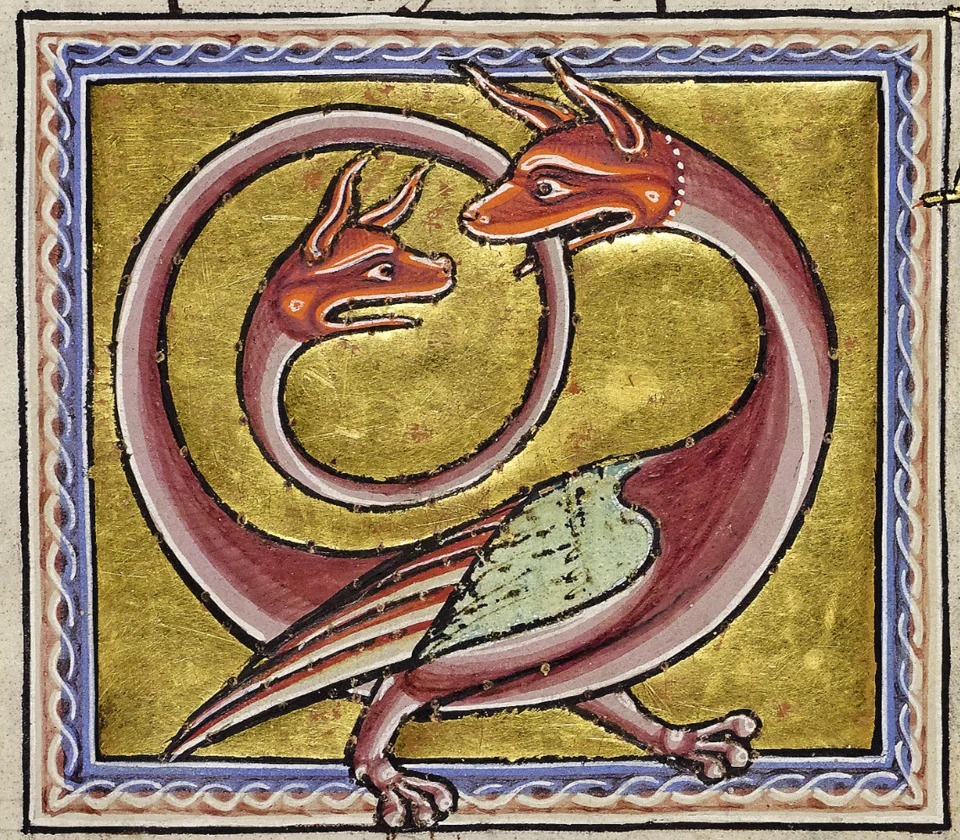
Amphisbaena
Image associated with the exact linked encyclopedia article; consult credited file description for its interpretation.
Overview
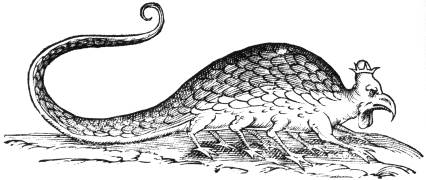
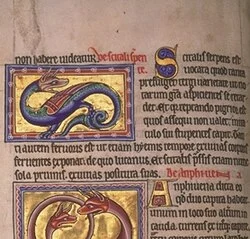
The manuscript calls this creature anphivena and explains its name through two heads: one in the expected place, the other at the tail. It moves rapidly toward either end, with the body making a circle, and its eyes shine. The passage also presents it as unusually able to face the cold. A cited line from Lucan makes the manuscript’s literary inheritance visible rather than leaving the description without an earlier textual connection.
The university commentary describes the painted animal as winged and clawed. Those features are evidence of this image, while the surviving prose emphasizes two-directional movement. Modern limbless lizards also receive amphisbaena-related names, but shared terminology does not establish that a living reptile possesses two functional heads. This profile concerns the represented creature and its textual history, not a substitute entry for a modern zoological genus.
Nicander’s Theriaca offers a different early description. In the selected passage, read in the1953 Gow–Scholfield translation, the two-headed creature is small, slow and dull-eyed, with mottled earth-coloured skin. The poem attributes therapeutic value to its skin. That is historical medical lore, not evidence of an effective treatment. Its sluggishness and dull sight differ from the swift, bright-eyed medieval description rather than merely adding detail to it.
Pliny’s Book VIII chapter35 places the amphisbæna among several kinds of serpents, specifying a second head at the tail and linking the doubling to an abundance of venom. The short statement does not supply the medieval miniature’s wings and claws. The nineteenth-century editors reject the two-head account and propose that similar-looking ends and movement in either direction helped generate it. That proposed explanation belongs to the commentary; it should not be mistaken for Pliny reporting anatomical doubt.
Lucan’s Civil War, also known as Pharsalia, gives the name a place within the Libyan serpent catalogue of Book IX. The surrounding passage tells how blood dripping from Medusa’s severed head produces dangerous creatures in the desert; the amphisbaena is one of the named forms. It is a poetic account within Cato’s journey, not a scientific family tree. The selected lines do not give this particular serpent an individual encounter, named victim or independent adventure. The explicit Lucan citation in Aberdeen supplies a documented literary connection, while no claim is made that every medieval feature comes from that single line.
Thomas Browne examines the tradition critically in Pseudodoxia Epidemica III.xv. The online text identifies its witness as the sixth edition of 1672, following first publication in 1646. Browne argues against treating two opposite heads as the normal organization of a recurring species. He discusses alleged unusual births separately, explaining that an exceptional formation would not establish a regularly reproducing animal kind. His historical physiological arguments are recorded as his reasoning, not offered wholesale as modern embryology.
Browne also proposes that similar-looking extremities and backward movement caused observers to mistake a tail for a second head. He compares other animals capable of reversing direction and ends by asking for stronger visual testimony. The chapter demonstrates that the creature’s reception includes doubt and criticism as well as repetition. Its long list of earlier authorities is useful for further research, but references named by Browne are not all claimed here as independently read works. Modern scientific uses of the name likewise remain distinct from the old two-headed representation.
Origins & earliest records
The selected account appears on folio68v of Aberdeen MS24, an English manuscript of around1200. Its explicit reference to Lucan supplies an earlier literary route that can be checked separately. The manuscript dates one surviving presentation; it does not determine an oral origin or make every later use of the name identical. Direct comparison now extends to selected Nicander, Lucan and Pliny passages, followed by Browne’s1672edition. These witness dates and editions do not establish a unique first oral origin.
Records & interpretation
The folio’s Latin, translation and picture support different parts of the profile: paired heads and movement in prose, wings and claws in the miniature. Lucan is named within the text itself. This establishes a documented tradition of representation, not biological confirmation that a serpent can feed and see from two heads. Complete selected Nicander amphisbaena passage and adjacent scytale comparison read in1953translation; complete Pliny VIII.35 and1747–1748notes; LucanBook IXMedusa blood/serpent catalogue sequence inRidley translation; complete Browne III.xvmain chapter and relevantnotes. Aberdeen68v anphivena paragraph/Latin/commentary reread. No independent Greek/Latin manuscript collation or medical-efficacy claim.
Selected bibliography
Documented works and useful reading. This is not a list of every appearance.
- 01
Aberdeen Bestiary, University Library MS24, 68v
Selected surviving folios inspected; text and image are treated as distinct evidence.
- 02
Theriaca — amphisbaena passage, approximately372–383
Selected complete passage and adjacent comparison;1953 dates the translation. Historical therapeutic assertion not endorsed.
- 03
Natural History — Book VIII, chapter35
Complete selected chapter;1747–1748editorial notes kept separate.
- 04
Civil War / Pharsalia — Book IX, Libyan serpent catalogue
Selected complete Medusa blood/catalogue sequence, including traditional line719; no complete Book IXclaim.
- 05
Pseudodoxia Epidemica — Book III, chapterXV
Complete main chapter155–157 in statedsixth edition;1646 first publication distinguished. Moderneditorial notes separately marked.
Family, evolution & connections
Medusa
Lucan’s Book IX includes the double-headed amphisbaena in the catalogue following Medusa’s blood falling onto Libya. This is a poetic origin sequence, introduced as a fabled explanation, not a biological pedigree or a claim that all later amphisbaena traditions share that origin.
References
Sources supporting this profile. Linked pages have their own scope and editorial standards.
- Primary textUniversity of Aberdeen, MS24 folio68vResearch access: 2026-10-05
- ReferenceUniversity of Manchester, Aberdeen Bestiary project and manuscript datingResearch access: 2026-10-05
- Primary poem in1953translationNicander, Theriaca: selected amphisbaena and scytale passagesResearch access: 2026-10-05
- Primary ancient text with separate editorial commentaryPliny/Bostock–Riley 1855: VIII.35 and notes1747–1748Research access: 2026-10-05
- Primary epic in historical translationLucan/Ridley: Book IXMedusa and serpent catalogueResearch access: 2026-10-05
- Primary early modern criticism with modern editorial notes distinguishedBrowne: Pseudodoxia EpidemicaIII.xv,1672editionResearch access: 2026-10-05
Image credits
Reference illustrationAmphisbaena
Image associated with the exact linked encyclopedia article; consult credited file description for its interpretation.