Bonnacon
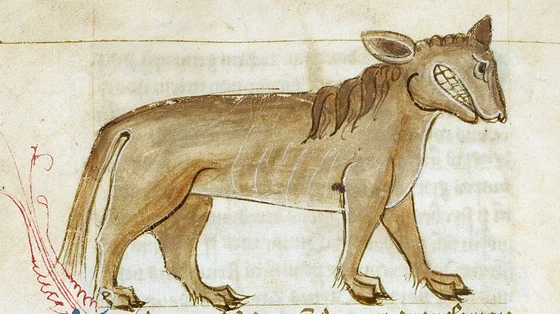
Image associated with the exact linked encyclopedia article; consult credited file description for its interpretation.
Overview
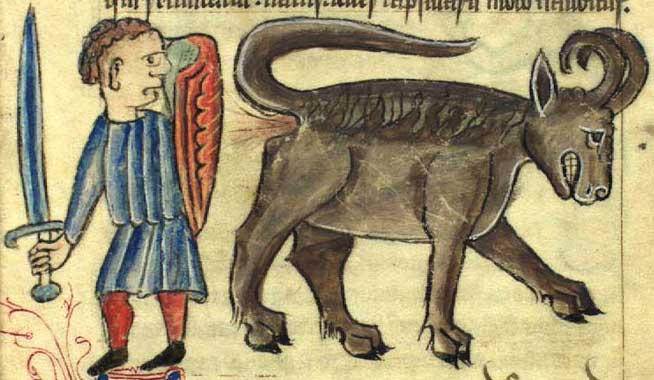
The manuscript describes the bonnacon’s horns as curling back so tightly that they fail to injure an approaching opponent. When the beast flees, a damaging discharge reaches its pursuers and burns what it touches. The description makes an unexpected part of the body perform the work normally associated with a bull’s forehead. Its remote Asian setting belongs to the bestiary’s account, not to verified regional zoology.
The accompanying illustration presents a hunter using a shield. University commentary notes that this defence appears in other texts but is not specified in the surviving passage on this page. That difference matters: an illustrated action can enrich the witness without becoming a sentence falsely attributed to its prose. The entry preserves this manuscript’s animal description rather than giving every later comic or heraldic bonnacon the same biography.
A much earlier comparison is the bonassus in Aristotle’s History of Animals. In Richard Cresswell’s 1887 translation, the complete account is Book IX, chapter XXXII, pages273–274. It locates the animal in Paeonia, at Mount Messapius, and records monapus as a local name. The description emphasizes a heavy bull-like body, horse-like mane, cloven hooves and short inward-bending horns. It also describes ordinary activities such as hunting and gathering to give birth. Those details make this a natural-history account containing extraordinary claims, rather than a surviving medieval tale about a named monster.
In that translation, a wounded animal retreats and then uses kicks and expelled dung for defence. The dung is described as caustic when the animal is frightened, capable of removing a pursuing dog’s hair, but not caustic when the animal is calm. The account also says that groups surround their birthing place with dung. These are claims made in the ancient text as translated, not experimentally established properties of a living species. The modern-looking behavioural explanation must not lend independent credibility to the extraordinary effect.
Pliny’s Natural History, Book VIII chapter16 in the Bostock–Riley edition, likewise locates a bonasus in Paeonia. Its horse’s mane, bull-like body and ineffective inward-curving horns lead into a flight-and-discharge defence. The comparison of contact with fire is already present there. The Aberdeen account instead names Asia. Keeping the geographical statements attached to their witnesses avoids converting either ancient or medieval literary geography into a verified animal distribution.
The measurements require particular caution. Cresswell prints four fathoms; the nineteenth-century note accompanying Pliny summarizes Aristotle with four feet; Pliny’s main passage uses three jugera. The editors themselves discuss the difficulty of a unit normally used for area occurring as a distance. These readings have not been silently converted into one modern range. The discrepancy is part of the transmission and translation history, not a reliable performance measurement. Greek manuscript collation would be needed to resolve the wording behind the different English accounts.
Cresswell’s zoological index places the ancient name beside historical bison identifications. That editorial identification is useful evidence for how later readers understood the animal, but it does not authenticate burning dung or prove a complete species-level identity for every bonnacon image. The record here consequently connects the medieval beast with earlier bovine descriptions while keeping literary transmission distinct from biological ancestry.
Origins & earliest records
Aberdeen University Library MS24, made in England around1200, preserves the selected account on folio12r. The folio is a medieval witness within a longer tradition of animal writing, not a first oral origin. Comparison with earlier natural histories and other bestiaries must use their own passages, rather than treating this manuscript as the original invention. Earlier selected witnesses now include Aristotle’s bonassus and Pliny’s bonasus, read in specified nineteenth-century translations. No precise manuscript descent or first oral occurrence is established.
Records & interpretation
The Latin text, institutional translation and accompanying miniature are distinct witnesses to description and depiction. The text supports the curled horns and burning defence; the shield belongs to the image and commentary. Neither supplies a specimen, measured discharge or biological identification establishing the described animal as a verified species. Complete Cresswell 1887 IX.XXXII273–274, relevant zoological-index entry, Pliny VIII.16 and editor notes 1658–1659 read. Aberdeen12r Latin transcription, full bonnacon translation and commentary reread. MIT’s retrieved Book IX text ended before the relevant account and was not used to claim a complete reading.
Selected bibliography
Documented works and useful reading. This is not a list of every appearance.
- 01
Aberdeen Bestiary, University Library MS24, 12r
Selected surviving folios inspected; text and image are treated as distinct evidence.
- 02
History of Animals — Book IX, chapter XXXII in Cresswell
Complete273–274 in George Bell & Sons edition; nineteenth-century index identification distinguished from primary account. Chapter numbering differs from theIX.45reference in Pliny’s editorial note.
- 03
Natural History — Book VIII, chapter16
Complete selected chapter and notes 1658–1659 in volumeII. Publication year is the translation’s, not the ancient work’s date.
Family & connections
A source-supported family tree or inspiration record has not yet been compiled for this profile. Related reading below indicates a connection in subject matter, not a proven lineage or creative influence.
Encyclopedia background
An additional attributed reference, separate from the editorial profile above.
Read the open encyclopedia overview
The bonnacon (also called bonasus or bonacho) (Ancient Greek: βόνασος or βόνασσος) is a legendary creature described as a bull with inward-curving horns and a horse-like mane.
Medieval bestiaries usually depict its fur as reddish-brown or black. Because its horns were useless for self-defense, the bonnacon was said to expel large amounts of caustic feces from its anus at its pursuers, burning them and thereby ensuring its escape.
Text from Wikipedia contributors, “Bonnacon”. CC BY-SA 4.0. Extracted introduction; formatting changed. Retrieved 5 October 2026. The source article may have changed since retrieval.
References
Sources supporting this profile. Linked pages have their own scope and editorial standards.
- Primary textUniversity of Aberdeen, MS24 folio12rResearch access: 2026-10-05
- ReferenceUniversity of Manchester, Aberdeen Bestiary project and manuscript datingResearch access: 2026-10-05
- Primary ancient account in historical translationAristotle/Cresswell 1887: IX.XXXII273–274, bonassusResearch access: 2026-10-05
- Primary ancient account with separately attributed editorial notesPliny/Bostock–Riley 1855: VIII.16 and notes 1658–1659Research access: 2026-10-05
Image credits
Reference illustrationBonnacon
Image associated with the exact linked encyclopedia article; consult credited file description for its interpretation.