Leucrocotta
Image associated with the exact linked encyclopedia article; consult credited file description for its interpretation.
Overview
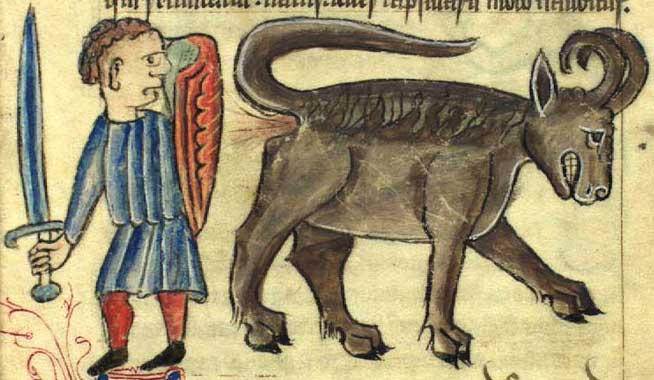
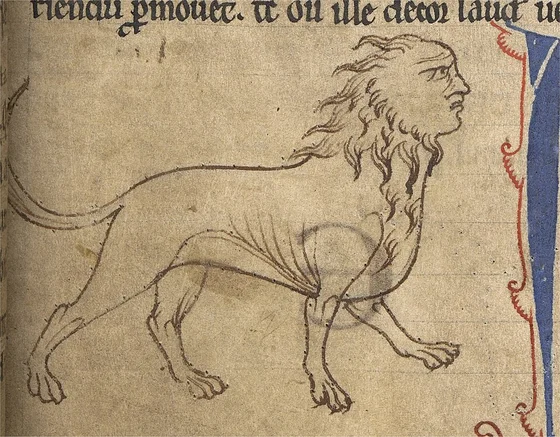
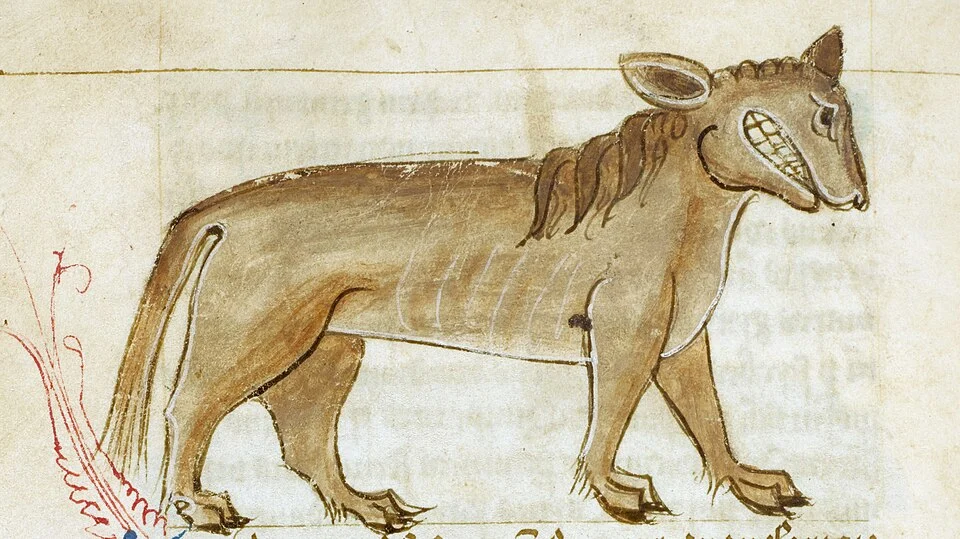
The surviving passage calls the beast leucrota, locates it in India and describes exceptional speed. It compares the size with an ass, the hindquarters with a deer and the chest and legs with a lion. The account breaks off during its description of the head. That interruption is a limit of the selected physical witness, not an invitation to write a seamless quotation from another version.
The university commentary identifies further features in the painted image and notes missing leaves in this part of the bestiary. Other witnesses may supply a remarkable jaw or speech imitation, but those details need separately identified textual support before becoming claims about this folio. Retaining the gap shows how manuscript survival affects knowledge of a creature, even when its familiar modern description seems much more complete.
Pliny’s Natural History offers a separately located ancient account in Book VIII, chapter 30 of the Bostock–Riley translation. The leucrocotta is placed among creatures attributed to Ethiopia and is compared in size with a wild ass. It has the legs of a stag, the neck, tail and breast of a lion, a badger’s head, and a divided hoof. The mouth extends toward the ears, and the dental apparatus is described as continuous bone. Pliny also reports imitation of human speech.
These details provide support for the jaw and vocal features in this particular ancient witness, but they do not restore the lost words of the Aberdeen manuscript. The body comparisons also differ: the surviving Aberdeen passage assigns deer-like hindquarters and lion-like chest and legs, whereas Pliny assigns the stag’s legs. One can compare the accounts without claiming that the later manuscript copied this wording unchanged or that the two authors imagined exactly the same animal.
Pliny places other extraordinary animals in the same chapter, including a wolf-and-dog-like crocotta, the movable-horned eale and the man-faced manticore. The juxtaposition does not give the leucrocotta their parentage, horns, face or tail weapon. In particular, the separate crocotta and later corocotta spellings need attention to their surrounding descriptions before names are equated.
The 1855 editors’ note 1718 explicitly struggles to identify the leucrocotta with a known animal. It compares some features with an Indian antelope and others with a hyena, and suggests that descriptions of different animals may have become confused. That explanation belongs to the history of interpretation; it is not evidence of a real antelope–hyena hybrid. The gap in Aberdeen and the differences among the comparisons remain visible instead of being resolved into an invented canonical species.
Origins & earliest records
The selected witness is folio15v of Aberdeen MS24, an English manuscript of around1200. University commentary explicitly identifies missing leaves affecting the leucrota and neighbouring creatures. The spelling leucrota is retained as a textual alias. This damaged witness does not by itself establish the earliest description or a complete medieval account. The earlier Pliny VIII.30 account is now independently located and read. It expands the textual history without supplying the missing physical leaves or proving an unbroken chain of copying.
Records & interpretation
The surviving text supports the speed, geographic attribution and several composite body comparisons. The institutional commentary explains the missing continuation and the illustration’s additional features. These are physical-manuscript and textual evidence, rather than a zoological specimen; filling the gap without attribution would conceal an important limitation of the source. Complete Pliny VIII.30 and note 1718 were read; Aberdeen 15v’s entire surviving leucrota paragraph, Latin and editorial commentary were reread. The damaged continuation remains a real source limit. No new inspection of the original manuscript or identification of a living species is claimed.
Selected bibliography
Documented works and useful reading. This is not a list of every appearance.
- 01
Aberdeen Bestiary, University Library MS24, 15v
Selected surviving folios inspected; text and image are treated as distinct evidence.
- 02
Natural History — Book VIII, chapter 30, note 1718
Complete chapter distinguishes the leucrocotta from neighbouring crocotta, eale and manticore accounts. Editorial identification remains tentative.
Family & connections
A source-supported family tree or inspiration record has not yet been compiled for this profile. Related reading below indicates a connection in subject matter, not a proven lineage or creative influence.
Encyclopedia background
An additional attributed reference, separate from the editorial profile above.
Read the open encyclopedia overview
The crocotta or corocotta, crocuta, leucrocotta, or leucrotta is a mythical dog-wolf of India or Aethiopia, linked to the hyena and said to be a deadly enemy of men and dogs.
Text from Wikipedia contributors, “Crocotta”. CC BY-SA 4.0. Extracted introduction; formatting changed. Retrieved 5 October 2026. The source article may have changed since retrieval.
References
Sources supporting this profile. Linked pages have their own scope and editorial standards.
- Primary textUniversity of Aberdeen, MS24 folio15vResearch access: 2026-10-05
- ReferenceUniversity of Manchester, Aberdeen Bestiary project and manuscript datingResearch access: 2026-10-05
- Ancient textual witness with separately attributed editorial comparisonPliny/Bostock–Riley 1855: VIII.30, leucrocotta and note 1718Research access: 2026-10-05
Image credits
Reference illustrationLeucrocotta
Image associated with the exact linked encyclopedia article; consult credited file description for its interpretation.