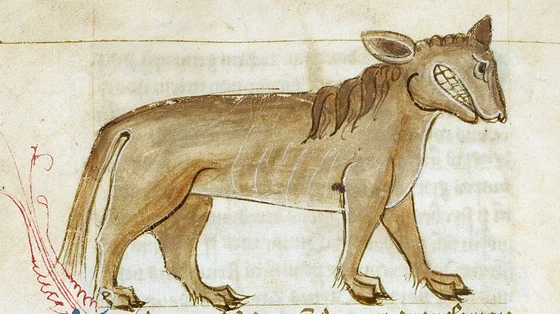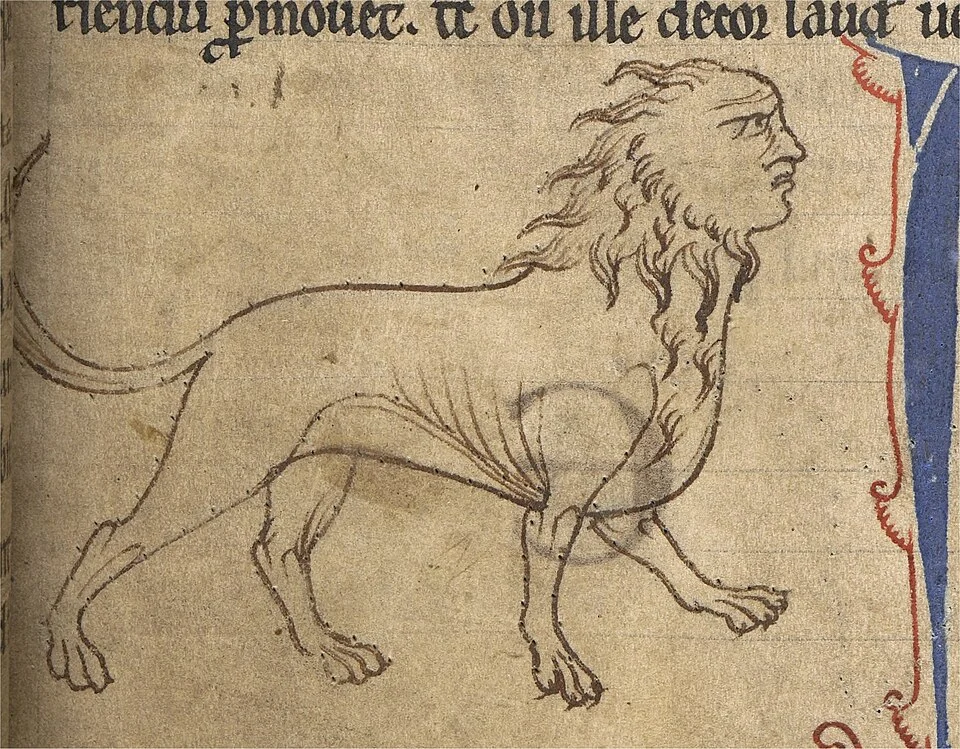
Medieval bestiary depiction of a manticore
Historical bestiary subject.
Overview
Ctesias's Indica, preserved in Photius's summary, describes a lion-sized Indian predator with a humanlike face and ears, blue eyes, a cinnabar-red coat and three rows of teeth. Its scorpionlike tail carries stings that can be launched toward attackers in front or behind and grow again after discharge. It fights with claws as well as stings and especially devours people. The summary says its projectiles kill other animals but spare elephants; hunters mounted on elephants kill the beasts with spears or arrows.
Pausanias expressly suspects that the reported manticore is a tiger. His alternative is evidence of disagreement within ancient writing, rather than a modern resolution of every detail. The Persian associations of its name and the Indian setting of Ctesias's report are distinct from proof that all local communities shared the same account. These selected witnesses describe no wings. Ctesias's reported creature, Photius's later summary, Pausanias's scepticism and subsequent illustrations remain separate parts of its transmission.
Pliny’s Natural History supplies a different transmission context. In Book VIII, chapter 30 of the Bostock and Riley translation, he attributes the description to Ctesias but places it among the animals of Æthiopia. The comb-like fit of the three tooth rows, human face and ears, blue eyes, blood-red colouring, lion’s body and scorpion-ending tail recur. Pliny adds a voice compared to the combined sound of flute and trumpet, exceptional speed and an appetite for human flesh. His placement should remain visible beside the Indian setting of the Photius account, rather than being silently changed to make the reports agree.
In Book VIII, chapter 45, Pliny attributes imitation of human speech to the manticore on Juba’s authority. The preceding description of an animal produced from a hyena and an Ethiopian lioness concerns the corocotta. That parentage is not assigned to the manticore. Their adjacency in the text and their shared association with unusual voices are documented connections; neither supplies a biological family tree for the composite creature. The nineteenth-century translators’ conjectural explanatory notes are separate from Pliny’s ancient statements.
Philostratus’s Life of Apollonius, III.45, stages a conversation about the reported man-eater. Apollonius describes the four-footed, lion-sized, human-headed animal and its long, thornlike tail hairs, which it supposedly fires at hunters. He calls the stories unbelievable. Iarchas answers that he has never heard in that country of an animal that shoots arrows. The narrator introduces this exchange by warning against indiscriminate belief or disbelief. These are positions within Philostratus’s literary account, not a modern field survey or an independently recorded interview.
The British Library identifies medieval manticore illustrations at Harley MS 3244, folio 43v; Royal MS 12 C XIX, folio 29v, dated about 1200–1210; and the Rochester Bestiary, Royal MS 12 F XIII, folio 24v, dated about 1230. These are separately located reception witnesses. Their catalogue identifications do not imply that every manuscript repeats exactly the same anatomy or that their complete Latin texts have been read here.
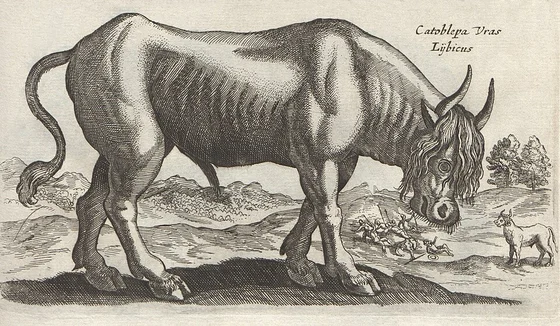
Flaubert’s The Temptation of St. Antony gives the creature its own speech and action in chapter VII. In the English edition carrying a 1904 copyright notice, the Mantichor enters after the Sadhuzag as a gigantic red lion with a human figure and three rows of teeth. It boasts of spreading plague and devouring armies in the desert, describes its twisted claws and sawlike teeth, then casts tail thorns in every direction while blood spatters the foliage. The Catoblepas follows. This dramatic apparition preserves familiar composite features while giving them a particular voice and setting; its plague-spitting and army-devouring claims are not retroactively inserted into Ctesias.
Origins & earliest records
Ctesias’s Indica is an early-fourth-century BCE work known through later transmission, including Photius’s ninth-century summary. The inspected page preserves that mediation rather than pretending to supply Ctesias’s intact original. Pausanias is a separate second-century CE witness. Together they establish a textual history with disagreement, not a verified oral origin.
Records & interpretation
Ctesias through Photius, Pausanias, Pliny and Philostratus preserve descriptions and disagreements about the creature. Medieval manuscript identifications and Flaubert’s dramatic apparition document reception. No independently examined specimen is established by these passages. Narrative location, an author’s report of testimony and a later translator’s conjecture are different kinds of evidence.
In the literature
“the face and ears of a man, and azure eyes”
BookVIII chapter30, Ctesias-attributed manticore paragraph · John Bostock and H.T.Riley
Pliny reports Ctesias’s description of an Ethiopian mantichora with three interlocking rows of teeth, human face and ears, blue eyes, blood-red colouring, a lion body and a scorpion-like tail sting. Its voice combines flute and trumpet, its speed is great and it prefers human flesh. InVIII45, after separately describing the corocotta’s supposed hyena/lioness parentage, he attributes to Juba a report that the Ethiopian manticore also imitates human speech. Translator notes explicitly treat the creature as imaginary and discuss earlier authors’ qualifications.
Selected bibliography
Documented works and useful reading. This is not a list of every appearance.
- 01
Indica, as summarized in Photius, Bibliotheca72
Selected manticore passage inspected through the cited text collection; Ctesias’s complete original is not preserved here.
- 02
Description of Greece IX.21.4
Located sceptical comparison with the tiger, kept distinct from a demonstrated modern identification.
- 03
Natural History VIII.30 and VIII.45
Complete relevant paragraphs with adjacent animal descriptions and translator notes read. Ctesias attribution and Æthiopian placement in30; Juba’s human-voice report in45; corocotta parentage belongs to the preceding animal.
- 04
Life of Apollonius III.45
Complete chapter45 read with immediate preceding discussion; Apollonius’s doubt and Iarchas’s response are attributed dialogue.
- 05
Harley MS3244, folio43v; Royal MS12 C XIX, folio29v; Rochester Bestiary, Royal MS12 F XIII, folio24v
Located illustrative reception witnesses identified by the custodial article. Complete manuscript text and original folio pixels were not examined for this root expansion.
- 06
The Temptation of St. Antony; Or, A Revelation of the Soul, VII
Complete Mantichor speech and stage action, immediate Sadhuzag/Catoblepas sequence, chapter opening and front matter read. Not a claim to have read the whole novel or identified the translator.
- 07
The Temptation of St. Antony — VII Mantichor speech and stage action
Inspected English volumeVII, SimonP.Magee,Chicago; copyright1904 M.WalterDunne; translator not named. Complete named Mantichor speech and stage action with preceding Sadhuzag/following Catoblepas and title/front matter read; no fullnovel reading claimed.
Family & connections
A source-supported family tree or inspiration record has not yet been compiled for this profile. Related reading below indicates a connection in subject matter, not a proven lineage or creative influence.
Located primary passages
Specific passages supporting details in this entry, grouped by their published witness.
Natural History VIII.30 and VIII.45
VolumeII, London: HenryG.Bohn,1855; identified English translation. Complete manticore paragraph inVIII30 and wholeVIII45 with adjacent hyena/corocotta distinction and relevant translator notes read; wholeNaturalHistory not claimed.
- Pliny reports Ctesias’s description of an Ethiopian mantichora with three interlocking rows of teeth, human face and ears, blue eyes, blood-red colouring, a lion body and a scorpion-like tail sting. Its voice combines flute and trumpet, its speed is great and it prefers human flesh. InVIII45, after separately describing the corocotta’s supposed hyena/lioness parentage, he attributes to Juba a report that the Ethiopian manticore also imitates human speech. Translator notes explicitly treat the creature as imaginary and discuss earlier authors’ qualifications.
Ctesias and Juba reports are mediated through Pliny, not independently reconstructed original texts. Corocotta parentage is not manticore ancestry. Voice descriptions in30/45 are separate statements. Historical translator conjectures about sculpture or animal origin not proven taxonomy.
Life of Apollonius III.45
Conybeare1912 Loeb translation explicitly identified on inspected Livius page. CompleteIII45 and preceding discussion44 read. Modern editorial notes are a separate layer and not copied. No wholebiography reading claimed.
- The narrator introduces a discussion of Indian marvels with an appeal to avoid wholesale belief or disbelief. Apollonius asks Iarchas about the man-eater and describes reports he cannot accept: four feet, a human-like head, lion size and cubit-long sharp tail hairs fired at hunters. Iarchas answers that Apollonius can describe things he has seen himself, but says he has not heard locally of arrow-shooting animals or golden springs. The exchange therefore preserves both a description and explicit doubt.
Attributed dialogue in literary biography, not eyewitness proof of a creature. Iarchas’s not-heard answer is not a zoological demonstration. Livius’s modern tiger-origin footnote is not silently promoted into Philostratus’s ancient text.
The Temptation of St. Antony; Or, A Revelation of the Soul, VII
Inspected English volumeVII, SimonP.Magee,Chicago; copyright1904 M.WalterDunne; translator not named. Complete named Mantichor speech and stage action with preceding Sadhuzag/following Catoblepas and title/front matter read; no fullnovel reading claimed.
- After the Sadhuzag’s music turns from sweet to discordant, Antony sees a huge red leonine figure with human form and three rows of teeth. The Mantichor boasts of desert terror, plague, armies eaten, twisted claws, saw-like teeth and bristling darts. It then actually casts tail thorns like arrows in every direction, spattering blood onto foliage. Catoblepas follows with a different body, heavy drooping head and threatened fatal gaze. These are sequential literary apparitions, not one combined animal.
The Temptation of St. Antony — VII Mantichor speech and stage action
Historical fictional depiction, not zoological or ethnographic evidence. Translator identity and exact source impression beyond the inspected1904 notice remain unresolved. No new exact quote added; modern rights outsideUSA not globally asserted. Sadhuzag/Catoblepas attributes not assigned to Mantichor.
Encyclopedia background
An additional attributed reference, separate from the editorial profile above.
Read the open encyclopedia overview
The manticore or mantichore (Latin: mantichorās; reconstructed Old Persian: *martyahvārah; Modern Persian: مردخوار mardḫ(w)ār) is a legendary creature from ancient Persian mythology, similar to the Egyptian sphinx that proliferated in Western European medieval art also. It has the face of a human, the body of a lion, and the tail of a scorpion or a tail covered in venomous spines similar to porcupine quills. There are some accounts that the spines can be launched like arrows. It eats its victims whole, using its three rows of teeth, and leaves no bones behind.
Text from Wikipedia contributors, “Manticore”. CC BY-SA 4.0. Extracted introduction; formatting changed. Retrieved 5 October 2026. The source article may have changed since retrieval.
References
Sources supporting this profile. Linked pages have their own scope and editorial standards.
- Primary textIndica, as summarized in Photius, Bibliotheca72; Description of Greece IX.21.4Research access: 2026-10-05
- Historical translation of ancient natural historyPliny, Natural History VIII.30 and VIII.45; Bostock and Riley1855, volumeIIResearch access: 2026-10-05
- Historical translation of ancient literary biographyPhilostratus, Life of Apollonius III.45; Conybeare1912 translationResearch access: 2026-10-05
- Primary literary text in historical English translationFlaubert, The Temptation of St. Antony, VII;1904 English editionResearch access: 2026-10-05
- Custodial manuscript identifications; selected Manticore sectionSarah J. Biggs, Weird and Wonderful Creatures of the Bestiary, British Library,17June2014Research access: 2026-10-05
Image credits
Historical illustrationMedieval bestiary depiction of a manticore
Historical bestiary subject.