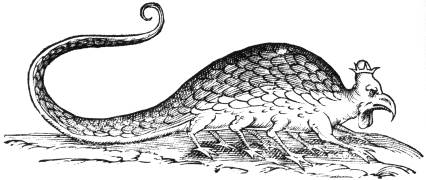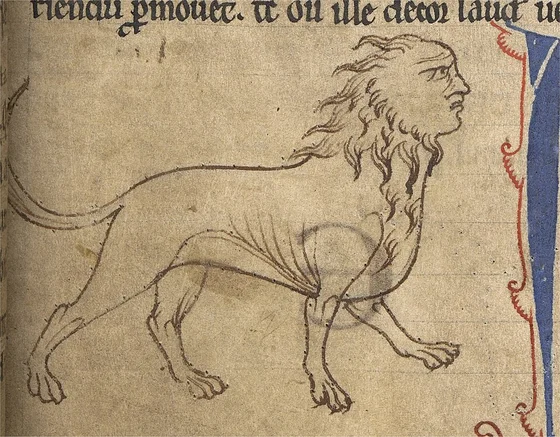
Catoblepas
Image associated with the exact linked encyclopedia article; consult credited file description for its interpretation.
Overview
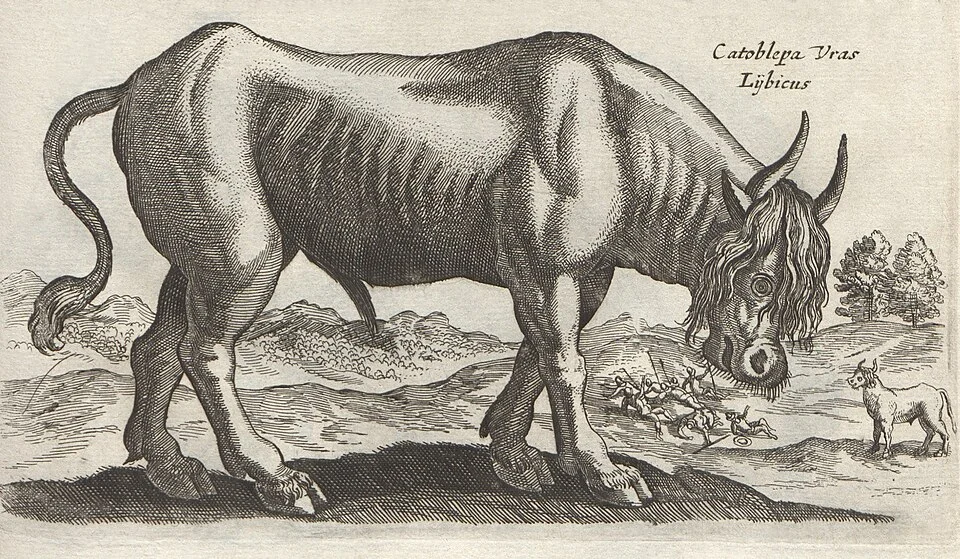
Pliny describes an otherwise sluggish animal whose heavy head normally hangs down. Its eyes become dangerous if a person sees them. Aelian’s account supplies a different concentration of details: an ox-sized body, bloodshot eyes, a hanging mane and poisonous food, followed by a breath that harms approaching animals. These are related textual portraits, but their particular mechanisms should remain attributed to the writer who presents them.
The name’s association with looking downward suits a creature whose posture limits its destructive power. The accounts belong to ancient descriptions of distant lands, where reported animals and extraordinary marvels often appear together. Modern identification with a familiar grazing animal may help explain some resemblance, but it is not established by these passages alone. A comparison must not turn speculation about a living species into proof that the gaze or breath described by the authors exists.
Pliny places the animal near the fountain Nigris among the Hesperian Ethiopians, introducing a contemporary belief that the fountain was a source of the Nile. In the 1855 Bostock–Riley translation the short account is Book VIII, chapter 32; other citation systems identify the passage as VIII.77. The head’s weight supplies a limit on its deadly eyes: it normally hangs down, sparing people from the gaze. This geography belongs to Pliny’s account and is not a verified distribution map for an identifiable animal.
The same translation’s note 1729 reports Cuvier’s suggestion that the description may derive from the gnu, drawing attention to its unusual, mournful appearance. This is a later zoological identification proposed by a named commentator. It does not authenticate the dangerous eyes, and it should not be presented as a demonstrated evolutionary relationship. The note also directs readers to Aelian VII.5. The continuous Attalus translation places the catoblepon in that section, while the earlier linked Theoi excerpt labels it VII.6; the locator discrepancy is recorded rather than repeated without qualification.
Aelian’s complete paragraph describes a bull-sized beast with narrow, bloodshot eyes and a horsehair-like mane hanging over its face. It eats poisonous roots and, when provoked, raises its mane and emits harmful breath. Other animals recognize the threat and withdraw. The paragraph gives a different mechanism from Pliny’s fatal sight of the eyes; its details remain one author’s account rather than extra powers silently appended to every catoblepas.
A much later speaking catoblepas appears in Gustave Flaubert’s The Temptation of St. Anthony. In the inspected 1910 Lafcadio Hearn translation, pages 252–253, it has a black buffalo’s body, a pig-like head and a long, slack neck. Its great mane conceals its feet as it lies in mud. It boasts of consuming venomous plants and even of once eating its own feet without noticing. Its speech combines destructive potential with lethargy and grotesque foolishness.
The creature tells Anthony that seeing its eyes would kill him. Anthony is simultaneously repelled and fascinated, then keeps his gaze on the ground as the apparition sequence proceeds to a basilisk. The passage does not depict the catoblepas killing him. It is an authored literary treatment, not an independent animal observation. The 1874 definitive French work and the inspected 1910 English edition are separate dates; the Gutenberg ebook’s added Redon illustrations are not assumed to have belonged to that printed edition.
Origins & earliest records
Pliny’s first-century CE Natural History and Aelian’s early-third-century On Animals are the selected witnesses. They locate the creature in African settings through Greek and Roman accounts, so Europe identifies the textual tradition here. These surviving works attest descriptions, not a secure beginning of oral transmission or verified discovery history. Pliny VIII.32 in Bostock–Riley corresponds to the cited VIII.77 passage; Aelian is located at VII.5 in the continuous inspected translation, despite the VII.6 label on the earlier excerpt page. Flaubert supplies later authored reception, not an ancient attestation.
Records & interpretation
The passages support the lowered head, dangerous eyes and Aelian’s separate breath account. Their differences are evidence of how a creature was described across texts. They do not constitute controlled observation of a lethal gaze or establish a single zoological identity, and no modern natural-history identification is asserted as proven. Complete Pliny VIII.32 with notes 1728–1729, Aelian VII.5 and the complete located Flaubert catoblepas scene with its transition were read. The Aelian section number is corroborated by Bostock–Riley’s note. No full Flaubert-book reading, original Greek collation or biological authentication is claimed.
Selected bibliography
Documented works and useful reading. This is not a list of every appearance.
- 01
Natural History VIII.77; On Animals VII.5
Selected inspected passage; original-work dates are distinguished from later translation and transmission. The linked Theoi excerpt labels Aelian VII.6; the continuous Attalus text and Bostock–Riley note 1729 locate it at VII.5.
- 02
Natural History — Book VIII, chapter 32, with notes 1728–1729
Complete catoblepas paragraph and nineteenth-century identification note; 1855 is this translation’s date.
- 03
On the Nature of Animals — VII.5
Complete paragraph with distinct poisonous-root and breath account. The website notes minor alterations to the translation.
- 04
The Temptation of St. Anthony — catoblepas scene, pp. 252–253
Alice Harriman edition of Hearn’s translation inspected through its transcription; definitive French work 1874. Only the located apparition sequence read. Redon images were added for the Gutenberg ebook.
Family & connections
A source-supported family tree or inspiration record has not yet been compiled for this profile. Related reading below indicates a connection in subject matter, not a proven lineage or creative influence.
Encyclopedia background
An additional attributed reference, separate from the editorial profile above.
Read the open encyclopedia overview
The catoblepas (from Latin catōblepas, ultimately from Greek καταβλέπω (katablépō) "to look downwards") is a legendary creature from Aethiopia, first described by Pliny the Elder and later by Claudius Aelianus.
One known description of the Catoblepas is said to resemble a cape buffalo, with its head always pointing downwards due to its great weight. Its stare or breath could kill people. The catoblepas is often thought to be based on real-life encounters with wildebeest, such that some dictionaries say that the word is synonymous with "gnu". Other depictions have it sporting the head of a hog and the body of a cape buffalo. It is sometimes known as an African version of a Gorgon.
Text from Wikipedia contributors, “Catoblepas”. CC BY-SA 4.0. Extracted introduction; formatting changed. Retrieved 5 October 2026. The source article may have changed since retrieval.
References
Sources supporting this profile. Linked pages have their own scope and editorial standards.
- Primary textTheoi primary excerpts: Pliny VIII.77; Aelian paragraph labeled VII.6 (continuous text VII.5)Research access: 2026-10-05
- Ancient account and separately attributed editorial hypothesisPliny/Bostock–Riley 1855: VIII.32 and notes 1728–1729Research access: 2026-10-05
- Modern English translation of the primary textAelian VII.5: complete catoblepon paragraphResearch access: 2026-10-05
- Later authored literary representationFlaubert/Hearn: 1910 title and complete catoblepas scene pp. 252–253Research access: 2026-10-05
Image credits
Reference illustrationCatoblepas
Image associated with the exact linked encyclopedia article; consult credited file description for its interpretation.