Basilisk
Image associated with the exact linked encyclopedia article; consult credited file description for its interpretation.
Overview
The basilisk is a small but disproportionately destructive serpent in classical accounts, and a creature with several different bodies in later European texts and images. Its royal name is explained through authority over other snakes and a pale crownlike marking. A lethal look, dangerous breath, a terrifying hiss and the weasel’s opposing power recur in different combinations. The sources disagree about size, appearance and mechanisms of harm; their claims should be read as particular literary and manuscript witnesses.
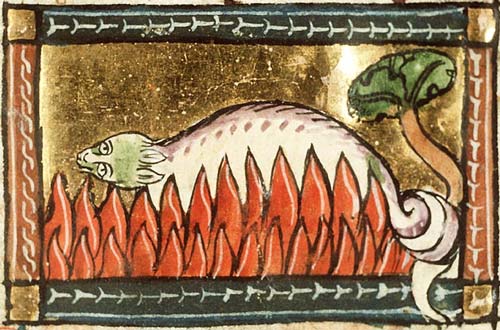
Pliny places the animal in Cyrene. Bostock and Riley’s translation gives a maximum length of twelve fingers; the Rackham excerpt renders the measure as a foot. A white head mark resembles a diadem, and the animal moves with its middle raised instead of proceeding through successive coils. Other snakes flee its hiss. Its influence ruins shrubs and grass, and even breaks stone. The opening comparison with the preceding catoblepas passage supplies the claim of lethal sight. Pliny reports a belief that poison can travel up a mounted man’s spear and kill both rider and horse. His counterforce is the weasel: introduced into the basilisk’s hole, it kills the creature through its odour but also dies. These reported marvels are not verified effects of a real snake.
Lucan gives the basilisk a place in the serpent catalogue of Book IX of the Civil War. The catalogue follows the story of Medusa’s blood falling on Libyan soil, within the poem’s account of Cato’s desert march. The basilisk’s raised royal head and hiss drive the other serpents away. A later episode makes its danger pass up Murrus’s lance into his hand. In the inspected English version, Murrus severs the affected limb and survives to watch it perish. This individual escape differs from Pliny’s report of the mounted attacker’s death; the two episodes should not be combined into one outcome.
In Arthur Golding’s 1587 rendering of Solinus, the name cockatrice is used for an almost half-foot serpent with a mitrelike marking. Its poison affects land and air, prevents birds from passing above its lair, and makes its victims unfit for scavengers. Weasels are sent into its hiding places. Solinus also reports that the people of Pergamus bought a dead specimen and suspended it in a golden net in Apollo’s temple to keep away birds and spiders. That is a historical author’s claim about a powerful carcass, not an authenticated surviving specimen. Golding’s vocabulary also shows why the names basilisk and cockatrice cannot always be separated by a simple modern rule about body shape.
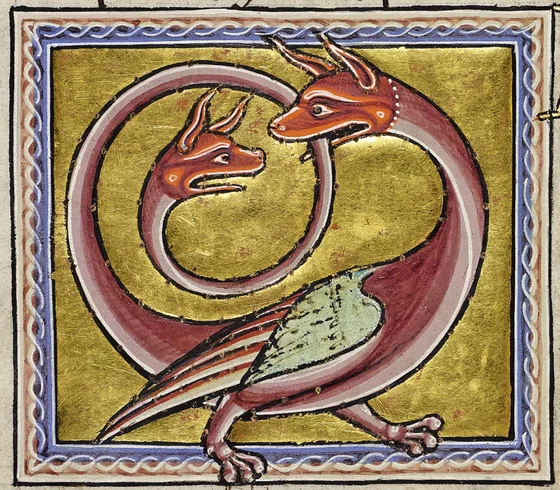
The Aberdeen Bestiary, MS24, presents its own combination on folios 66r–66v. The creature’s scent drives away or kills other crawling animals, while its gaze destroys humans and flying birds. Its prose describes a half-foot animal with white markings and uses regulus and sibilus as related names. A further passage connects a bite near water with hydrophobia and madness, and attributes killing power to its hiss. Men introduce weasels into the hiding places, where they pursue and defeat it; the compiler interprets the remedy through the Creator’s ordering of the world. The university’s commentary identifies a raptor’s beak, cockscomb, wings, claws and tail in the miniature. That birdlike picture must remain distinct from both the folio’s short serpent description and Pliny’s account.
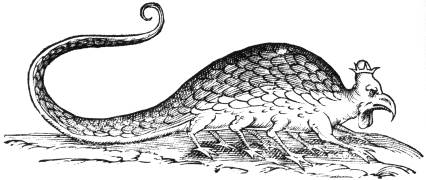
Thomas Browne’s discussion takes a more questioning approach without rejecting every old claim. In the selected 1672 sixth edition of Pseudodoxia Epidemica, he distinguishes the ancient serpent from the familiar winged, legged cockatrice. He describes manufactured examples made from ray or skate skins, adding that he had examples made to satisfy his own curiosity. He doubts the rule that whichever creature looks first must kill the other, and rejects a cock’s egg incubated by a toad as a regular means of producing a basilisk. His argument about incubation separates the warming of an egg from the kind of animal that develops. Yet he still entertains harmful emissions at a distance and other ideas that are not modern biology. The chapter documents a selective critique, rather than a complete experimental disproof of every basilisk tradition.
Origins & earliest records
Pliny and Lucan provide first-century CE literary witnesses among the sources compared here. Aberdeen MS24, made in England around 1200, is a later manuscript witness; Golding’s Solinus translation is dated 1587, and the selected Browne text is the 1672 sixth edition of a work first published in 1646. These publication and manuscript dates do not establish the first use of the name or the origin of every motif. Earlier Greek references require separate examination.
Records & interpretation
Surviving texts, manuscripts and images document the basilisk’s cultural history. Pliny’s dead-body report and Solinus’s temple carcass are claims in literary sources, not authenticated specimens available here. Browne records both criticism and remaining belief. The alleged effects on sight, water, air, vegetation and bodies are attributed historical assertions, without biological or medical validation.
In the literature
“He was supposed to be produced from the egg of a cock hatched under toads or serpents.”
Chapter XXIX, “The Cockatrice, or Basilisk”, opening paragraph
Bulfinch conflates these names in this heading. Use as a historical literary example; do not imply all traditions identify the creatures.
“When it hisses, all the other serpents fly from it:”
BookVIII chapters32–33, printed pp281–282 · John Bostock and H. T. Riley
The serpent frightens others in Pliny’s account.
“Hee is given to the utter destruction”
ChapterXXXIX, selected Cyrene / Cockatrice passage · Arthur Golding
Golding’s English excerpt describes destructive influence.
“for satisfaction of my own curiosity I have caused some”
BookIII chaptervii, complete pp130–134
Browne describes commissioning fabricated specimens; this excerpt does not assert that real basilisks were manufactured.
“Swift through the weapon ran The poison to his hand:”
BookIX, selected serpent catalogue and Murrus encounter; matching1896 printed pp290 and293 (translation verse numbering differs from Latin) · Edward Ridley, identified by textual collation
The Murrus encounter describes poison moving along the lance.
Selected bibliography
Documented works and useful reading. This is not a list of every appearance.
- 01
Aberdeen Bestiary, University Library MS24, 66r–66v
Selected surviving folios inspected; text and image are treated as distinct evidence.
- 02
Natural History VIII.78
Earlier serpent account compared with the medieval manuscript without merging their anatomies.
- 03
Natural History VIII.32–33, preceding catoblepas comparison and The Serpents Called Basilisks
Chapter 33, p. 282, with the preceding sight comparison; distinguishes reported effects and the mutually fatal weasel encounter.
- 04
Civil War / Pharsalia, Book IX, serpent catalogue and Murrus episode
Book IX basilisk catalogue, p. 290, and Murrus episode, p. 293, in the 1896 Longmans, Green edition. These passages match the Project Gutenberg text; its exact underlying print impression remains unidentified. Located passages and Medusa context were read, not the complete book.
- 05
The Excellent and Pleasant Worke of Iulius Solinus Polyhistor, chapter XXXIX, basilisk passage
Located Cyrene passage uses cockatrice for the small serpent and reports the Pergamus temple carcass.
- 06
Pseudodoxia Epidemica III.vii: Of the Basilisk
Chapter pp. 130–134 discusses ancient and modern forms, fabricated specimens, distant poison, priority of sight and supposed generation.
- 07
Aberdeen Bestiary MS24, De basilisco / De regulis
Selected complete basilisk text on66r–66v; preceding dragon and following viper descriptions kept separate. Medieval Latin transcription and modern English translation inspected digitally; original folio pixels not newly checked.
- 08
Natural History VIII.32–33, catoblepas comparison and basilisk
Inspected volumeII1855 English translation; complete chapters32–33 digitally read. Ancient composition first centuryCE; ebook release not substituted for edition.
- 09
The Excellent and Pleasant Worke of Iulius Solinus Polyhistor, selected XXXIX basilisk passage
ArthurGolding1587 English translation, explicitly chapterXXXIX in the hosted excerpt. Full selected excerpt read; entire chapter/book not claimed.
- 10
Pseudodoxia Epidemica III.vii, Of the Basilisk
First edition1646; selected sixth1672, pp130–134. Complete main chapter independently read; modern JamesEason annotations distinguished from Browne.
- 11
Pharsalia / Civil War IX, basilisk catalogue and Murrus episode
Gutenberg602 header omits translator/print edition. Opening and full Murrus passage match EdwardRidley, ThePharsaliaofLucan, LongmansGreen1896, direct title transcription https://en.wikisource.org/wiki/Page:The_Pharsalia_of_Lucan;_(IA_cu31924026485809).pdf/7 and Cornell scan OCR https://archive.org/details/cu31924026485809 . Exact underlying ebook impression not established; later1919 wording differs. Only selected BookIX passages read, not full poem.
Family, evolution & connections
Catoblepas
Natural History 8.32 describes the Catoblepas killing those who look at its eyes; chapter 33 immediately compares the Basilisk with that power. This is a documented textual juxtaposition of a lethal-gaze motif, not evidence that either creature existed. It does not establish shared ancestry or collapse later basilisk depictions into Pliny's small serpent.
Weasel in Pliny's account
Pliny's Natural History 8.33 portrays a weasel as the Basilisk's counterforce: its odour kills the monster, while the weasel also dies. This preserves an explicitly stated interaction within an ancient account, rather than a verified predation event. The translation does not securely identify a modern weasel species; contemporary mustelid classification cannot validate the alleged lethal effect.
Located primary passages
Specific passages supporting details in this entry, grouped by their published witness.
Aberdeen Bestiary, University Library MS24, 66r–66v
Selected complete basilisk text on66r–66v; preceding dragon and following viper descriptions kept separate. Medieval Latin transcription and modern English translation inspected digitally; original folio pixels not newly checked.
- The selected text explains the royal name, fleeing serpents, lethal scent and glance, harmful passage of birds, weasel counteraction, short white-marked body, dry habitats and harmful bites near water. Sibilus is identified with regulus and said to kill by hissing before biting or burning.
Source-specific medieval claims, not actual zoology. The hosted modern English translation is not assumed public domain and is paraphrased only; the weasel account here does not state its death. Description of the painted winged creature is separate image commentary.
Natural History VIII.32–33, catoblepas comparison and basilisk
Inspected volumeII1855 English translation; complete chapters32–33 digitally read. Ancient composition first centuryCE; ebook release not substituted for edition.
- The preceding catoblepas has a heavy lowered head and fatal eyes. Chapter33 assigns similar power to a Cyrenaican basilisk, at most twelve fingers long, with a white crown-like mark. Other snakes flee its hiss; it moves upright on its middle and damages vegetation and stones. The spear-mediated death of rider and horse is presented as an earlier general belief. A weasel kills it by its odour but also dies.
Twelve fingers is the historical translation unit; not silently converted to twelve inches. Reported killing powers and alleged trial are literary testimony, not natural-history verification. Catoblepas is a distinct animal used in the comparison.
The Excellent and Pleasant Worke of Iulius Solinus Polyhistor, chapter XXXIX, basilisk passage
ArthurGolding1587 English translation, explicitly chapterXXXIX in the hosted excerpt. Full selected excerpt read; entire chapter/book not claimed.
- The excerpt places a white half-foot serpent in the wilderness behind Cyrene, with a small mitre-like head pattern. It advances with half its body raised, terrifies snakes, injures earth and air, and leaves carcasses avoided by beasts and birds. Weasels overcome it. A purchased carcass is reportedly hung in a golden net in Apollo’s temple at Pergamus to exclude spiders and birds.
Cockatrice is the word used for this serpent in Golding; not imported avian anatomy. The hosted section is an excerpt and does not establish a full Solinus edition reading. Modern webpage notes are not quoted.
Pseudodoxia Epidemica III.vii: Of the Basilisk
First edition1646; selected sixth1672, pp130–134. Complete main chapter independently read; modern JamesEason annotations distinguished from Browne.
- Browne accepts a creature called basilisk on textual authority but distinguishes the ancient small crowned serpent from a winged, legged cockatrice and fabricated ray-skin specimens. He commissioned similar specimens himself. He considers distant and eye-mediated poison possible within his physical assumptions, rejects priority of sight under reception theories, and questions regular generation from a cock’s egg under a toad. He discusses translation differences and a supposed Egyptian symbolic origin.
Historical reasoning is not current physiology or confirmed biology; he does not reject every basilisk claim. Modern editor notes and Latin quotations attributed to others are not presented as Browne’s own observations.
Pharsalia / Civil War IX, basilisk catalogue and Murrus episode
Gutenberg602 header omits translator/print edition. Opening and full Murrus passage match EdwardRidley, ThePharsaliaofLucan, LongmansGreen1896, direct title transcription https://en.wikisource.org/wiki/Page:The_Pharsalia_of_Lucan;_(IA_cu31924026485809).pdf/7 and Cornell scan OCR https://archive.org/details/cu31924026485809 . Exact underlying ebook impression not established; later1919 wording differs. Only selected BookIX passages read, not full poem.
- The catalogue calls the basilisk a deserted-sands king with a raised regal head, whose hissing frightens the other snakes before poison strikes. Murrus pierces one with his lance; poison travels through the weapon to his hand. He cuts off the arm and shoulder and survives while the severed hand perishes.
Poetic episode, not actual venom mechanics; Murrus survives, unlike Pliny’s reported rider-and-horse deaths. Gutenberg1996 is electronic preparation only. Ridley attribution is independently corroborated; full ebook-to-print collation and exact impression remain unresolved.
Encyclopedia background
An additional attributed reference, separate from the editorial profile above.
Read the open encyclopedia overview
In ancient European bestiaries and folklore, a basilisk ( or ) is a legendary reptile reputed to be a serpent king, who causes any being to die when glanced at. According to the Naturalis Historia of Pliny the Elder, the basilisk of Cyrene is a small snake, "being not more than twelve inches in length", that is so venomous, it leaves a wide trail of deadly venom in its path, its gaze likewise just as lethal.
According to Pliny, the basilisk's weakness is the odor of a weasel. The weasel was thrown into the basilisk's hole, recognizable because some of the surrounding shrubs and grass had been scorched by its presence. It is possible that the legend of the basilisk and its association with the weasel in Europe was inspired by accounts of certain species of Asiatic and African snakes (such as cobras) and their natural predator, the mongoose.
Text from Wikipedia contributors, “Basilisk”. CC BY-SA 4.0. Extracted introduction; formatting changed. Retrieved 5 October 2026. The source article may have changed since retrieval.
References
Sources supporting this profile. Linked pages have their own scope and editorial standards.
- Primary textUniversity of Aberdeen, MS24 folio66rResearch access: 2026-10-05
- Primary textUniversity of Aberdeen, MS24 folio66vResearch access: 2026-10-05
- ReferenceUniversity of Manchester, Aberdeen Bestiary project and manuscript datingResearch access: 2026-10-05
- Primary textPliny, Natural History VIII.78, selected English excerptResearch access: 2026-10-05
- Historical literary translationPliny, Bostock–Riley volume II, Book VIII.32–33Research access: 2026-10-05
- Historical literary translationLucan, Book IX, Project Gutenberg English textResearch access: 2026-10-05
- Historical literary translationSolinus, Golding 1587, selected chapter XXXIX passageResearch access: 2026-10-05
- Primary textBrowne, Pseudodoxia Epidemica III.vii, sixth-edition textResearch access: 2026-10-05
- Primary printed translation and bibliographic witnessRidley 1896 Pharsalia, Cornell University Library scanResearch access: 2026-10-05
Image credits
Reference illustrationBasilisk
Image associated with the exact linked encyclopedia article; consult credited file description for its interpretation.