Salamander (bestiary)
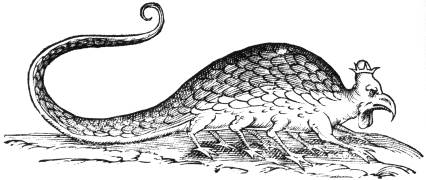
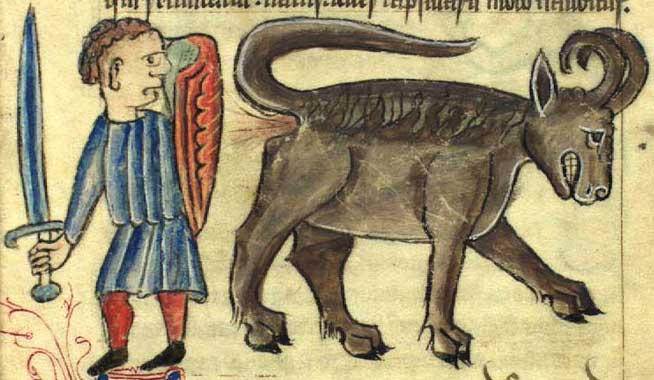
Image associated with the exact linked encyclopedia article; consult credited file description for its interpretation.
Overview
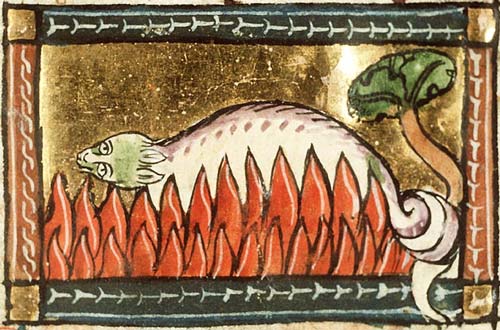
The selected account describes a creature able to live in flames without pain or destruction and to put fire out. Its poisonous power extends beyond a single bite: climbing a tree contaminates its fruit, and entering a well makes the water deadly. The bestiary thus presents the salamander through opposite kinds of environmental influence, resisting heat while carrying danger into familiar sources of food and drink.
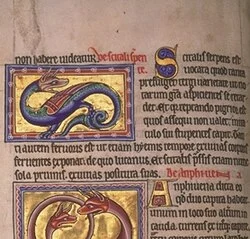
Folio70r illustrates several of these situations, with creatures in a tree, a vessel and flames. Such scenes are useful evidence for what a medieval artist chose to emphasize. They do not show how living salamanders behave. The display name marks this as a folklore profile, keeping the represented fire-resistant creature separate from future biological entries on actual amphibian species and from later elemental beings that share the name.
Origins & earliest records
The selected account crosses folios69v–70r of Aberdeen MS24, an English manuscript made around1200. This profile follows its medieval animal lore, rather than claiming that the manuscript invented the fire association. Earlier natural histories and later elemental traditions need separate witnesses, since the same name has been used for different explanatory purposes.
Records & interpretation
The text directly supplies resistance to flames, extinguishing fire and poisoning fruit or water; the illustration arranges those claims into scenes. These provide manuscript evidence for a historical representation. They are not experimental findings about amphibians, and the described danger should not be treated as a modern account of salamander toxicology.
In the literature
“the animal not only resists fire, but extinguishes it”
Chapter XXIX, “The Salamander”
Historical fire-salamander belief, explicitly introduced by Bulfinch as an account attributed to ancient philosophers; not real amphibian biology.
Selected bibliography
Documented works and useful reading. This is not a list of every appearance.
- 01
Aberdeen Bestiary, University Library MS24, 69v–70r
Selected surviving folios inspected; text and image are treated as distinct evidence.
Family & connections
A source-supported family tree or inspiration record has not yet been compiled for this profile. Related reading below indicates a connection in subject matter, not a proven lineage or creative influence.
Encyclopedia background
An additional attributed reference, separate from the editorial profile above.
Read the open encyclopedia overview
The salamander is an amphibian of the order Urodela which once, like many real creatures, often was imagined to have fantastic and sometimes occult qualities by pre-modern authors, as in the allegorical descriptions of animals in medieval bestiaries. The legendary salamander is often depicted as a typical salamander in shape, with a lizard-like form, but is usually ascribed an affinity with fire, sometimes specifically elemental fire.
Text from Wikipedia contributors, “Salamanders in folklore”. CC BY-SA 4.0. Extracted introduction; formatting changed. Retrieved 5 October 2026. The source article may have changed since retrieval.
References
Sources supporting this profile. Linked pages have their own scope and editorial standards.
- Primary textUniversity of Aberdeen, MS24 folio69vResearch access: 2026-10-05
- Primary textUniversity of Aberdeen, MS24 folio70rResearch access: 2026-10-05
- ReferenceUniversity of Manchester, Aberdeen Bestiary project and manuscript datingResearch access: 2026-10-05
Image credits
Reference illustrationSalamander (bestiary)
Image associated with the exact linked encyclopedia article; consult credited file description for its interpretation.