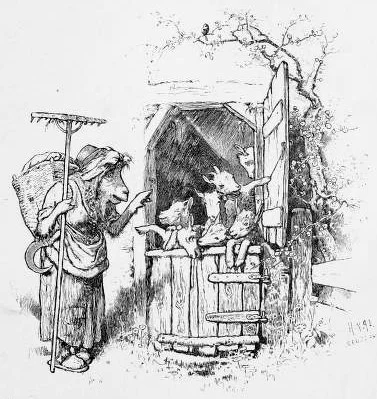
Wolf of the Seven Kids
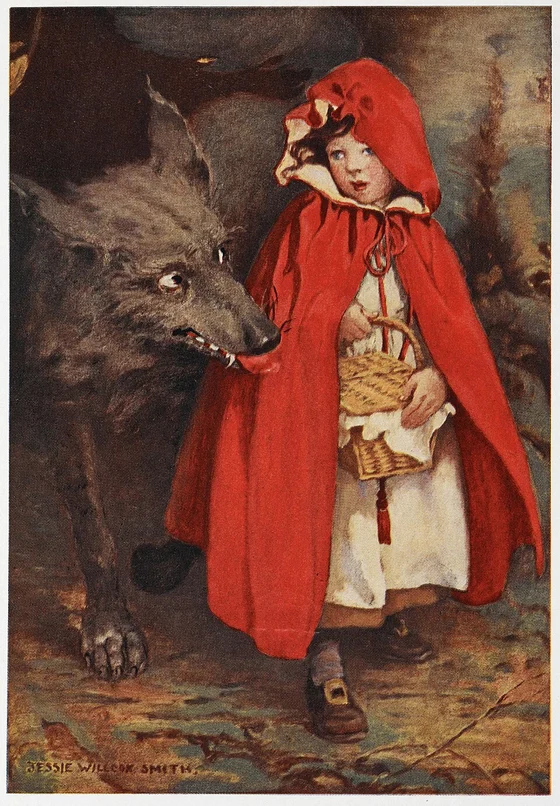
Image associated with the exact linked encyclopedia article; consult credited file description for its interpretation.
Overview
The wolf in Hunt’s translation of Grimm tale 5 attacks a household whose mother has warned her seven children how to recognize him. His rough voice and black feet initially betray him when he pretends to be their mother returning with presents. He buys and eats chalk to soften his voice, but the children still reject him after seeing his paws against the window. The deception is therefore revised in response to the children’s tests rather than succeeding immediately.
He next tells a baker that his feet are injured and obtains a coating of dough. A miller then refuses to whiten them with meal because he suspects a trick. The wolf threatens to eat the miller, who gives in. These are two different methods of obtaining help: a false injury story and an explicit threat. On the third visit, the children accept the pale paws as proof of their mother’s identity and open the door.
Six kids are found in their hiding places and swallowed. The youngest escapes inside the clock-case and tells the returning mother what happened. Outside, the wolf sleeps beneath a tree and snores loudly enough to shake its branches. The mother sees movement in his belly and sends the survivor for scissors, needle and thread. Cutting him open releases all six children alive and uninjured; the narrator explains their survival through his having swallowed them whole.
All seven children gather stones, which replace the swallowed kids, and their mother sews the sleeping wolf up. He wakes thirsty, hears the stones rattling and wonders why his expected meal feels different. At the well, their weight makes him fall into the water and drown. The reunited family celebrates around it. The stones thus connect the rescue to the particular ending; this wolf does not simply fall dead on waking as the first wolf in Hunt’s Little Red-Cap does.
This is a speaking, disguising fairy-tale animal whose bodily events obey the story. The passage provides no personal name, pack, parents or transformation into a human. Similar swallowing-and-rescue episodes can be compared without assuming that every tale features the same individual wolf or describes the behaviour of a real species.
Origins & earliest records
This entry follows tale 5 in the Grimm brothers’ Household Tales, using Margaret Hunt’s 1884 English translation. The collection was repeatedly revised during the nineteenth century and mediates material from storytellers and earlier literature. Its publication and translation dates identify the selected witness, not the beginning of every related oral narrative.
Records & interpretation
Complete Grimm tale 5 in Hunt’s translation read, including its ending. The textual evidence supports these particular narrative actions; animal speech, knowledge and extraordinary bodily events are not presented as zoological observations.
In the literature
“bought himself a great lump of chalk, ate this and made his voice soft with it.”
Tale 5 The Wolf and the Seven Little Kids; paragraph beginning “It was not long before some one knocked at the house-door and…” · Margaret Hunt
The wolf changes his voice with chalk to imitate the kids’ mother.
“the heavy stones made him fall in,”
Tale 5 The Wolf and the Seven Little Kids; paragraph beginning “And when he got to the well and stooped over the water…” · Margaret Hunt
The stones substituted for swallowed kids cause the wolf to fall into the well and drown.
Selected bibliography
Documented works and useful reading. This is not a list of every appearance.
- 01
Household Tales, tale 5: The Wolf and the Seven Little Kids
Complete selected tale read from opening through ending. This English witness is distinguished from other editions and related oral narratives.
- 02
Household Tales: 5 The Wolf and the Seven Little Kids
Margaret Hunt’s English translation, London: George Bell and Sons, 1884; Gutenberg e-text identifies Hunt. Translation date corroborated by the Wikisource scanned title page and National Library of New Zealand catalogue.
Family, evolution & connections
Little Red-Cap’s Wolf
Hunt’s Seven Little Kids has the goat mother cut open the sleeping wolf and replace six surviving children with stones. Little Red-Cap instead gives that rescue to a huntsman, followed by the girl fetching stones. The parallel is a particular rescue sequence, with different victims and rescuers; it should not be read as realistic animal physiology.
Located primary passages
Specific passages supporting details in this entry, grouped by their published witness.
Household Tales, tale 5: The Wolf and the Seven Little Kids
Margaret Hunt’s English translation, London: George Bell and Sons, 1884; Gutenberg e-text identifies Hunt. Translation date corroborated by the Wikisource scanned title page and National Library of New Zealand catalogue.
- The wolf changes his voice with chalk to imitate the kids’ mother.
- The stones substituted for swallowed kids cause the wolf to fall into the well and drown.
- The seventh kid escapes by hiding in the clock-case.
This describes the version printed in Hunt’s translation; German tale origin and other versions require separate evidence.
References
Sources supporting this profile. Linked pages have their own scope and editorial standards.
- Primary textGrimm/Hunt, complete tale 5Research access: 2026-10-05
Image credits
Reference illustrationWolf of the Seven Kids
Image associated with the exact linked encyclopedia article; consult credited file description for its interpretation.