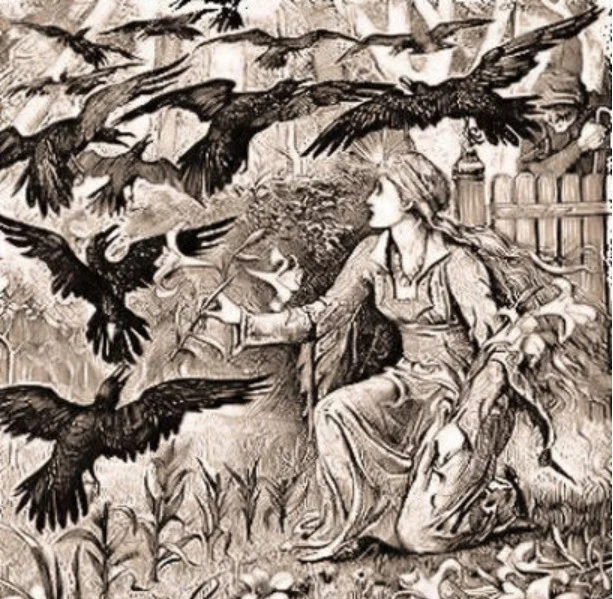
Twelve Raven Brothers
Image associated with the exact linked encyclopedia article; consult credited file description for its interpretation.
Overview
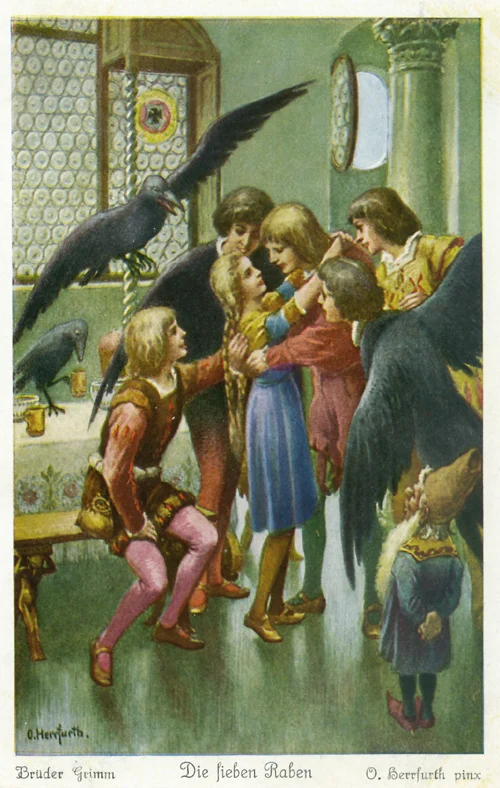
The brothers flee a father who plans to kill them if the next child is a girl. Years later their sister finds their forest home and overcomes their anger toward girls. Their reconciliation is disrupted when she gathers twelve lilies as gifts: the flowers’ removal changes the brothers into ravens and makes the dwelling disappear. An innocent household gesture thus creates a second separation.
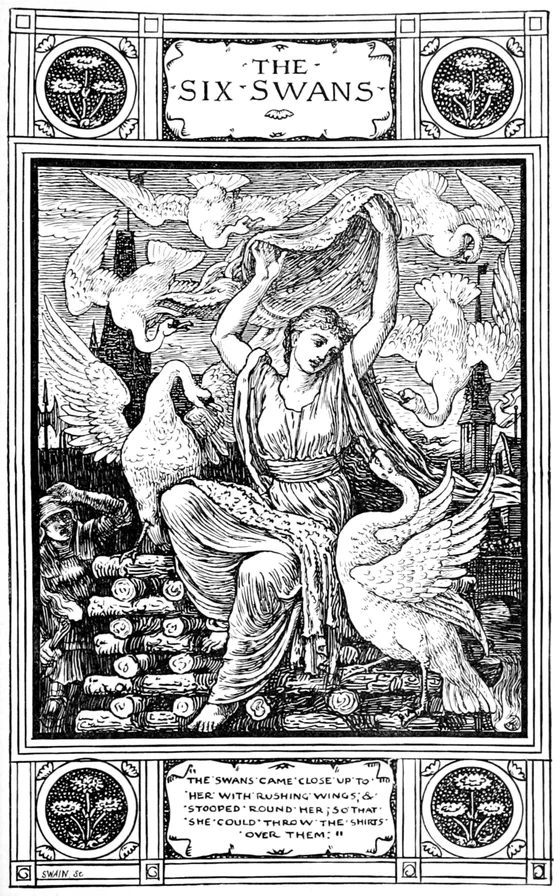
An old woman tells the sister that seven years without speaking or laughing can release the birds. She keeps that silence even after marrying a king and being falsely accused, until the brothers return at her execution and recover human form. Their shared transformation and rescue are treated as one profile. The selected tale differs from both the seven-raven journey and the six-swan sewing task.
The father’s decision concerns inheritance: he intends a future daughter to possess everything. He has twelve coffins prepared and orders the mother to keep the plan secret. Benjamin, the youngest, discovers why she grieves and helps arrange the brothers’ escape. Their mother promises a white flag if a boy is born and a red flag if a girl is born. After eleven days Benjamin sees the red signal, and the brothers retreat farther into the forest. Their later hostility to girls comes from this threat, although the sister herself has caused no harm.
The siblings spend ten years in the bewitched hut before their sister learns they exist. Twelve small shirts in the family washing prompt her questions, and her mother shows her the coffins. The girl, distinguished by a golden star on her forehead, takes the shirts into the forest. Benjamin recognizes her but first hides her beneath a tub. He obtains his brothers’ promise to spare the next girl they meet before revealing her identity. Reconciliation therefore precedes the enchantment; she is welcomed rather than blamed for their exile.
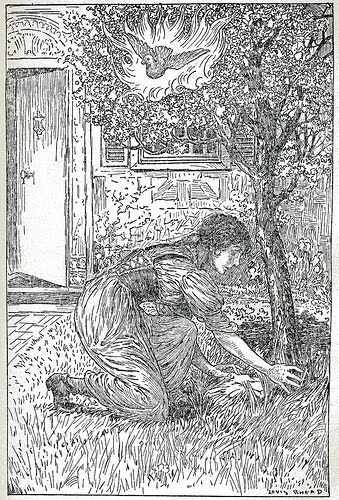
The sister keeps house with Benjamin while the eleven others hunt. Her fatal mistake is to pick the garden’s twelve lilies as presents for the brothers. The transformation happens immediately, and both house and garden vanish. The old woman who appears explains that seven years of complete silence, including no laughter, offer the only remedy. A single spoken word, even with only an hour remaining, would destroy that attempt and kill the brothers. No rescue shirts or starwort sewing are required in this tale.
The girl sits spinning in a tree until a hunting greyhound alerts a king to her presence. When he asks her to marry him, she nods assent. He carries her down and takes her home, but her continuing silence becomes a vulnerability at court. The king’s mother repeatedly slanders her as a beggar and treats her failure to laugh as a sign of a bad conscience. The king eventually accepts the accusations and orders her execution despite still loving her.
At the climax the fire is already burning and reaching her clothes. The seven years expire at the last instant; the twelve ravens descend, become the brothers upon touching the ground, extinguish the flames and release her. Only then can she explain her silence. The ending punishes the hostile older woman with death. Hunt’s text calls her the king’s mother in the accusation scene and a stepmother at the conclusion; this wording is retained as an editorial inconsistency rather than used to invent an additional antagonist.
Origins & earliest records
This entry follows tale 9 in the Grimm brothers’ Household Tales, using Margaret Hunt’s 1884 English translation. The collection was repeatedly revised during the nineteenth century and mediates material from storytellers and earlier literature. Its publication and translation dates identify the selected witness, not the beginning of every related oral narrative.
Records & interpretation
Complete tale 9 read in Hunt’s English text, including the final transformation or marriage and punishment. The 1884 volume title and translator’s preface were also inspected in transcription. Hunt explains editorial selection and combination of variants, so this is a located literary witness rather than a verbatim field recording. No German manuscript collation or verification of supernatural existence is claimed.
In the literature
“the twelve brothers were changed into twelve ravens,”
Tale 9 The Twelve Brothers; paragraph beginning “Once on a time the two at home had prepared a beautiful…” · Margaret Hunt
Picking the twelve flowers transforms the brothers into ravens.
“for thou must be dumb for seven years, and mayst not speak or laugh,”
Tale 9 The Twelve Brothers; paragraph beginning ““No,” said the woman, “there is but one in the whole world,…” · Margaret Hunt
Seven years of silence are required to release the twelve brothers.
Selected bibliography
Documented works and useful reading. This is not a list of every appearance.
- 01
Household Tales, tale 9: The Twelve Brothers
Complete numbered tale 9, including its ending, read in English transcription. The 1884 edition identifies Margaret Hunt as translator; the translator’s preface was separately checked. This is one selected witness, not an exhaustive variant bibliography.
- 02
Household Tales: 9 The Twelve Brothers
Margaret Hunt’s English translation, London: George Bell and Sons, 1884; Gutenberg e-text identifies Hunt. Translation date corroborated by the Wikisource scanned title page and National Library of New Zealand catalogue.
Family, evolution & connections
Unnamed sister in The Twelve Brothers
Hunt’s Twelve Brothers identifies Benjamin as the youngest of twelve sons and gives them a later-born sister. Their mother protects the boys from their father’s plan before the girl is born. The sister’s subsequent rescue concerns her own siblings; it does not make her the sister of the seven ravens in another tale.
Located primary passages
Specific passages supporting details in this entry, grouped by their published witness.
Household Tales, tale 9: The Twelve Brothers
Margaret Hunt’s English translation, London: George Bell and Sons, 1884; Gutenberg e-text identifies Hunt. Translation date corroborated by the Wikisource scanned title page and National Library of New Zealand catalogue.
- Picking the twelve flowers transforms the brothers into ravens.
- Seven years of silence are required to release the twelve brothers.
- The brothers regain human form at the end of the sister’s silence.
This describes the version printed in Hunt’s translation; German tale origin and other versions require separate evidence.
References
Sources supporting this profile. Linked pages have their own scope and editorial standards.
- Primary textGrimm/Hunt, Household Tales, tale 9Research access: 2026-10-05
- Historical edition and editorial statementGrimm’s Household Tales, volume I (1884): title and translator’s prefaceResearch access: 2026-10-05
Image credits
Reference illustrationTwelve Raven Brothers
Image associated with the exact linked encyclopedia article; consult credited file description for its interpretation.