Bremen Town Musicians
Image associated with the exact linked encyclopedia article; consult credited file description for its interpretation.
Overview
The Bremen Town Musicians are four animal companions who leave households in which their usefulness has diminished or their lives are threatened. In Hunt’s translation of Grimm tale 27, an ageing donkey escapes when his master begins considering how to save the cost of keeping him. A hound can no longer hunt and has fled a planned killing. An old cat with worn teeth has escaped a mistress who wants to drown it. A cock faces being killed for the next day’s meal. Their circumstances differ, but they agree to seek a livelihood together.
The donkey proposes that he play the lute and the hound the kettledrum; the cat and cock contribute their voices. These are plans for work in Bremen, not instruments they are later shown performing on. Unable to reach the city before nightfall, the group stops in a wood. From its high perch the cock sees a light, and they find a house where robbers are eating. The donkey looks through the window and the companions devise a way to dislodge its occupants.
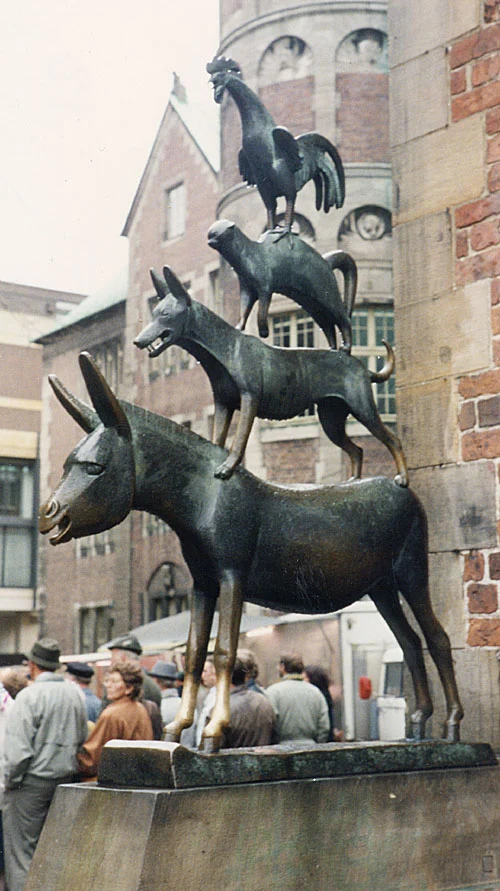
They form a stack: donkey at the window, hound on the donkey, cat on the hound and cock on the cat’s head. Their simultaneous braying, barking, mewing and crowing is followed by a crash through the window. The robbers flee because they think a ghost has arrived. The animals eat what remains and settle in separate sleeping places: donkey in the yard, hound behind the door, cat by the hearth and cock on a roof beam.
After midnight a robber returns to investigate. Mistaking the cat’s shining eyes for embers, he tries to light a match and is scratched. The hound bites his leg, the donkey kicks him and the awakened cock calls out. In his frightened report, these become a clawed witch, a knife-wielding man, a black monster with a club and a judge demanding his capture. Those figures are the robber’s explanations of animal actions; the tale has not introduced four additional supernatural inhabitants.
The robbers do not return, and the companions like the house so much that they remain there. Their intended arrival and employment in Bremen are never narrated. The ensemble’s defining feature is cooperation among displaced animals: their ordinary sounds and defensive abilities acquire extraordinary meaning for the people they frighten, while their conversations and shared plans belong to the fairy-tale world.
Origins & earliest records
This entry follows tale 27 in the Grimm brothers’ Household Tales, using Margaret Hunt’s 1884 English translation. The collection was repeatedly revised during the nineteenth century and mediates material from storytellers and earlier literature. Its publication and translation dates identify the selected witness, not the beginning of every related oral narrative.
Records & interpretation
Complete Grimm tale 27 in Hunt’s translation read, including its ending. The textual evidence supports these particular narrative actions; animal speech, knowledge and extraordinary bodily events are not presented as zoological observations.
In the literature
“the donkey brayed, the hound barked, the cat mewed, and the cock crowed;”
Tale 27 The Bremen Town-Musicians; paragraph beginning “When this was done, at a given signal, they began to perform…” · Margaret Hunt
The four animal musicians combine their cries to frighten the robbers.
Selected bibliography
Documented works and useful reading. This is not a list of every appearance.
- 01
Household Tales, tale 27: The Bremen Town-Musicians
Complete selected tale read from opening through ending. This English witness is distinguished from other editions and related oral narratives.
- 02
Household Tales: 27 The Bremen Town-Musicians
Margaret Hunt’s English translation, London: George Bell and Sons, 1884; Gutenberg e-text identifies Hunt. Translation date corroborated by the Wikisource scanned title page and National Library of New Zealand catalogue.
Family & connections
A source-supported family tree or inspiration record has not yet been compiled for this profile. Related reading below indicates a connection in subject matter, not a proven lineage or creative influence.
Located primary passages
Specific passages supporting details in this entry, grouped by their published witness.
Household Tales, tale 27: The Bremen Town-Musicians
Margaret Hunt’s English translation, London: George Bell and Sons, 1884; Gutenberg e-text identifies Hunt. Translation date corroborated by the Wikisource scanned title page and National Library of New Zealand catalogue.
- The four animal musicians combine their cries to frighten the robbers.
- The animals stack themselves in order to reach the robbers’ window.
- The four settle in the robbers’ house rather than completing the journey to Bremen.
This describes the version printed in Hunt’s translation; German tale origin and other versions require separate evidence.
Encyclopedia background
An additional attributed reference, separate from the editorial profile above.
Read the open encyclopedia overview
The "Town Musicians of Bremen" (German: Die Bremer Stadtmusikanten) is a German fairy tale collected by the Brothers Grimm and published in Grimms' Fairy Tales in 1819 (KHM 27).
It tells the story of four ageing domestic animals, who after a lifetime of hard work are neglected, mistreated and marked for death by their former masters. Eventually, they decide to run away and become town musicians in the city of Bremen. Contrary to the story's title, the characters never arrive in Bremen, as they succeed in tricking and scaring off a band of robbers, capturing their spoils, and moving into their house. It is a story of Aarne–Thompson Type 130 ("Outcast animals find a new home").
Text from Wikipedia contributors, “Town Musicians of Bremen”. CC BY-SA 4.0. Extracted introduction; formatting changed. Retrieved 5 October 2026. The source article may have changed since retrieval.
References
Sources supporting this profile. Linked pages have their own scope and editorial standards.
- Primary textGrimm/Hunt, complete tale 27Research access: 2026-10-05
Image credits
Reference illustrationBremen Town Musicians
Image associated with the exact linked encyclopedia article; consult credited file description for its interpretation.