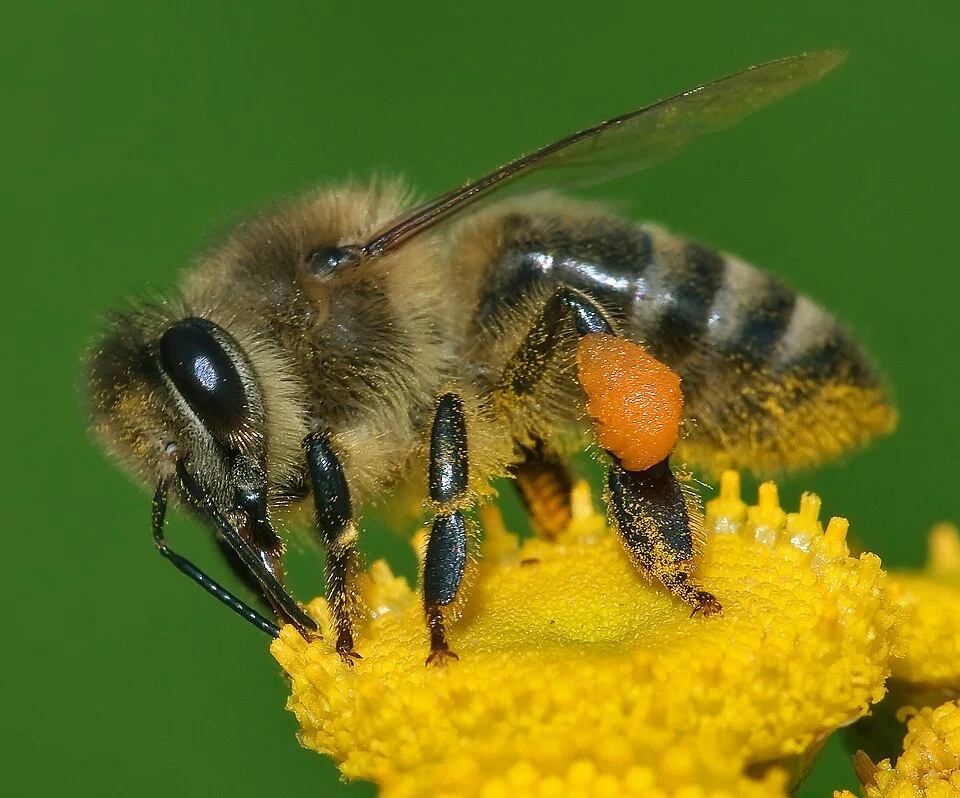
Western honey bee
Image associated with the exact linked encyclopedia article; consult credited file description for its interpretation.
Overview
Western honey bee colonies organise activities across reproductive and worker roles. Workers collect nectar and pollen, processing nectar into honey that can support the colony when food is difficult to obtain. Pollen carried between flowers also contributes to plant reproduction, although honey bees are only one part of a much larger pollinator community.
The species is widespread through human management as well as natural populations. Colonies regulate conditions within the hive, and their survival depends on food, climate, pathogens and other pressures. Beekeeping and pollination services create important human relationships, but they do not make every bee a honey producer or every crop dependent on this species. A species profile should also distinguish colony-level activity from the capabilities of a single worker.
Hasegawa and Ikeno's 2011 study investigated one aspect of waggle-dance communication: how bees might distinguish a dancer's sounds from other wing sounds in a dark hive. Their experimental bees were collected near a hive entrance at the University of Hyogo in Japan during 2007. Each was tethered to a torque sensor in a flight simulator, where its turning response controlled which loudspeaker presented a sound. The legs did not contact a vibrating comb, and odor cues were excluded. This arrangement isolates an orienting response to sound-related cues while differing substantially from a freely moving follower beside a real dancer.
The researchers compared recorded dance sounds, flight sounds and white noise. Bees oriented toward both dance and flight sounds, whose carrier frequencies were similar, but not significantly toward white noise. Importantly, the overall differences between those three groups were not statistically significant; the evidence for orientation came from comparisons within each treatment. When dance and flight sounds were offered together, bees preferred dance sounds. Synthetic pulse sequences helped test what distinguished them: regularly timed sequences with longer intervals attracted responses that random timing or very short intervals did not reliably reproduce.
These results support a role for both frequency and rhythm in the controlled task. They do not demonstrate that sound alone encodes every detail of a food location or is sufficient for recruitment in a natural colony. The authors proposed that bees first locate wing-generated cues and then assess rhythmic intervals, but did not directly trace the underlying neural processing. They also acknowledged uncertainty about the relevant airflow detection inside natural hives. An observed preference without conditioning in this experiment is distinct from proof that all components of dance-following are innate, learned in the same way, or identical across honey-bee species.
Origins & earliest records
Apis mellifera existed before organised beekeeping and before its modern scientific naming. The history of human honey use cannot date the species' evolutionary origin. Present-day global distribution partly reflects managed introductions, so a modern hive's location need not indicate an ancient native population in the same region.
Evidence & interpretation
Observations of foraging and hive activity show nectar processing, pollen transport and colony organisation. Experiments and managed records can test responses to conditions, but colony outcomes vary. Evidence about one species must not stand for all bees or insects, and the benefits of managed honey bees should be distinguished from the full ecology of wild pollinators.
Selected bibliography
Documented works and useful reading. This is not a list of every appearance.
- 01
What is honey and why do bees make it?
Selected institutional scientific reading; not a complete bibliography.
- 02
How Do Honeybees Attract Nestmates Using Waggle Dances in Dark and Noisy Hives?
PLOS ONE 6(5):e19619, published 16 May. Complete main experiments, Discussion and Methods; tethered sound-localization assay, CC Attribution.
- 03
The Scent of the Waggle Dance
Corinna Thom, David C.Gilley, Judith Hooper and Harald E.Esch, PLOS Biology5(9)e228,21August2007; DOI10.1371/journal.pbio.0050228
- 04
Thrice out of Asia and the adaptive radiation of the western honey bee
Science Advances 7(49):eabj2151, 3 December 2021.
Family, evolution & connections
Honey bees and sampled bee relatives — mitochondrial subtree
Five Apidae tips pruned from the 16-taxon analysis in Figure 3.
Scroll sideways to see all branches. With a keyboard, focus the tree and use the arrow keys.
- Selected sampled Apidae
- Sampled Apis pair
- Apis cerana
- Other sampled bee branch
- Melipona bicolor
- Sampled Bombus pair
- Bombus hypocrita sapporoensis
- Bombus ignitus
Concatenated amino acids from 13 mitochondrial protein-coding genes; MP, ML and NJ analyses. Actual figure inspected. Only two Apis species were sampled; this cannot identify the closest relatives across all honey bees. Mitochondrial history is not a complete nuclear species tree. Outgroups and branch lengths omitted.
Seven sampled holometabolous insects in the 2017 genomes-only analysis
Seven insect tips pruned from Figure 4A, a 28-species ecdysozoan analysis. This is a sparse sample, not a complete insect-order phylogeny.
Scroll sideways to see all branches. With a keyboard, focus the tree and use the arrow keys.
- Selected Figure 4A insect subtree
- Sampled hymenopterans
- Nasonia vitripennis
- Bee / ant pair
- Solenopsis invicta
- Other sampled holometabolous insects
- Sampled beetles
- Dendroctonus ponderosae
- Tribolium castaneum
- Sampled mosquito / moth pair
- Anopheles gambiae
- Plutella xylostella
Combined whole-genome orthologues: 322 loci and 67,256 aligned residues, analyzed with RAxML and PhyloBayes; Figure 4A branching only. The figure separates Bayesian support, bootstrap support and individual-locus agreement. Its holometabolous stem has Bayesian support 0.52 despite maximal concatenated bootstrap support; many individual genes disagree at deeper nodes. Transcriptome-inclusive Figure 4B is a separate analysis. Branch lengths and deeper tardigrade placement are omitted.
Taxonomic classification
A hierarchy of classified groups, not a chain of direct ancestors.
- kingdomAnimalia
- phylumArthropoda
- classInsecta
- orderHymenoptera
- familyApidae
- genusApis
- speciesApis mellifera
Apis cerana
Figure 3 pairs A. mellifera with A. cerana under all three methods. Only these two Apis species were available in this analysis, so the result does not establish their position relative to every other honey-bee species.
Solenopsis invicta (sampled genome tree)
Figure 4A groups Apis mellifera with Solenopsis invicta, beside the sampled wasp Nasonia. This seven-insect pruning retains the study’s branching without treating its sparse sample as a complete insect phylogeny.
Apis dorsata
The concatenated-protein analysis groups A. mellifera with A. dorsata rather than A. florea. Only three honey-bee species were sampled; this is not a complete Apis phylogeny.
Apis florea
The dwarf honey bee branches outside the mellifera/dorsata pair in this study. Earlier divergence does not mean a living A. florea was the ancestor of either species.
Varroa destructor
Ramsey’s 2019 adult-worker experiments traced fat-body material into feeding mites. Han’s 2024 experiments instead found hemolymph predominating in mites feeding on pupae, using biostains and comparative protein evidence. Together these studies support feeding differences across host and parasite stages, rather than one universal tissue diet; neither attributes every colony loss to this interaction.
Located primary passages
Specific passages supporting details in this entry, grouped by their published witness.
The Scent of the Waggle Dance
Corinna Thom, David C.Gilley, Judith Hooper and Harald E.Esch, PLOS Biology5(9)e228,21August2007; DOI10.1371/journal.pbio.0050228
- The study identifies a chemical component of honeybee dance communication alongside movements and other signals. Four hydrocarbons were more abundant around dancers, and experimental exposure to a mixture of three increased hive departures relative to solvent controls. This supports a behavioral effect but does not establish precisely how scent attracts followers or transmits the dance’s location information; those mechanisms remain proposed explanations.
Full methods, data and experimental replication not independently checked. Departure counts are the study’s proxy for foraging; mechanisms and evolutionary interpretations are hypotheses, not complete demonstrations.
Primary source witness
2021
- Analysis of 251 genomes supports an Asian ancestral range and multiple dispersal routes. Two resolved tree topologies differ, and lineages show admixture. Selection-associated loci are enriched among worker-biased genes; this association does not demonstrate every gene’s function or settle the species’ origin independently of sampling and models.
Complete Introduction, Results, Discussion and main Methods; captions 1–4.
Supplements, raw data and analysis reruns unreviewed. Historical species/subspecies counts are not asserted as current taxonomy; no direct ancestral individuals identified.
Encyclopedia background
An additional attributed reference, separate from the editorial profile above.
Read the open encyclopedia overview
The western honey bee (Apis mellifera) is the most common of the 7–12 species of honey bees worldwide. The genus name Apis is Latin for 'bee', and mellifera is the Latin for 'honey-bearing' or 'honey-carrying', referring to the species' production of honey.
Like all honey bee species, the western honey bee is eusocial, creating colonies with a single fertile female (or "queen"), many normally non-reproductive females or "workers", and a small proportion of fertile males or "drones". Individual colonies can house tens of thousands of bees. Colony activities are organized by complex communication between individuals, through both pheromones and the waggle dance.
The western honey bee was one of the first domesticated insects, and it is the primary species maintained by beekeepers to this day for both its honey production and pollination activities. With human assistance, the western honey bee now occupies every continent except Antarctica. Western honey bees are threatened by pests and diseases, especially the Varroa mite and colony collapse disorder. As of 2025, the western honey bee was assessed as "Data Deficient" on the IUCN Red List.
Western honey bees are an important model organism in scientific studies, particularly in the fields of social evolution, learning, and memory; they are also used in studies of pesticide toxicity, especially via pollen, to assess non-target impacts of commercial pesticides.
Text from Wikipedia contributors, “Western honey bee”. CC BY-SA 4.0. Extracted introduction; formatting changed. Retrieved 5 October 2026. The source article may have changed since retrieval.
References
Sources supporting this profile. Linked pages have their own scope and editorial standards.
- MuseumWhat is honey and why do bees make it?Research access: 2026-10-05
- ResearchHasegawa and Ikeno 2011 dance-sound discriminationResearch access: 2026-10-05
Image credits
Reference illustrationWestern honey bee
Image associated with the exact linked encyclopedia article; consult credited file description for its interpretation.