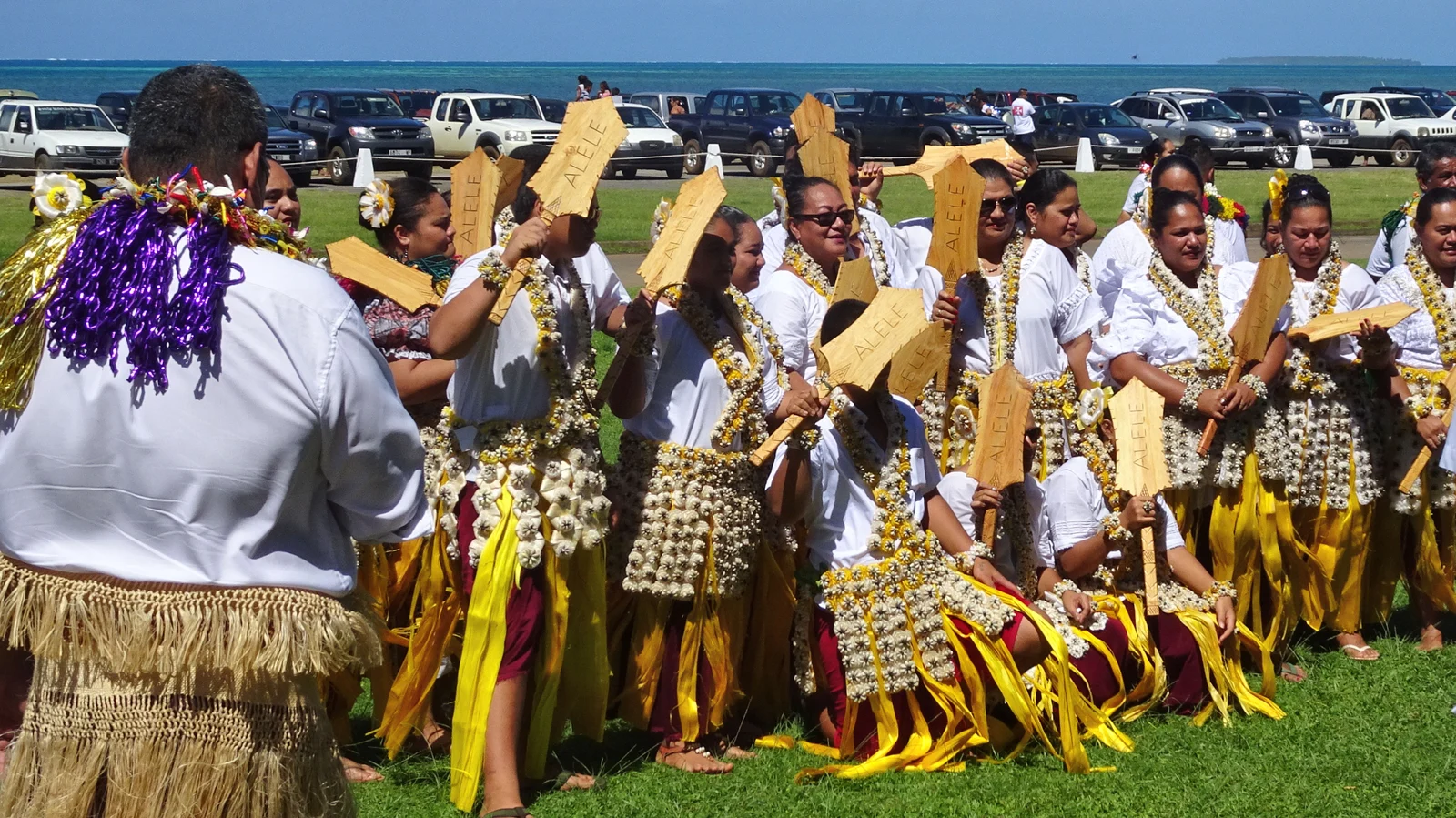
A group in white shirts, shell-covered adornments and yellow skirts holds woven fans marked ALELE beside a waterfront during the Wallis territorial festival.
The Alele group at the 2017 Fête du Territoire on Wallis, photographed by Brigitte & Heinz on 29 July. Visible fans identify Alele. This particular Wallis event does not depict every Wallisian or Futunian community.
Overview
Wallisian and Futunian communities share a territorial setting while maintaining distinct languages and cultural expressions. Wallis is also known as Uvéa; Futuna forms a separate island group. The territorial cultural affairs service describes heritage as living expressions and collective memory, as well as monuments and objects. It explicitly recognises that individuals understand culture differently: some emphasise language, music, dance and crafts, while others place customary institutions at its centre. This variation is retained rather than presenting a single checklist of beliefs. The service’s public remit also includes care of historical sites, situating cultural work within local institutions.
The Académie des langues wallisienne et futunienne provides a specific setting for language development. Its self-description distinguishes establishment in 2015 from its inauguration in March 2019. Separate branches serve the two languages, with local resource people chosen for linguistic expertise and professional experience. The academy describes its purpose as protecting, promoting and transmitting Wallisian and Futunian, while helping them develop in contemporary life. These institutional dates identify an organisation’s history, not the beginning of the communities or languages. Its French, Faka'uvea and Fakafutuna website navigation also makes the distinction between the languages visible in a shared public institution.
Artistic documentation provides another example of connection without uniformity. Te Papa’s collection narrative, based on its 2009–2010 Tapa: Pacific Style exhibition, distinguishes Uvéa ngatu from Futuna tapa. For Futuna it names large siapo sheets alongside garments and sashes called salatasi or salalua, lafi and tepi. This museum account identifies different forms and terminology within the two island settings. It is a bounded collection interpretation, not a claim that every person produces barkcloth or that contemporary cultural life is exhausted by museum-selected objects. No craft-making instructions or ceremonial uses are reproduced here.
Recent academy announcements document practical teaching collaborations. A March 2023 account names Australian-based Tongan author Annabel Piliu, intermediary Franck Asi Talatini and reviewer Claire Moyse-Faurie in the translation of two children’s books into both languages. The stated purpose was to support parents and guardians in teaching short everyday phrases. A separate February 2023 report describes university training for teachers in local language and culture education, and records a December 2022 diploma presentation coordinated by Stéphane Minvielle. These named projects connect writers, translators, linguists and educators. The announcements were read; the books, course materials and learners’ outcomes were not independently inspected.
History & identity
Territorial self-description, language institution accounts and a bounded museum narrative document contemporary cultural work. Institution and exhibition dates are not community-origin dates.
Sources & representation
Five complete selected written bodies read; named collaborators, distinct language branches and museum terminology retained with their respective scopes.
Selected bibliography
Documented works and useful reading. This is not a list of every appearance.
- 01
Constitution/Conservation du Patrimoine culturel
Complete public body read; varied understandings of living heritage and stated institutional remit retained.
- 02
Présentation générale
Complete presentation and council sections read; 2015 establishment, 2019 inauguration and distinct branches retained; no current individual officeholding assumed.
- 03
Tapa: Pacific Style - Uvéa (Wallis) ngatu and Futuna tapa
Complete brief collection narrative read; terminology and exhibition context retained, craft procedures excluded.
- 04
Livres pour enfants d’Annabel PILIU
Complete 7 March 2023 announcement read; named collaboration and educational purpose retained; actual books not inspected.
- 05
Diplôme Universitaire Langues, cultures océaniennes et apprentissages
Complete 17 February 2023 training account read; December 2022 presentation and named coordinator retained; course materials not inspected.
Language & cultural connections
Source-supported language and cultural connections have not yet been compiled for this profile.
References
Sources supporting this profile. Linked pages have their own scope and editorial standards.
- Territorial cultural service self-descriptionConstitution/Conservation du Patrimoine culturelResearch access: 2026-10-05
- Language institution self-descriptionPrésentation généraleResearch access: 2026-10-05
- Museum collection interpretationTapa: Pacific Style - Uvéa (Wallis) ngatu and Futuna tapaResearch access: 2026-10-05
- Named language publishing collaborationLivres pour enfants d’Annabel PILIUResearch access: 2026-10-05
- Institutional teacher-training accountDiplôme Universitaire Langues, cultures océaniennes et apprentissagesResearch access: 2026-10-05
Image credits
Contextual community activity photographA group in white shirts, shell-covered adornments and yellow skirts holds woven fans marked ALELE beside a waterfront during the Wallis territorial festival.
The Alele group at the 2017 Fête du Territoire on Wallis, photographed by Brigitte & Heinz on 29 July. Visible fans identify Alele. This particular Wallis event does not depict every Wallisian or Futunian community.