Vucub Caquix
Image associated with the exact linked encyclopedia article; consult credited file description for its interpretation.
Overview
Seven Macaw's radiance is a claim to authority, not merely colourful plumage. In the Popol Vuh narrative, he presents his brilliance as sufficient to replace the sun and moon. Lewis Spence's historical abridgement places the confrontation at a fruit tree: the Hero Twins, Hunahpu and Xbalanque, strike him with a blowpipe projectile, injuring his jaw and bringing him down. Victory is incomplete, because he tears away Hunahpu's arm and carries it home. His wife, Chimalmat, encounters him there in pain. The twins then enlist an elderly pair, who approach under a healing disguise and persuade the suffering boaster to accept treatment. His precious teeth are replaced with maize grains and other splendid features are removed; the arm is recovered and restored. The episode makes pride vulnerable through the very bodily display that supported it. Spence's identification of the elderly helpers is his interpretive layer, and translations should be compared before treating every named participant or material as fixed. Zipacna and Cabrakan, Seven Macaw's sons, receive their own defeats in neighbouring episodes, extending the challenge to claims of mountainous strength.
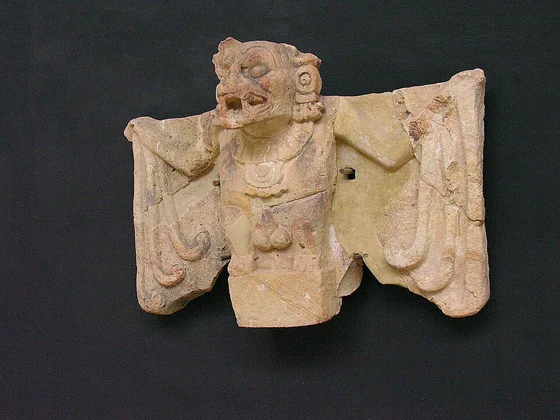
The resemblance between this narrative and earlier Maya bird imagery requires care. Lucia R. Henderson's Metropolitan Museum catalogue essay examines a jade figure dated 200–600 CE, with a human body and a Principal Bird Deity face. Jewellery, shining eyes and precious-material signs connect that figure with radiance and wealth. Henderson cautions against simply renaming it Seven Macaw: the earlier deity's visual history reaches back around 200 BCE and changed profoundly before the sixteenth-century textual witness. She treats the avian figures as related but historically distinct. The museum also connects the Principal Bird Deity with world directions and rulership, giving readers a concrete reason why a splendid supernatural bird could carry cosmological weight. Such interpretation helps locate Seven Macaw within a larger history of Maya imagery without turning resemblance into proof that every bird carving illustrates the fruit-tree encounter. The manuscript tradition, literary episode and archaeological image remain different forms of evidence, each with its own date and interpretive limits.
Origins & earliest records
The Popol Vuh survives through colonial textual transmission, including Ximénez's early eighteenth-century manuscript. Vucub Caquix belongs to that documented narrative, whose oral and visual histories cannot be dated solely from the surviving copy. Associations with earlier Maya imagery require iconographic argument rather than an automatic identification of every bird image.
Records & interpretation
The narrative provides direct textual evidence for the fruit-tree encounter, injured jaw, lost arm and removal of splendid bodily features. Manuscript and translation histories establish transmission, not a zoological sighting. Spence's English abridgement is a historical interpretive layer whose terminology and identifications should be checked against newer translations and Maya scholarship.
In the literature
“its owner’s eyes were of silver”
The Myth of Vukub-Cakix; paragraph beginning “After this catastrophe, ere yet the earth was quite recovered from…”
Vukub-Cakix’s boastful radiance is represented through silver, emerald and precious metals.
“seized the god by the arm and wrenched it from the body.”
The Myth of Vukub-Cakix; paragraph beginning “Now Vukub-Cakix had a great tree of the variety known in…”
After the blowpipe attack, Vukub-Cakix tears off Hun-Ahpu’s arm and takes it home.
“for his glittering teeth they substituted grains of maize.”
The Myth of Vukub-Cakix; paragraph beginning “But Hun-Ahpu and Xbalanque were in no mind that he should…”
Disguised elders remove Vukub-Cakix’s precious teeth and eyes; he dies and the hero’s arm is recovered.
Selected bibliography
Documented works and useful reading. This is not a list of every appearance.
- 01
Popol Vuh, Ayer MS 1515
Surviving manuscript witness; its date does not establish the beginning of the tradition.
- 02
The Popol Vuh: The Mythic and Heroic Sagas of the Kichés of Central America
Historical English abridgement and commentary, used critically; not a substitute for K'iche' scholarship.
- 03
Deity figure, object 1979.206.1069: catalogue essay
Distinguishes the earlier Principal Bird Deity from later Seven Macaw while discussing related imagery.
Family, evolution & connections
Vukub-Cakix’s two sons in Spence’s retelling
Spence’s 1908 abbreviated English retelling, pp. 12–15, not an independently collated K’iche’ manuscript.
Scroll sideways to see all branches. With a keyboard, focus the tree and use the arrow keys.
The passage expressly names Zipacna and Cabrakan as Vukub-Cakix’s two sons. Chimalmat is called spouse but her motherhood is not separately stated in this passage, so she is not inserted as joint parent. Source-specific spellings retained; no modern Indigenous people’s ancestry or universally harmonized genealogy is claimed.
Zipacna
Spence’s English retelling expressly identifies Zipacna as one of Vukub-Cakix’s two sons.
Cabrakan
The same passage names Cabrakan as the other son; the later summary again identifies both as Vukub-Cakix’s sons.
Chimalmat in Spence’s Popol Vuh retelling
Spence calls Chimalmat Vukub-Cakix’s spouse. This passage does not separately identify her as mother of the two sons.
Located primary passages
Specific passages supporting details in this entry, grouped by their published witness.
Primary source witness
Lewis Spence,1908 study and narrative synopsis, preface datedJuly1908; not a complete literal translation of the K’iche’ text.
- Vukub-Cakix’s boastful radiance is represented through silver, emerald and precious metals.
- After the blowpipe attack, Vukub-Cakix tears off Hun-Ahpu’s arm and takes it home.
- Disguised elders remove Vukub-Cakix’s precious teeth and eyes; he dies and the hero’s arm is recovered.
This is Spence’s English synopsis, not a quotation attributed to an ancient K’iche’ author. The underlying tradition and manuscript need separate modern scholarly context; no claim of earliest attestation.
Encyclopedia background
An additional attributed reference, separate from the editorial profile above.
Read the open encyclopedia overview
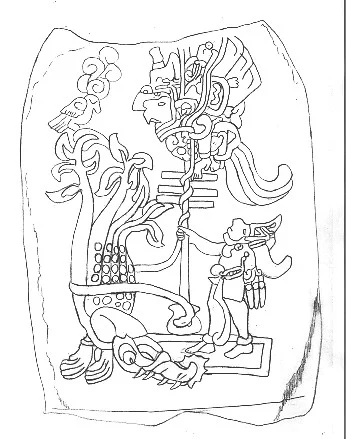
Vucub-Caquix (K'iche': Wuqub’ Kaqix, [ʋuˈquɓ kaˈqiʃ], possibly meaning 'seven-macaw') is the name of a bird demon defeated by the Hero Twins of an ancient Maya myth preserved in an 18th-century K'iche' document, the ʼ'Popol Vuh'ʼ. The episode of the demon's defeat was already known by the end of the Mesoamerican Preclassic period, before the year 200, as represented in steles 2 and 25 at Izapa in Mexico, which is its earliest representation and the precedent of the story that was narrated in the Popol Vuh many centuries later. In his appearances, Vucub-Caquix is described as a demon bird and a false sun god with shining eyes that daily sat on a big tree to eat its fruits, he was also the father of Zipacna, an underworld demon deity, and Cabrakan, the Earthquake God.
Text from Wikipedia contributors, “Vucub Caquix”. CC BY-SA 4.0. Extracted introduction; formatting changed. Retrieved 5 October 2026. The source article may have changed since retrieval.
References
Sources supporting this profile. Linked pages have their own scope and editorial standards.
- Primary textThe Popol Vuh: The Mythic and Heroic Sagas of the Kichés of Central AmericaResearch access: 2026-10-05
- ReferencePopol Vuh research guideResearch access: 2026-10-05
- MuseumThe Met: Deity figure and Principal Bird Deity interpretationResearch access: 2026-10-05
Image credits
Reference illustrationVucub Caquix
Image associated with the exact linked encyclopedia article; consult credited file description for its interpretation.