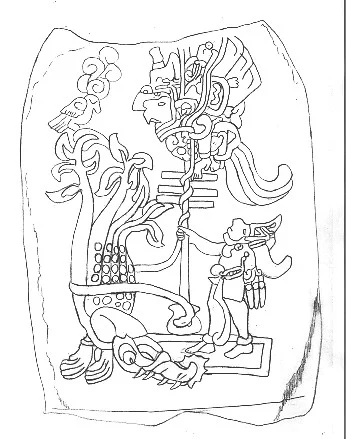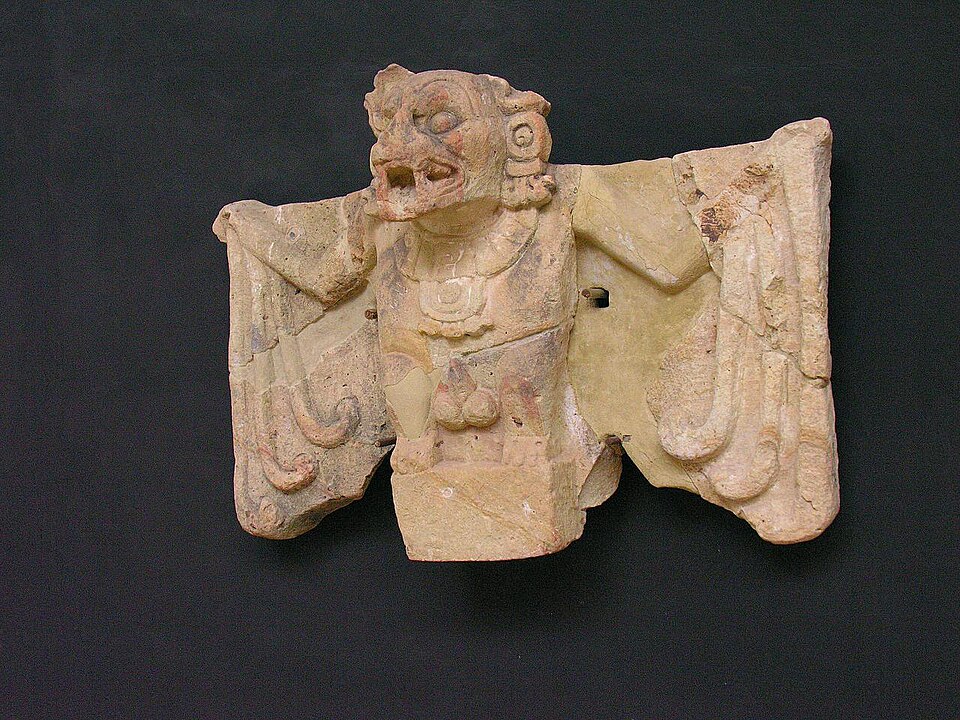
Bat sculpture associated with Camazotz at Copán, Honduras
Archaeological sculpture; Commons description explicitly identifies Cama Zotz.
Overview
Spence places the bat-house sixth in the Hero Twins’ Xibalba ordeals, after houses of gloom, lances, cold, tigers and fire. Camazotz, whom he calls Ruler of Bats, suddenly appears from above and cuts off Hunahpu’s head.
The beheading does not end the twins’ journey in Spence’s account, but he explicitly says he cannot explain the recovery from his reading of the difficult passage. An assembly of animals and another ball contest follow; the twins subsequently emerge from the ordeals. These details belong to his 1908 abridgement, whose admitted uncertainty should remain visible when comparing fuller translations.
The Spanish translation by Francisco Ximénez, published by C. Scherzer in 1857, gives a fuller sequence and prints the bat’s name as Gamazotz. The twins shelter inside their blowpipes while bats fill the house. Hun-ahpu puts his head out to check whether dawn has come, and the bat cuts it off; the head is then displayed at the place this translation calls the cementerio. Xbalanque summons animals to choose their foods, and a tortuga supplies a substitute head shaped with eyes and a face; Heart of Heaven and Huracán assist, while a vulture delays dawn four times. In the ensuing ball game a rabbit draws the Xibalba lords away, allowing Xbalanque to retrieve and replace his brother’s original head. The substitute is put in its place and subsequently shattered. Ximénez’s wording calls it a tortuga but then says it breaks into pepitas, leaving a difficulty that this account preserves rather than silently resolving with another translation. The brothers finish the ordeal alive; this fuller witness does not erase Spence’s separately stated uncertainty.
Origins & earliest records
Camazotz is documented in the Popol Vuh manuscript and translation tradition, which preserves material older than its surviving colonial copies. The age of bat imagery elsewhere in Mesoamerica cannot by itself date this named figure. Connections between representations and the narrative require evidence rather than the assumption that every supernatural bat is Camazotz.
Records & interpretation
The bat-house ordeal and beheading are directly attested in the selected text. Spence openly notes difficulty interpreting the following recovery episode, an important limit on using his abridgement. Manuscript scholarship and iconography can illuminate transmission and representation; neither turns the bat being into a confirmed animal species or validates all later adaptations. The complete bat-house and recovery sequence in Ximénez’s Spanish translation, Scherzer’s 1857 edition, pp. 66–69, was also inspected. Its substitute-head wording is reported with the unresolved tortuga/pepitas discrepancy; no manuscript or modern-translation reading is implied.
In the literature
“head being cut off by Camazotz”
The Second Book; paragraph beginning “Then came the third ordeal in the “House of Cold.” Here…”
Camazotz decapitates Hun-Ahpu during the House of Bats ordeal in Spence’s synopsis.
“y luego fué cortada su cabeza por el Gamazotz,”
Bat-house ordeal, printed p.67; complete selected sequence66–69 · Francisco Ximénez (Spanish); published by C.Scherzer
Hun-ahpu puts his head out of the blowpipe to check for dawn and Gamazotz decapitates him. The printed name is retained exactly.
Selected bibliography
Documented works and useful reading. This is not a list of every appearance.
- 01
Popol Vuh, Ayer MS 1515
Surviving manuscript witness; its date does not establish the beginning of the tradition.
- 02
The Popol Vuh: The Mythic and Heroic Sagas of the Kichés of Central America
Historical English abridgement and commentary, used critically; not a substitute for K'iche' scholarship.
- 03
Las historias del origen de los indios de esta provincia de Guatemala
Viena: Carlos Gerold é Hijo, pp. 66–69, complete bat-house ordeal and head-recovery sequence; title-page editorial framing inspected. Tortuga/pepitas wording retained without emendation. This printed Spanish witness is distinct from a direct reading of the original manuscript or modern K’iche’ scholarship.
- 04
Las historias del origen de los indios de esta provincia de Guatemala — bat-house and recovery sequence
Las historias del origen de los indios de esta provincia de Guatemala, Spanish Francisco Ximénez translation published with introduction and annotations by C.Scherzer; Viena: Carlos Gerold é Hijo1857, original title visually checked. Complete selected bat-house and recovery sequence printed66–69 read in OCR and all four original folios visually inspected. Printed70 visible only as next-episode boundary; not a claim whole volume or original K’iche’ manuscript read.
Family & connections
A source-supported family tree or inspiration record has not yet been compiled for this profile. Related reading below indicates a connection in subject matter, not a proven lineage or creative influence.
Located primary passages
Specific passages supporting details in this entry, grouped by their published witness.
Primary source witness
Lewis Spence,1908 study and narrative synopsis, preface datedJuly1908; not a complete literal translation of the K’iche’ text.
- Camazotz decapitates Hun-Ahpu during the House of Bats ordeal in Spence’s synopsis.
The Second Book; paragraph beginning “Then came the third ordeal in the “House of Cold.” Here…”
This is Spence’s English synopsis, not a quotation attributed to an ancient K’iche’ author. The underlying tradition and manuscript need separate modern scholarly context; no claim of earliest attestation.
Las historias del origen de los indios de esta provincia de Guatemala
Las historias del origen de los indios de esta provincia de Guatemala, Spanish Francisco Ximénez translation published with introduction and annotations by C.Scherzer; Viena: Carlos Gerold é Hijo1857, original title visually checked. Complete selected bat-house and recovery sequence printed66–69 read in OCR and all four original folios visually inspected. Printed70 visible only as next-episode boundary; not a claim whole volume or original K’iche’ manuscript read.
- The twins shelter within blowpipes while bats surround them. Hun-ahpu exposes his head to check dawn and Gamazotz cuts it off; the Xibalba lords order it placed at the location translated cementerio. Xbalanque summons animals to select foods. A tortuga supplies a substitute head, shaped with eyes and a face with assistance from Heart of Heaven and Huracán; the vulture delays dawn four times. In the next ball game a rabbit diverts the lords toward the tomato patch while Xbalanque retrieves and replaces the original head. The substitute is then shattered and described as breaking into pepitas. The twins survive this ordeal; the next paragraph begins a distinct death episode.
Complete bat-house and head-recovery sequence, printed pp.66–69
Actual printed Gamazotz, tortuga, cementerio and pepitas are retained, without emending from a different translation. The apparent tortuga/pepitas difficulty remains unresolved. This is not original K’iche’ manuscript collation; Spence1908 separately admitted recovery uncertainty is not erased or attributed to Ximénez.
Encyclopedia background
An additional attributed reference, separate from the editorial profile above.
Read the open encyclopedia overview
In the Late Post-Classic Maya mythology of the Popol Vuh, Camazotz ( from Mayan /kama ˈsots’/) (alternate spellings Cama-Zotz, Sotz, Zotz) is a bat spirit at the service of the lords of the underworld. Camazotz means "death bat" in the Kʼicheʼ language. In Mesoamerica generally, the bat is often associated with night, death, and sacrifice.
Text from Wikipedia contributors, “Camazotz”. CC BY-SA 4.0. Extracted introduction; formatting changed. Retrieved 5 October 2026. The source article may have changed since retrieval.
References
Sources supporting this profile. Linked pages have their own scope and editorial standards.
- Primary textThe Popol Vuh: The Mythic and Heroic Sagas of the Kichés of Central AmericaResearch access: 2026-10-05
- ReferencePopol Vuh research guideResearch access: 2026-10-05
- Primary textXiménez/Scherzer 1857: complete bat-house and recovery sequenceResearch access: 2026-10-05
Image credits
Exact subjectBat sculpture associated with Camazotz at Copán, Honduras
Archaeological sculpture; Commons description explicitly identifies Cama Zotz.