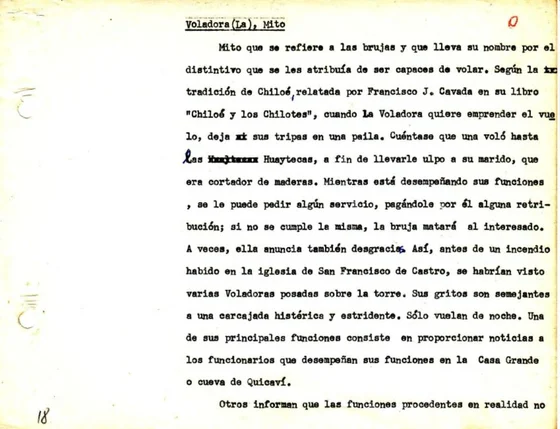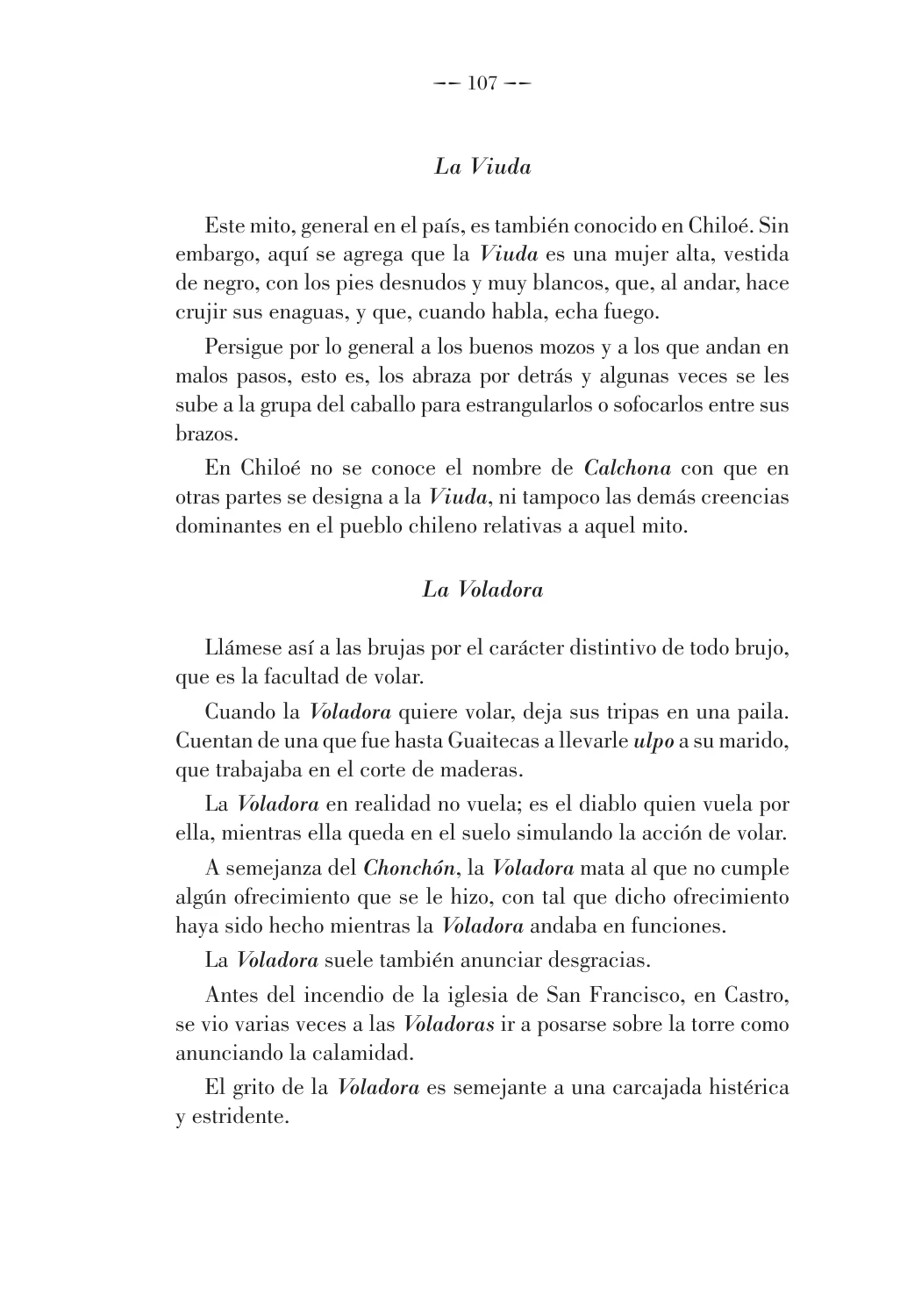
viuda-of-chiloe, named printed passage in Cavada museum edition, page107; documentary source-page facsimile
Exact documentary text facsimile of the named being, not creature artwork. Original1914 source reprinted in the2016 museum edition; page contains historical terminology and collector interpretations.
Overview
The Viuda appears in Cavada's account as a tall woman dressed in black, with conspicuously white bare feet and rustling skirts. Fire comes from her mouth when she speaks. She approaches men from behind, embraces them dangerously, or climbs onto the back of a horse to choke its rider. The collector associates her pursuit with handsome men and those considered to be behaving improperly.
These details place the apparition within stories of night travel, attraction and the danger of an unexpected companion. They also carry historical judgments about sexuality and behaviour, which the article reports rather than endorses. Cavada says the name Calchona and other mainland features were not recognised in Chiloé as he knew it. That local distinction matters: merging every Chilean female apparition into one creature would erase the particular island account.
Vicuña Cifuentes’s 1915 comparison records mainland variations under the same name. In a Santiago account, the black-clad woman mounts behind a rider and kills through her embrace. The La Serena version instead frightens and bruises travellers without killing them, then throws herself to the ground with a noise compared to a sack of bones striking a hard surface. Another Santiago description gives her the very different appearance of an enormous white phantom blocking the road.
A further Santiago account changes her motive: she is a suffering soul seeking release by revealing a buried treasure. She embraces travellers to whisper its location, but unintentionally suffocates them before communicating the secret. The failure perpetuates her unrest. Vicuña then quotes Cavada’s Chilote description, preserving a basis for comparing these regional forms without making all their traits belong to the island figure. His suggestion that several Latin American apparitions are substantially the same, and his rejection of a proposed origin in the Cerrillos de Teno bandits, remain a collector’s comparative arguments rather than demonstrated common ancestry.
Origins & earliest records
Cavada calls the Viuda a belief known across Chile but records specific Chilote additions in his 1914 collection. His statement describes the distribution perceived by one collector, not a proven route of diffusion or a first attestation. The island name and features therefore remain attached to this historical witness.
Records & interpretation
Printed page 107 supports the appearance, dangerous embrace, horse encounter and explicit contrast with Calchona. The evidence documents a story and its moral framing; it cannot establish supernatural attacks or the behaviour of real women. The collector supplies no systematic survey proving that every island community rejected the mainland name. Vicuña Cifuentes’s complete section XXXVII, pp. 92–93 (1915), adds specifically labelled Santiago and La Serena variants and quotes Cavada at original p. 100, distinct from the modern museum edition’s p. 107.
In the literature
“cuando habla, echa fuego.”
IV: Mitos / La Viuda; printed p.107; paragraph beginning “Este mito, general en el país…”
The Chiloé variant is a tall black-clad barefoot woman, with very white feet, whose speech emits fire and who embraces men from behind or mounts behind a rider to suffocate him.
Selected bibliography
Documented works and useful reading. This is not a list of every appearance.
- 01
Chiloé y los chilotes
Historical folklore witness; cited printed pages 107. The museum edition updates orthography.
- 02
Chiloé y los chilotes (1914) de Francisco J. Cavada: un estudio glotopolítico
Critical context for the collector's linguistic authority and national modernisation project.
- 03
Mitos y supersticiones recogidos de la tradición oral chilena
Complete XXXVII, La Viuda, pp. 92–93: four locally labelled mainland accounts, quotation from Cavada original p. 100, and explicitly editorial origin/comparison discussion. Earlier comparative authorities cited there remain indirect.
Family & connections
A source-supported family tree or inspiration record has not yet been compiled for this profile. Related reading below indicates a connection in subject matter, not a proven lineage or creative influence.
Located primary passages
Specific passages supporting details in this entry, grouped by their published witness.
Chiloé y los chilotes
Underlying work1914; inspected fourth museum edition, Ancud, November2016 (ISBN978-956-9172-04-5); modern typography, pagination and annotations.
- The Chiloé variant is a tall black-clad barefoot woman, with very white feet, whose speech emits fire and who embraces men from behind or mounts behind a rider to suffocate him.
IV: Mitos / La Viuda; printed p.107; paragraph beginning “Este mito, general en el país…”
This is Cavada’s historical collected account reproduced in2016, with its Christian and colonial framing; source criticism does not endorse its judgments or alleged practices. Exact inspected2016 pages, not assumed original1914 pagination. Spanish passage retained without an invented translation.
References
Sources supporting this profile. Linked pages have their own scope and editorial standards.
- Primary textChiloé y los chilotes — Museo Regional de Ancud edition, pp. 107Research access: 2026-10-05
- ResearchCritical study of Cavada's collectionResearch access: 2026-10-05
- Primary textVicuña Cifuentes 1915, complete La Viuda sectionResearch access: 2026-10-05
Image credits
Historical text facsimileviuda-of-chiloe, named printed passage in Cavada museum edition, page107; documentary source-page facsimile
Exact documentary text facsimile of the named being, not creature artwork. Original1914 source reprinted in the2016 museum edition; page contains historical terminology and collector interpretations.