La Llorona
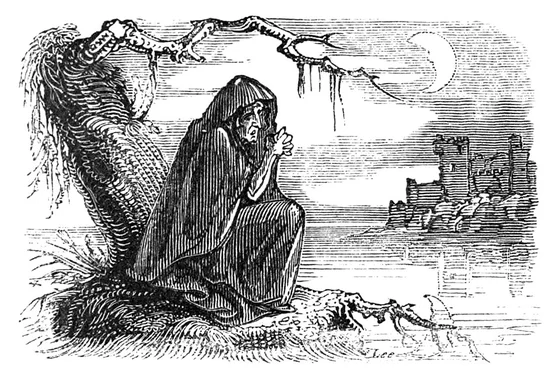
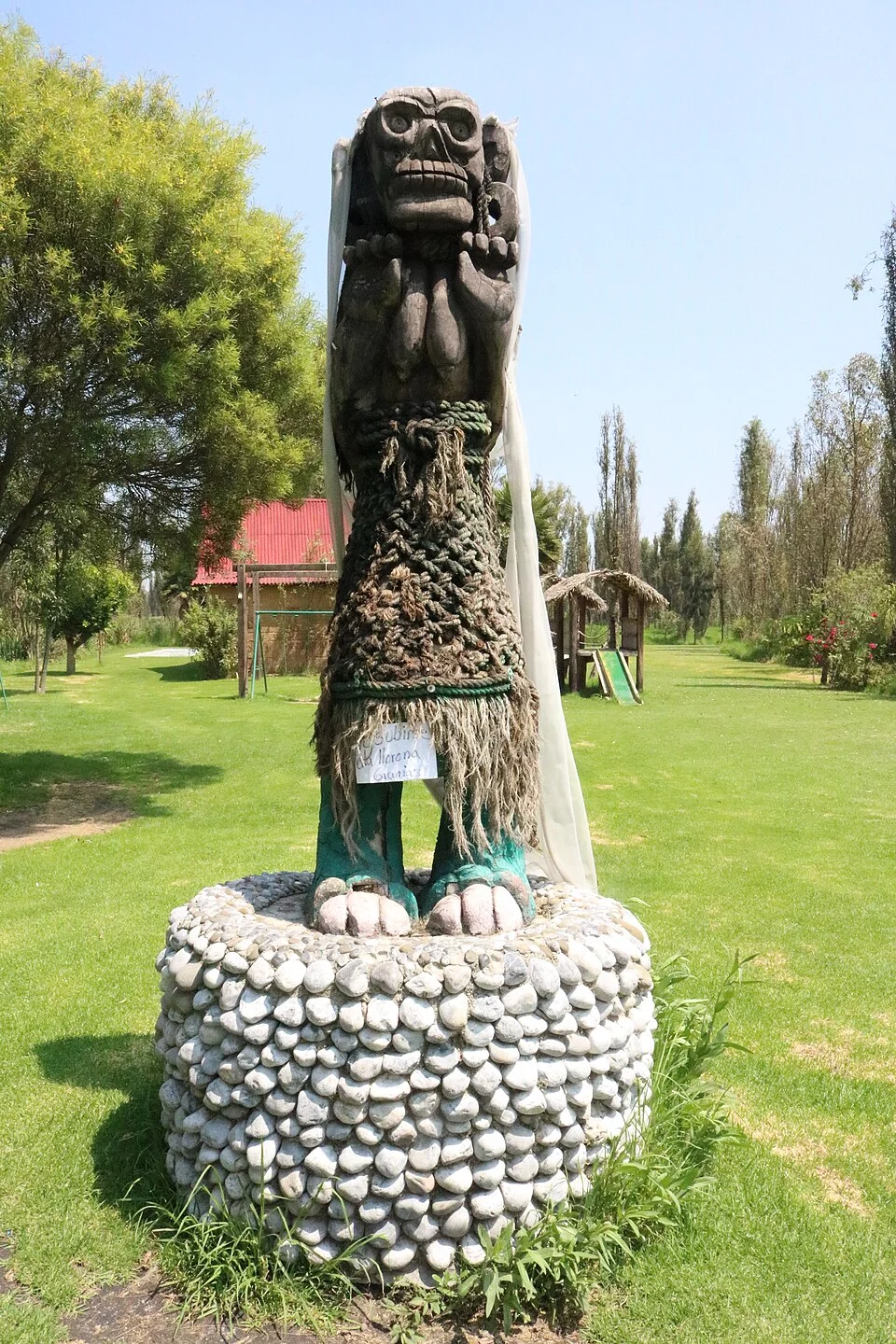
Image associated with the exact linked encyclopedia article; consult credited file description for its interpretation.
Overview
Weeping is the name’s central feature, but La Llorona stories vary in almost every other respect. Some concern a ghost, others an undying wanderer; appearance, actions and backstory can change. Water, lost children and dangerous nighttime encounters recur in influential versions without being mandatory in every telling.
The Library of Congress discusses the legend’s importance in Mexican and Mexican American lives alongside songs and narrative retellings. A colonial or Indigenous figure sometimes proposed as an antecedent should not be declared the single origin without evidence. This entry retains the variety and emotional range, including grief and warning, rather than reducing the woman to a standardized horror antagonist.
Thomas Allibone Janvier’s account appeared in print in 1906 and was collected with explanatory notes in Legends of the City of Mexico in 1910. In the book’s final note he names his friend Gilberto Cano as the source of the version in his text. The narrative addresses a listener as Señor and presents an alarming account of city life after dark. Its opening compares the woman with a fiery cow: the cow looks dangerous but does no actual harm, whereas the narrator insists that the woman does. This contrast belongs to Cano’s account as shaped by Janvier, not to a fixed classification of Mexican spirits.
In that telling, she wears a white petticoat and white rebozo. When she is walking quietly she can look respectable, although the same figure also runs and cries for her children. The narrator says that, while alive, she repeatedly drowned newborn children in the canals around the city. Neither the date nor the precise beginning of her remorse is known. A priest and saints are suggested as possible causes, with neither confirmed. There is no specified total of two children and no narrated abandonment by a husband in this particular account.
People who go out in a crowd at midnight fail to see her, because the story says she appears only when the street is empty. Sleeping watchmen encounter her differently. She wakes one to ask the time; after he answers midnight, she says she must be in a distant city at noon, cries for her children and disappears. The watchmen report these encounters to skeptical officers. Their temporary collapse is described in language of death, but the tale also lets them recover and report what happened.
The officer’s own encounter occurs near Santa Anita. He approaches a white-clad woman and asks her to uncover her face. She reveals a skull on a skeleton and exhales an icy breath; he falls unconscious. On recovering, he returns to the Diputación and tells his story, then dies later. That narrated sequence is more specific than the opening assertion that anyone who speaks to her dies in the same instant. Keeping both makes the rhetorical intensity and the internal variation visible.
The narrator also claims simultaneous appearances in widely separated parts of the city and country. Travelers meet her on a lonely road, ask where she is going and hear the question about her children before she vanishes; one subsequently goes mad. The closing speaker says that he has heard her running feet and cries, particularly on stormy nights, but has never seen her. The printed work documents those claims and their literary arrangement. It does not independently establish the deaths, appearances or a historical woman responsible for them.
Janvier’s Note IX advances a different kind of argument. He compares the weeping figure with accounts of Cihuacóatl transmitted through Orozco y Berra and Sahagún, then confidently calls her a survival of the older goddess. That is Janvier’s historical interpretation. The quoted similarities in white clothing, crying and children do not by themselves establish an uninterrupted line of transmission or make every later version a direct retelling of one ancient narrative. His further claim that she remains unchanged everywhere should likewise remain attributed to him.
The same note reports a metrical version by Vicente Riva Palacio whose events differ substantially from Cano’s account. In Janvier’s summary, Luisa has three children by Don Muño de Montes Claros. After seeing his marriage celebration with a woman of his own rank, she kills the sleeping children with a dagger he left with her. Her white clothing is stained with blood; she runs crying through the city and is eventually executed by garrote. Don Muño’s funeral takes place on the same day. This is a reported literary version involving a dagger and three children, not the canal drownings in Janvier’s main narrative; the original poem has not been independently read for this entry.
A family version remembered by Camille Acosta and published by the American Folklife Center instead names María. After her husband leaves, she drowns their two sons and herself, then seeks other children. Its attribution identifies a particular remembered telling, not a standard ending for every Llorona story.
The University of New Mexico’s Anaya archive documents deliberate literary adaptation. Its manuscript records identify successive drafts of The Legend of La Llorona, including an August 1983 revision before the 1984 novel. Its record for Maya’s Children identifies a separate 1997 children’s book. The catalogued titles and drafts establish distinct works; they are not evidence that every plot detail in those books was already present in oral tradition. Neither modern book is presented here as fully read.
Origins & earliest records
The inspected historical book witness is Janvier’s Legends of the City of Mexico (1910), whose Note IX credits Gilberto Cano. The Library of Congress identifies the earlier 1906 Harper’s Magazine appearance. Janvier’s proposed Cihuacóatl ancestry is reported as his interpretation, not established as the sole origin.
Records & interpretation
Complete Janvier main tale and Note IX read in the public transcription; the Library of Congress article was read for publication history and the attributed contemporary family version. Anaya archive catalogue and manuscript descriptions were read, not the complete modern books or manuscript images. Printed and collected accounts establish circulation and interpretation, not independently verified hauntings.
In the literature
“I myself, Señor, have heard the running of her feet and her wailings; but I never have seen her.”
Legend of La Llorona, final paragraph; chapter starts printed p.134
The first-person narrative distinguishes heard footsteps and wailing from an actual sighting; Note IX identifies Cano as Janvier’s authority. This is an attributed historical literary report, not a present factual sighting.
Selected bibliography
Documented works and useful reading. This is not a list of every appearance.
- 01
La Llorona
1906 Harper’s Magazine appearance identified by the Library of Congress; the original magazine pages have not been independently inspected here.
- 02
Legends of the City of Mexico — Legend of La Llorona
Complete main tale read in public transcription; the book collects the earlier printed account.
- 03
Legends of the City of Mexico — Note IX
Complete note read. Attributes Cano, argues an Aztec antecedent and summarizes a differing Riva Palacio metrical version.
- 04
Metrical La Llorona retelling reported by Janvier
Known here through Janvier’s Note IX only; exact original edition and full poem not independently examined.
- 05
The Legend of La Llorona: A Short Novel
Publication metadata and archive descriptions verified. Three initial manuscript drafts are catalogued; the novel is not claimed fully read.
- 06
Maya’s Children: The Story of La Llorona
Distinct children’s adaptation identified by the author archive; catalogue-level coverage, not a full-text review.
- 07
Legends of the City of Mexico — Legend of La Llorona and Note IX
Thomas A. Janvier, Legends of the City of Mexico, Harper & Brothers, New York and London, January 1910; title/copyright transcription independently checked. Earlier 1906 periodical appearance is a distinct bibliographic lead, not newly read here.
Family, evolution & connections
Narrative family: La Llorona in Acosta’s remembered telling
The telling attributed to Camille Acosta on the Library of Congress page.
Scroll sideways to see all branches. With a keyboard, focus the tree and use the arrow keys.
- First unnamed boy (one of two; order not stated)
- Second unnamed boy (one of two; order not stated)
Explicit parentage in the named source witness. One remembered version, not all La Llorona traditions. Sons and husband are unnamed; no father is inferred from marriage alone.
Narrative family: La Llorona in Janvier’s 1906 text
Janvier’s 1906 text reproduced by the Library of Congress.
Scroll sideways to see all branches. With a keyboard, focus the tree and use the arrow keys.
- Her unnamed children (number indefinite)
Explicit parentage in the named source witness. The child count is indefinite; the collective node is not a generation. Separate from Acosta’s two-son telling.
Two unnamed sons (Camille Acosta’s remembered telling)
Acosta’s remembered telling identifies Maria’s two boys; Janvier’s separate 1906 text instead leaves the number of her children indefinite. These witnesses are kept separate rather than combined into one fixed family.
Located primary passages
Specific passages supporting details in this entry, grouped by their published witness.
Legends of the City of Mexico — Legend of La Llorona
Thomas A. Janvier, Legends of the City of Mexico, Harper & Brothers, New York and London, January 1910; title/copyright transcription independently checked. Earlier 1906 periodical appearance is a distinct bibliographic lead, not newly read here.
- Janvier’s account presents a harmful white-clad wailing apparition, accounts of drowned children and encounters, and a narrator who reports hearing but not seeing her.
Legend of La Llorona, complete chapter beginning printed p.134
Claims are narrative reports, not empirically verified events. No single global La Llorona biography or universal motive imposed; no whole Janvier collection claimed.
Legends of the City of Mexico — Note IX
Thomas A. Janvier, Legends of the City of Mexico, Harper & Brothers, New York and London, January 1910; title/copyright transcription independently checked. Earlier 1906 periodical appearance is a distinct bibliographic lead, not newly read here.
- Janvier explicitly credits Cano, argues for an Aztec survival, and summarizes a distinct Riva Palacio version with Luisa and Don Muño.
Note IX, Legend of La Llorona, complete note beginning printed p.162
No independent original Sahagún, Orozco y Berra or Riva Palacio poem review asserted here; Janvier’s universalizing and colonial religious language remains attributed, not endorsed. Interpretation does not establish uninterrupted ancient origin.
Encyclopedia background
An additional attributed reference, separate from the editorial profile above.
Read the open encyclopedia overview
La Llorona (Latin American Spanish: [la ʝoˈɾona]; 'the Crying Woman, the Weeping Woman, the Wailer') is a vengeful ghost in Hispanic American folklore who is said to roam near bodies of water mourning her children she drowned in the river. Whoever hears her crying is said to either suffer misfortune, death, or become extremely unsuccessful in life.
The lore of La Llorona is well known in Mexico and the southwestern United States. Her legend is traditionally told throughout Mexico, Central America and northern South America.
La Llorona is sometimes conflated with La Malinche, the Nahua woman who served as Hernán Cortés's interpreter and also bore his son. La Malinche is considered both the mother of the modern Mexican people and a symbol of national treachery for her role in aiding the Spanish.
Text from Wikipedia contributors, “La Llorona”. CC BY-SA 4.0. Extracted introduction; formatting changed. Retrieved 5 October 2026. The source article may have changed since retrieval.
References
Sources supporting this profile. Linked pages have their own scope and editorial standards.
- ReferenceLibrary of Congress: La Llorona, an introduction to the weeping womanResearch access: 2026-10-05
- Primary textJanvier: complete Legend of La LloronaResearch access: 2026-10-05
- Primary textJanvier: complete Note IXResearch access: 2026-10-05
- Institutional researchAmerican Folklife Center: publication history and attributed variantsResearch access: 2026-10-05
- Author archive catalogueRudolfo Anaya archive: novel publication recordResearch access: 2026-10-05
- Author archive catalogueRudolfo Anaya archive: manuscript descriptionsResearch access: 2026-10-05
- Author archive catalogueRudolfo Anaya archive: Maya’s ChildrenResearch access: 2026-10-05
Image credits
Reference illustrationLa Llorona
Image associated with the exact linked encyclopedia article; consult credited file description for its interpretation.