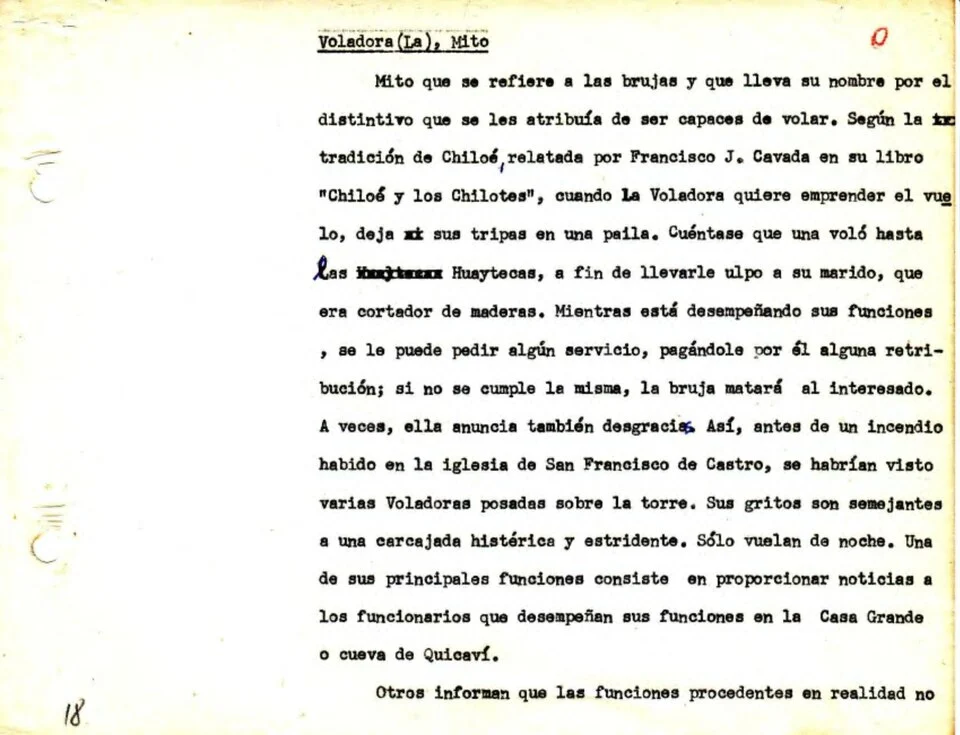
Voladora named folklore typescript; documentary source-page facsimile
Primary named typescript article, documentary text facsimile rather than creature artwork. Printed heading Voladora(La),Mito visually inspected.
Overview
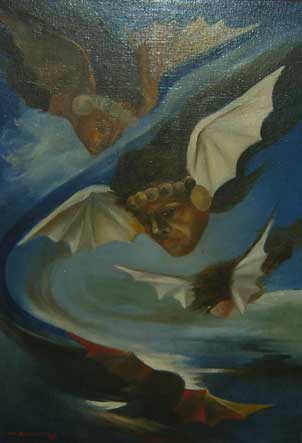
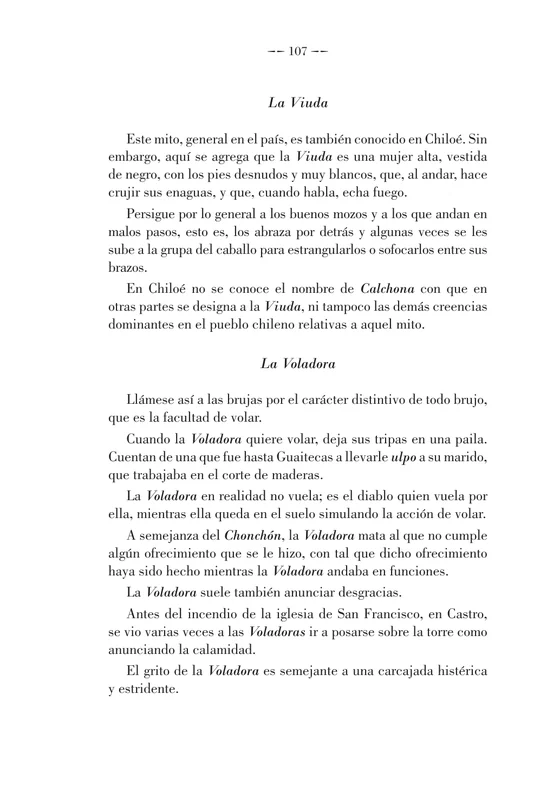
Cavada describes the Voladora as a woman associated with witchcraft who leaves her intestines in a basin before flying. One recorded story sends her to Guaitecas with ulpo for her husband, who is working at timber cutting. Other passages connect her with the cave's correspondence, promises that must be honoured and a piercing cry resembling a shrill laugh. Her journeys take place at night.
The collector also attributes appearances on the tower of Castro's San Francisco church to warnings of an approaching fire. He supplies a Christian explanation in which the devil flies while the woman imitates flight on the ground. Vicuña's 1915 quotation of that passage preserves the explanation, then quotes Cavada's glossary separately: the woman becomes a bird at night and recovers her earlier form at daybreak. These formulations are preserved as distinct statements, rather than choosing one universal mechanism. The messenger's errand with ulpo, the witches' correspondence, punishment for an unfulfilled promise and ominous tower appearances place the figure within specific island stories.
Origins & earliest records
The 1914 book preserves a written witness to Voladora stories already circulating when Cavada collected them. Its local place names and timber-working anecdote locate this version within the archipelago, but do not date the tradition's beginning. The 2016 museum republication makes the historical text accessible without supplying a new field collection.
Records & interpretation
Cavada's printed pp. 107–108 support the intestines, night journeys, messenger function, cry and Guaitecas episode. Vicuña's pp. 93–94 quote this material and a separate Cavada glossary definition of nocturnal bird transformation. The latter is an indirect quoted witness here. Reported church omens and punishment remain story claims, while the devil explanation is attributed to the historical text.
In the literature
“deja sus tripas en una paila.”
IV: Mitos / La Voladora; printed p.107; paragraph beginning “Cuando la Voladora quiere volar…”
Cavada reports the witch leaving her entrails in a pan and visiting Guaitecas with food for her husband, while explaining in his Christian frame that the devil does the flight while she imitates it on the ground.
Selected bibliography
Documented works and useful reading. This is not a list of every appearance.
- 01
Chiloé y los chilotes
Historical folklore witness; cited printed pages 107–108. The museum edition updates orthography.
- 02
Mitos y supersticiones recogidos de la tradición oral chilena
Printed pp. 93–94: quotations of Cavada's narrative and separate bird-transformation glossary.
- 03
Chiloé y los chilotes (1914) de Francisco J. Cavada: un estudio glotopolítico
Critical context for the collector's linguistic authority and national modernisation project.
Family & connections
A source-supported family tree or inspiration record has not yet been compiled for this profile. Related reading below indicates a connection in subject matter, not a proven lineage or creative influence.
Located primary passages
Specific passages supporting details in this entry, grouped by their published witness.
Chiloé y los chilotes
Underlying work1914; inspected fourth museum edition, Ancud, November2016 (ISBN978-956-9172-04-5); modern typography, pagination and annotations.
- Cavada reports the witch leaving her entrails in a pan and visiting Guaitecas with food for her husband, while explaining in his Christian frame that the devil does the flight while she imitates it on the ground.
IV: Mitos / La Voladora; printed p.107; paragraph beginning “Cuando la Voladora quiere volar…”
- The version restricts Voladora flight to night and gives correspondence for cave personnel as a principal function.
IV: Mitos / La Voladora; printed p.108; paragraph beginning “La Voladora sólo puede volar de noche…”
This is Cavada’s historical collected account reproduced in2016, with its Christian and colonial framing; source criticism does not endorse its judgments or alleged practices. Exact inspected2016 pages, not assumed original1914 pagination. Spanish passage retained without an invented translation.
References
Sources supporting this profile. Linked pages have their own scope and editorial standards.
- Primary textChiloé y los chilotes — Museo Regional de Ancud edition, pp. 107–108Research access: 2026-10-05
- Primary textMemoria Chilena: Vicuña Cifuentes, Mitos y supersticiones (1915), pp. 93–94Research access: 2026-10-05
- ResearchCritical study of Cavada's collectionResearch access: 2026-10-05
Image credits
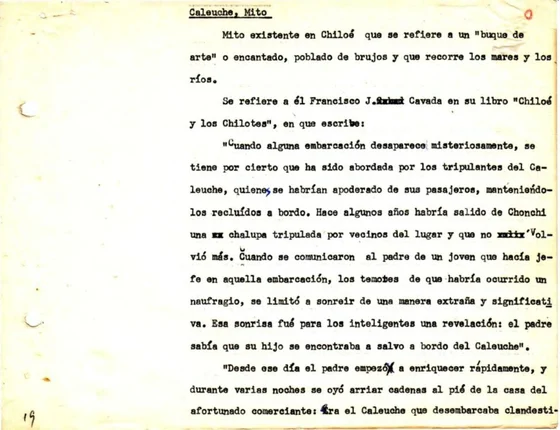
Historical text facsimileVoladora named folklore typescript; documentary source-page facsimile
Primary named typescript article, documentary text facsimile rather than creature artwork. Printed heading Voladora(La),Mito visually inspected.