Vānara
Image associated with the exact linked encyclopedia article; consult credited file description for its interpretation.
Overview
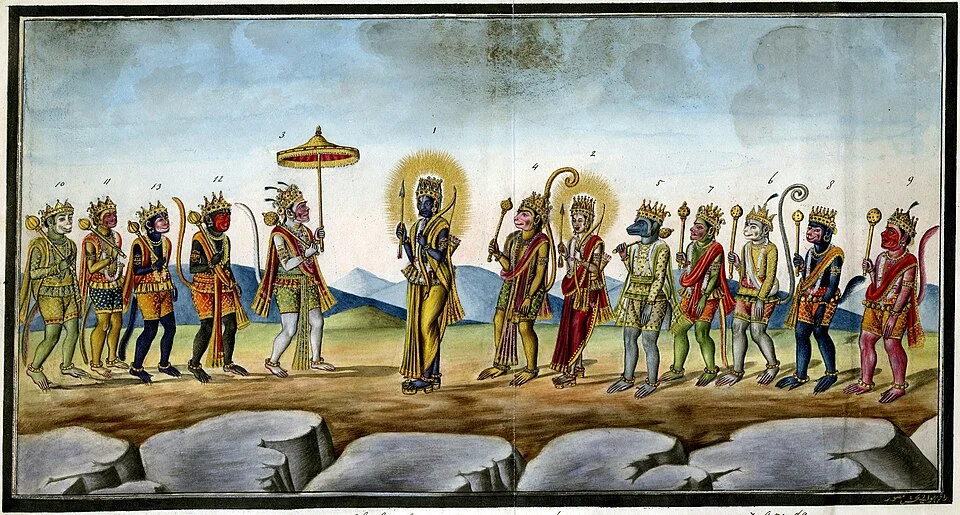
Vānara are the extraordinary simian allies of Rama in the Ramayana. Manmatha Nath Dutt’s 1891 translation of Balakandam, section XVII, presents their origin as a deliberate preparation for Vishnu’s mission. Brahma commands the gods to produce powerful beings in monkey forms who possess intelligence, moral understanding, knowledge of war and peace, and the ability to change shape. Their intended task is to help overcome the ten-headed Ravana. This creation episode gives them a purpose and capacities beyond those of ordinary forest animals.
The narrative distributes their parentage among particular divine figures. Indra fathers Vali, the Sun fathers Sugriva, Vishvakarma fathers Nala, and Agni fathers Nila. The Wind fathers Hanuman, whose body is compared in hardness to adamant and whose speed and intelligence are emphasized. Other gods and supernatural classes produce further forest-ranging allies. The offspring retain characteristic colors, forms and powers of their respective fathers. These individual genealogies distinguish the named heroes within the broader company instead of reducing every vānara to Hanuman’s identity.
Their bodies and combat methods are described in extravagant epic terms. They live on roots and fruits, fight with nails and teeth as well as weapons, hurl rocks and mountains, crush trees, cross the ocean and rise into the sky. Their roars can bring down birds, and they can overcome wild elephants. Such comparisons establish heroic strength in the narrative; they are not measurements of a biological species. The section also places the bands in multiple mountains and forests and describes leaders who generate further heroic followers.
Bears and other simian groups are included in the allied host, but the same passage distinguishes them by name. Jambavan, the foremost bear, has a separate origin in Brahma’s yawn. Vali protects bears and monkeys through his strength, while Sugriva, Nala, Nila and Hanuman appear among the leaders. Dutt’s repeated English word monkey belongs to a historical translation of this epic representation. It should not be used to identify the beings with a particular modern animal species or real human population. This witness establishes divine creation, varied leadership and formidable forest allies rather than a single uniform creature template.
Griffith’s Book IV, cantos III–IV, gives Hanuman a diplomatic encounter with Rama and Lakshmana. Sent by the exiled Sugriva, he approaches in a mendicant’s disguise and invites an alliance. Rama praises the envoy’s controlled speech and learning, judging those qualities necessary for a ruler’s success. Lakshmana then explains the brothers’ need for help in finding Sita. Hanuman resumes his vanara form and carries the visitors to his king. The episode places disguise, education and negotiation beside bodily strength: assistance begins through a political exchange, rather than through treating all vanara as anonymous animals. These details belong to this translated encounter, not to a universal anatomy.
Origins & earliest records
South Asia; selected epic creation narrative in Ramayana BalakandamXVII.
Records & interpretation
Identified primary passage directly read; sculpture and interpretive museum record distinguished where applicable.
In the literature
“do ye produce sons wearing the shapes of monkeys.”
Bālakāndam, section XVII; paragraph beginning “When Vishnu had accepted the sonship of that high- souled king,…” · Manmatha Nath Dutt
The gods are directed to generate monkey-shaped allies for Vishnu.
“could assume shapes and repair everywhere, at will.”
Bālakāndam, section XVII; paragraph beginning “When Vishnu had accepted the sonship of that high- souled king,…” · Manmatha Nath Dutt
The epic’s monkey allies possess powers of transformation and travel.
“And they faught with nails and teeth,—and were accomplished in all weapons.”
Bālakāndam, section XVII; paragraph beginning “When Vishnu had accepted the sonship of that high- souled king,…” · Manmatha Nath Dutt
The translated epic describes the allies’ fighting abilities; source spelling “faught” retained.
Selected bibliography
Documented works and useful reading. This is not a list of every appearance.
- 01
The Ramayana: verse translation
Book IV, cantos III–IV, printed pp.325–328: Hanuman’s diplomatic approach and introduction to Sugriva.
- 02
The Ramayana, Volume1: Balakandam and Ayodhyakandam
Balakandam sectionXVII, creation of simian allies
- 03
The Rāmāyana, Volume 1: Bālakāndam and Ayodhyākāndam
Calcutta, Deva Press, 1891, as the hosted title page states. Bālakāndam prose translation.
Family, evolution & connections
Textual families: named monkey-form heroes in Rāmāyana XVII
Ten named divine progenitor groups and eleven offspring explicitly enumerated in Dutt’s 1891 Bālakāndam XVII translation.
Scroll sideways to see all branches. With a keyboard, focus the tree and use the arrow keys.
- Selected independent divine families (grouping, not an ancestor)
- Indra
- Vāli
- Sun god
- Sugriva
- Vrihaspati
- Tārā (male monkey leader in this passage)
- Bestower of riches
- Gandhamādana
- Vicwakarma
- Nala
- Agni
- Nila
- The Acwins (joint divine progenitors)
- Maindra
- Dwivida
- Varuna
- Sushena
- Paryyanya
- Sarava
- Wind god
- Hanumān
Retain each stated parent-child relationship, grouping the independent families under a non-ancestral heading. The root heading groups independent families and is not an ancestor. Mothers are not individually identified in this list. The male Tārā here is not silently equated with Vāli’s wife in other episodes. Translator spellings are retained. Epic divine generation is distinct from biological evolution; other textual versions may differ.
Vāli (Dutt’s Rāmāyana XVII)
Dutt’s translation explicitly names Indra as progenitor of Vāli. This records the selected epic’s divine parentage of a named monkey-form hero; it is not a natural primate family tree or a universal account of all vānara traditions.
Sugriva (Dutt’s Rāmāyana XVII)
Dutt’s translation explicitly names Sun god as progenitor of Sugriva. This records the selected epic’s divine parentage of a named monkey-form hero; it is not a natural primate family tree or a universal account of all vānara traditions.
Tārā (male monkey leader in this passage) (Dutt’s Rāmāyana XVII)
Dutt’s translation explicitly names Vrihaspati as progenitor of Tārā (male monkey leader in this passage). This records the selected epic’s divine parentage of a named monkey-form hero; it is not a natural primate family tree or a universal account of all vānara traditions.
Gandhamādana (Dutt’s Rāmāyana XVII)
Dutt’s translation explicitly names Bestower of riches as progenitor of Gandhamādana. This records the selected epic’s divine parentage of a named monkey-form hero; it is not a natural primate family tree or a universal account of all vānara traditions.
Nala (Dutt’s Rāmāyana XVII)
Dutt’s translation explicitly names Vicwakarma as progenitor of Nala. This records the selected epic’s divine parentage of a named monkey-form hero; it is not a natural primate family tree or a universal account of all vānara traditions.
Nila (Dutt’s Rāmāyana XVII)
Dutt’s translation explicitly names Agni as progenitor of Nila. This records the selected epic’s divine parentage of a named monkey-form hero; it is not a natural primate family tree or a universal account of all vānara traditions.
Maindra and Dwivida (Dutt’s Rāmāyana XVII)
Dutt’s translation explicitly names The Acwins (joint divine progenitors) as progenitor of Maindra and Dwivida. This records the selected epic’s divine parentage of a named monkey-form hero; it is not a natural primate family tree or a universal account of all vānara traditions.
Sushena (Dutt’s Rāmāyana XVII)
Dutt’s translation explicitly names Varuna as progenitor of Sushena. This records the selected epic’s divine parentage of a named monkey-form hero; it is not a natural primate family tree or a universal account of all vānara traditions.
Sarava (Dutt’s Rāmāyana XVII)
Dutt’s translation explicitly names Paryyanya as progenitor of Sarava. This records the selected epic’s divine parentage of a named monkey-form hero; it is not a natural primate family tree or a universal account of all vānara traditions.
Hanumān (Dutt’s Rāmāyana XVII)
Dutt’s translation explicitly names Wind god as progenitor of Hanumān. This records the selected epic’s divine parentage of a named monkey-form hero; it is not a natural primate family tree or a universal account of all vānara traditions.
Primary records and illustrations
The Rāmāyana, translated by Manmatha Nath Dutt
Volume 1, Bālakāndam; 1891 translation. Section XVII; creation of Rama’s allies
Complete BalakandamXVII creation passage directly read in Dutt 1891 translation. Named divine parentage, varied bodies, forest diet, weapons and feats support expanded description; this does not claim collation of Sanskrit manuscripts.
Located primary passages
Specific passages supporting details in this entry, grouped by their published witness.
Primary source witness
Calcutta, Deva Press, 1891, as the hosted title page states. Bālakāndam prose translation.
- The gods are directed to generate monkey-shaped allies for Vishnu.
- The epic’s monkey allies possess powers of transformation and travel.
- The translated epic describes the allies’ fighting abilities; source spelling “faught” retained.
- Hanumān’s father is the wind god in this creation account.
- The passage distinguishes Sugrīva and Vāli’s divine parentage.
Bālakāndam, section XVII; paragraph beginning “Some of these monkeys began to dwell on the top of…”
- The epic supplies habitat and food details for the generated monkey allies.
Historical translation or collector’s published version; not zoological evidence, a universal account or an assertion about all living communities.
Encyclopedia background
An additional attributed reference, separate from the editorial profile above.
Read the open encyclopedia overview
In Hinduism, Vanara (Sanskrit: वानर, lit. 'forest-dwellers') are either monkeys, apes, or a race of forest-dwelling people.
In the epic the Ramayana, the Vanaras help Rama defeat Ravana. They are generally depicted as humanoid apes, or human-like beings.
Text from Wikipedia contributors, “Vanara”. CC BY-SA 4.0. Extracted introduction; formatting changed. Retrieved 5 October 2026. The source article may have changed since retrieval.
References
Sources supporting this profile. Linked pages have their own scope and editorial standards.
- Primary epic in translationThe Ramayana: verse translationResearch access: 2026-10-05
- Secondary referenceVānara — contextual bibliographyResearch access: 2026-10-05
- Primary narrative in historical translationThe Rāmāyana, translated by Manmatha Nath Dutt — exact record or passageResearch access: 2026-10-05
- Primary epic in historical translation; reviewed passageGriffith, The Rámáyan, Book IV III–IV, printed pp.325–328Research access: 2026-10-05
Image credits
Reference illustrationVānara
Image associated with the exact linked encyclopedia article; consult credited file description for its interpretation.