Rakshasa
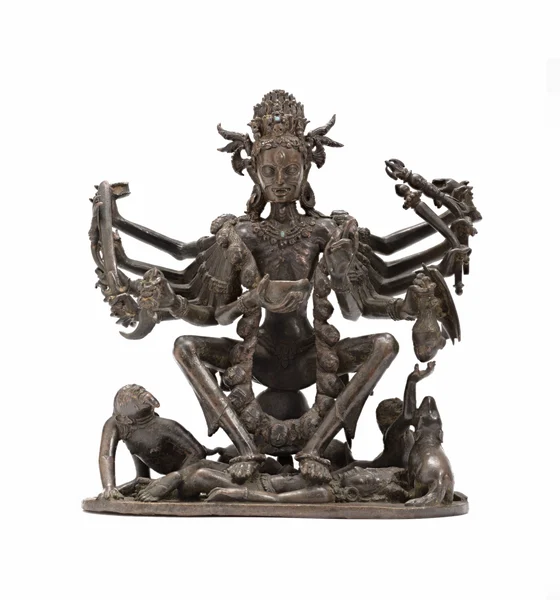
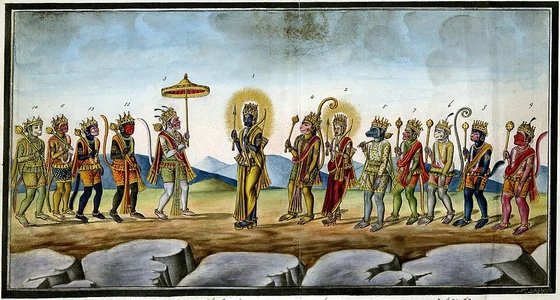
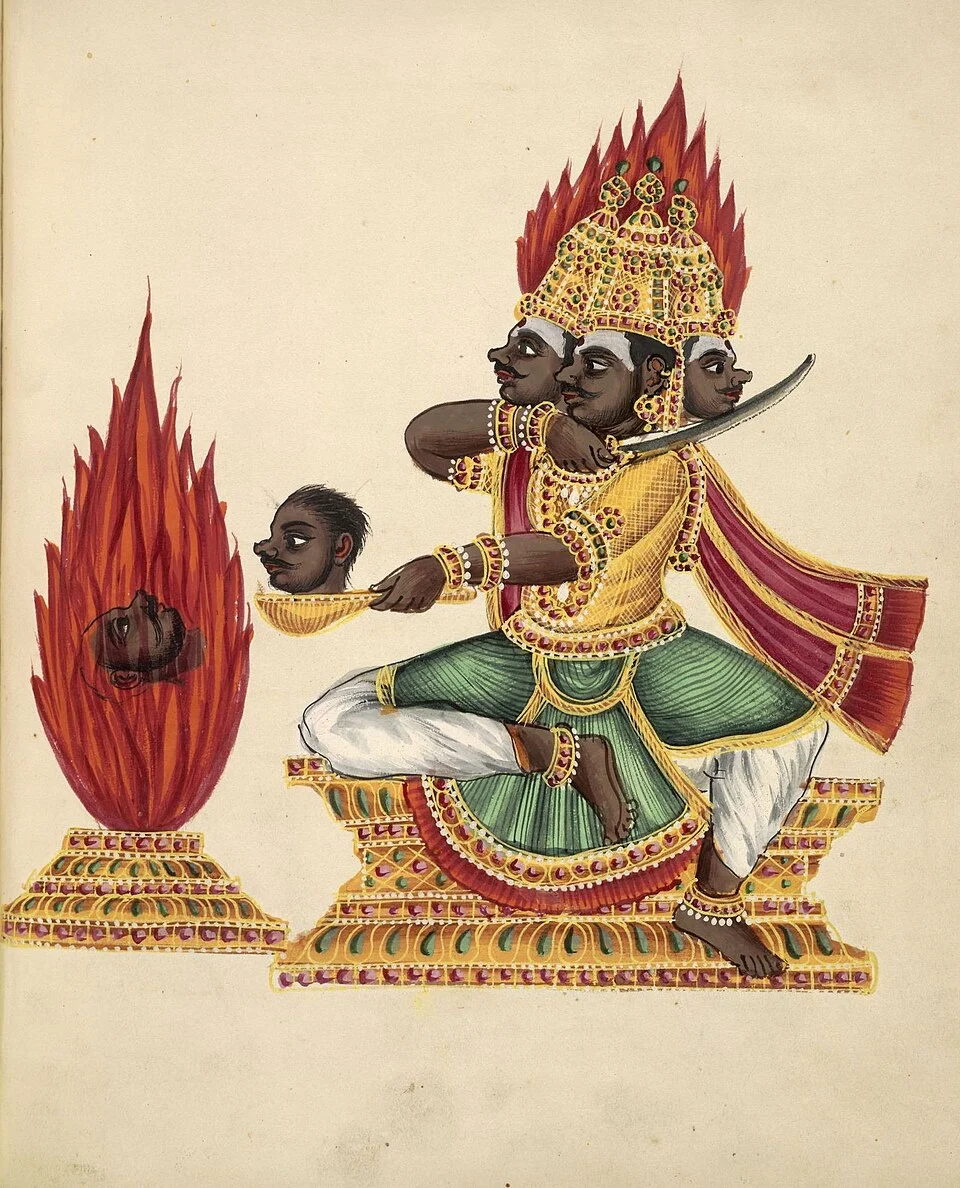
Image associated with the exact linked encyclopedia article; consult credited file description for its interpretation.
Overview
Rakshasa is a supernatural category whose members receive different bodies, histories, and outcomes in the directly read Ramayana episodes. In Manmatha Nath Dutt’s historical English translation of the Balakanda, Māricha is described as having large arms, a huge head, a capacious mouth, and an enormous body. His mother Tārakā comes from a yaksha family, showing that the narrative’s names do not create a simple taxonomy of unrelated animal species.
Section XXV recounts the family’s change of condition. After Sunda’s destruction, Tārakā and her son approach the sage Agastya in anger. She intends to devour him. Agastya curses Māricha to become a rakshasa and curses Tārakā to abandon her earlier shape for a terrible one. The following encounter calls her both yakshini and rakshasi in the translation. Those overlapping terms belong to the episode and should not be erased to make a modern classification tidier.
In section XXVI Tārakā raises thick dust and uses illusion to shower rocks upon Rāma and Lakshmana. She changes forms and disappears from view during the fight. The sage urges Rāma to act before evening, when the rakshasas become harder to control. Rāma ultimately kills her. These are narrated abilities and events attached to a named participant, not an anatomy or battle rule proven for every rakshasa across all literature.
Section XXX gives Māricha and Suvāhu another distinct encounter. They arrive with followers in the sky, displaying terrifying appearances and pouring blood upon a sacrificial altar. Rāma uses different weapons and gives the attackers different outcomes: Māricha is flung into the sea alive, Suvāhu is killed, and the remaining attackers are destroyed. The ritual is completed after the assault is stopped.
Together these passages support illusion, altered form, aerial action, destructive violence, familial relationships, and a curse-derived identity within this version. They do not establish that all members are mindless, equally evil, or identical in appearance. The historical translation is a reading witness to particular epic episodes; its English spellings and classifications should not replace comparison with Sanskrit recensions or later retellings.
A different collected Santal telling appears as The Killing of the Rakhas in Bompas’s 1909 volume. Its man-eater has emptied villages and waits near a ford, where Jhalka lures it with mirrors. Fascinated by its reflection and believing the man captures other Rakhas, it exposes itself to his axe. Jhalka takes ears, tongue and toes as proof of the kill. This episode emphasizes deception and recognition rather than aerial attack or shape-changing. The term Rakhas is retained as this English translation’s local narrative designation; the account does not establish that every detail belongs to the Sanskrit epic category, and it supplies no basis for importing Māricha’s enormous anatomy into this unnamed antagonist.
Other Santal accounts give the local Rakhas different outcomes. In The Monkey Nursemaid, an antagonist tries to reach seven children in a palm tree and is injured by knives their monkey guardian has fastened to its trunk. The monkey heals it using medicines, recited verses and blowing, while bargaining for equipment for the children. The final agreement includes seven horses but only two hogs, after the Rakhas objects to the original demand for seven. It promises not to eat the children or their parents, accompanies the return procession and shares the welcoming meal. Unlike the mirror-deceived Rakhas, it survives through negotiation.
In Fuljhari Raja, Lita seeks a flower that can restore his father’s sight. A Rakhas first proposes eating him, but its wife persuades it to welcome him as their lonely daughter’s husband. The daughter agrees to help her new husband and advises him to request a hair from her father when they leave. The flower restores the blind king’s sight, while the hair produces a golden palace when addressed. These are separate objects with separate effects. The household’s cooperation belongs to this telling; it does not make every Rakhas a benevolent donor or identify all their daughters with one person.
The Sons of the Kherohuri Raja instead describes sixteen hundred Rakhases swallowing a wedding company, including its animals. Chando lifts one bride out of danger, and she sends a parrot to summon her absent husband. He kills the attackers when they return, and they disgorge those they swallowed. Water wrung from a cloth restores the dead company to life; it does not revive the Rakhases. The rescued brothers subsequently wound their benefactor and abandon him. Chando and his unnamed wife heal this still-living prince, a different event from the earlier restoration of the dead. His eventual return makes him ruler over the frightened brothers. The complete ending preserves both the supernatural attack and the later human betrayal.
The Kingdom of the Ogres in Wilhelm and Martens’s 1921 Chinese Fairy Book offers a further, differently mediated comparison. Its editorial note applies the name Rakshas to the beings called ogres in the English narrative. A merchant named Su, from the place the edition calls Annam, is driven ashore near their cave dwellings. The first two beings he meets have spear-like teeth and luminous eyes, and initially threaten to eat him. His prepared food changes the encounter: he becomes their cook, gradually learns their language and is eventually allowed to move freely.
Su marries an unnamed young woman from the community, and affection develops between them. During a festival she helps obtain pearls for his necklace and speaks for him before their ruler. That ruler arrives with a violent storm and later departs upon it; the narrative does not assign this particular ability to every inhabitant. Su and his wife have two boys and a girl, explicitly described as human in form and unusually strong. Su later leaves secretly with one son, who receives the name Panther and rises in military service after their return to Annam.
Panther’s eventual search for the rest of the family includes a separate ogre who saves him after a shipwreck. The rescuer says Wo-Me is his former home, carries the boy’s boat rapidly through the sea and disappears before he can be thanked. He is not identified as Panther’s father or another relative. Panther then reunites with his mother and siblings and brings them home. The mother objects to Su’s unexplained departure and fears ridicule because of her appearance; those concerns are part of her represented perspective, rather than evidence that she is merely a hostile obstacle.
The remaining children are named Leopard and Ogrechild in this translation. Both become associated with exceptional martial skill, and the mother protects Leopard on campaign. The emperor rewards her courage with the title translated as The Superwoman. Thus a story beginning with threatened predation ends with family reunion and recognition of an ogress’s protective acts. Its closing editorial identification of these monsters with earlier inhabitants of Ceylon is prejudicial historical framing, not reliable evidence about a real population or the origin of the Sanskrit category. The tale is retained as a located literary comparison, with that unsupported identification kept separate.
Origins & earliest records
The selected work or object is a witness to this representation. Its date is not asserted to be the beginning of the tradition; textual layers and regional variants need separate review. The selected Dutt1891 Ramayana episodes, Bompas1909 Santal collection and Wilhelm/Martens1921 English retelling are distinct publication witnesses. The last book’s note supplies the Rakshas identification for its unnamed ogres; this review establishes neither that identification’s earlier textual source nor a first occurrence of the tradition.
Records & interpretation
The linked source and contextual bibliography support the stated motifs. Material objects document iconography; narratives document imagined encounters. Neither alone is zoological confirmation. Additional root review: complete LXXVI (The Monkey Nursemaid); LXXXI (Fuljhari Raja); LXXXIV (The Sons of the Kherohuri Raja) read from opening through ending in the selected English edition. Existing earlier-witness findings are retained; no original Santali manuscript collation is claimed. Complete The Kingdom of the Ogres, LVI pp189–196 and its final note independently read; English title/copyright and translator preface also inspected. The note’s equation with an actual population is not accepted as ethnographic or biological evidence. No underlying Chinese original for this episode was collated.
In the literature
“There is a Rakshasa named Rāvana, sprung from the line of Pulastya.”
Bālakāndam, section XX; paragraph beginning “Hearing the words of Viswāmitra, that best of monarchs remained insensible…” · Manmatha Nath Dutt
Viśvāmitra identifies Rāvaṇa’s Rakshasa identity and lineage.
“that Rakshasa of dreadful form daily frightens people.”
Bālakāndam, section XXIV; paragraph beginning “Then next morning which happened to be fine, those repressors of…” · Manmatha Nath Dutt
The preceding description identifies the frightening Rakshasa as Māricha, Tārakā’s son.
“they being deceitful warriors.”
Bālakāndam, section XX; paragraph beginning “Hearing the words of Viswāmitra, that best of monarchs remained insensible…” · Manmatha Nath Dutt
Daśaratha describes Rakshasas as deceptive warriors while objecting to Rāma’s departure.
Selected bibliography
Documented works and useful reading. This is not a list of every appearance.
- 01
The Ramayana, Volume 1: Balakandam and Ayodhyakandam
Dutt English translation; printed Balakandam title page 1891. Specific episodes in sections XXIV–XXVI and XXX directly read.
- 02
Dutt Ramayana, Balakandam sections XXIV–XXVI and XXX
Taraka, Maricha, and Suvahu episodes directly read in Dutt 1891; no universal rakshasa anatomy inferred.
- 03
Folklore of the Santal Parganas
XCV, The Killing of the Rakhas, pp. 286–289; full tale and preface directly read. Bodding/Murmu/Bompas mediation; individual oral narrator unspecified.
- 04
Folklore of the Santal Parganas: The Monkey Nursemaid
Complete tale LXXVI, pp. 232–234 independently read. Individual narrator unnamed in this witness; literary events remain source-specific.
- 05
Folklore of the Santal Parganas: Fuljhari Raja
Complete tale LXXXI, pp. 244–247 independently read. Individual narrator unnamed in this witness; literary events remain source-specific.
- 06
Folklore of the Santal Parganas: The Sons of the Kherohuri Raja
Complete tale LXXXIV, pp. 251–254 independently read. Individual narrator unnamed in this witness; literary events remain source-specific.
- 07
The Chinese Fairy Book — LVI: The Kingdom of the Ogres
Complete English tale pp189–196 and attached note read. The note, rather than each narrative sentence, labels the ogres Rakshas. Family roles and protective acts retained; prejudicial identification with real inhabitants rejected as factual evidence.
Family, evolution & connections
Su and the ogress’s children — Wilhelm/Martens LVI
Complete The Land of the Ogres narrative and note, pp.189–196. Article attachment follows the note’s Rakshas label, not a class-wide lineage.
Scroll sideways to see all branches. With a keyboard, focus the tree and use the arrow keys.
- Su and his unnamed ogress wife, joint parents
- Panther, son
- Leopard, son; married an official’s unnamed daughter
- Ogrechild, daughter; married Panther’s unnamed subordinate
Explicit married parents and two boys and one girl, later individually named. The mother and two later spouses are unnamed. The ogre rescuer and ruler are not assigned kinship. The note’s identification with a real Ceylon population is prejudicial editorial interpretation, excluded from the family facts; animal-like personal names are not biological species.
Su and his unnamed ogress wife
The narrative makes the merchant Su and the unnamed ogress a married pair. Its final editorial Rakshas label explains this article link; it does not establish a pedigree for all rakshasas or justify the note’s real-population identification.
Panther, Leopard and Ogrechild
The couple explicitly have two boys and one girl, later named Panther, Leopard and Ogrechild. These are human-form children within this tale, not zoological panthers and leopards.
Leopard’s wife and Ogrechild’s husband
Leopard marries an official’s unnamed daughter; Ogrechild marries one of Panther’s unnamed subordinates. Their separate marriages do not identify either spouse with the earlier rescuer or the ogres’ ruler.
Primary records and illustrations
The Rāmāyana, translated by Manmatha Nath Dutt
Volume 1, Bālakāndam; 1891 translation. Section XXX; attack on Viśvāmitra’s sacrifice
Exact section read in the published transcription; primary epic in historical translation. No separate historical image verified.
During the guarded sacrifice, Māricha and Suvāhu arrive with followers and use supernatural appearances in the sky. They shower blood over the altar. Rāma responds with different weapons: the first throws Māricha into the sea without killing him, while a later weapon kills Suvāhu and another destroys the remaining attackers. The episode gives named rakshasas different outcomes within one action, rather than treating the category as a single anonymous beast. Its threat concerns the disruption of a ritual in a particular narrative setting. The translated passage supports illusion, aerial arrival and violence here; it does not provide an anatomy that can be assigned to every rakshasa in the entire epic.
Located primary passages
Specific passages supporting details in this entry, grouped by their published witness.
Primary source witness
Calcutta, Deva Press, 1891, as the hosted title page states. Bālakāndam prose translation.
- Viśvāmitra identifies Rāvaṇa’s Rakshasa identity and lineage.
- Daśaratha describes Rakshasas as deceptive warriors while objecting to Rāma’s departure.
Historical translation or collector’s published version; not zoological evidence, a universal account or an assertion about all living communities.
Primary source witness
Calcutta, Deva Press, 1891, as the hosted title page states. Bālakāndam prose translation.
- The preceding description identifies the frightening Rakshasa as Māricha, Tārakā’s son.
Historical translation or collector’s published version; not zoological evidence, a universal account or an assertion about all living communities.
Encyclopedia background
An additional attributed reference, separate from the editorial profile above.
Read the open encyclopedia overview
Rakshasa (Sanskrit: राक्षस, pronounced [ɾɑːk.ʂɐ.s̪ɐ], romanized: rākṣasa; Pali: rakkhasa; lit. 'demon' or 'fiend') are a race of usually malevolent beings prominently featured in Hinduism, Buddhism, Jainism, and Indonesian folk Islam. They reside on Earth but possess supernatural powers, which they usually use for evil acts such as disrupting Vedic sacrifices or eating humans.
The term is also used to describe asuras, a class of power-seeking beings that oppose the benevolent devas. They are often depicted as antagonists in Hindu scriptures, as well as in Buddhism and Jainism. The feminine form of rakshasa is rakshasi (राक्षसी, IPA: [ɾɑːk.ʂɐ.s̪iː], rākṣasī).
Text from Wikipedia contributors, “Rakshasa”. CC BY-SA 4.0. Extracted introduction; formatting changed. Retrieved 5 October 2026. The source article may have changed since retrieval.
References
Sources supporting this profile. Linked pages have their own scope and editorial standards.
- Primary epic in translationThe RāmāyanaResearch access: 2026-10-05
- Secondary referenceRakshasa — contextual bibliographyResearch access: 2026-10-05
- Primary narrative in historical translationThe Rāmāyana, translated by Manmatha Nath Dutt — exact record or passageResearch access: 2026-10-05
- Historical translation of collected Santal narrativeBompas, The Killing of the Rakhas, XCVResearch access: 2026-10-05
- Historical translation of collected Santal narrativeBompas1909, LXXVI: The Monkey Nursemaid, pp. 232–234Research access: 2026-10-05
- Historical translation of collected Santal narrativeBompas1909, LXXXI: Fuljhari Raja, pp. 244–247Research access: 2026-10-05
- Historical translation of collected Santal narrativeBompas1909, LXXXIV: The Sons of the Kherohuri Raja, pp. 251–254Research access: 2026-10-05
- Historical English literary retelling; editorial identification distinguishedWilhelm/Martens1921 LVI: complete ogre-family narrative and editorial noteResearch access: 2026-10-05
Image credits
Reference illustrationRakshasa
Image associated with the exact linked encyclopedia article; consult credited file description for its interpretation.