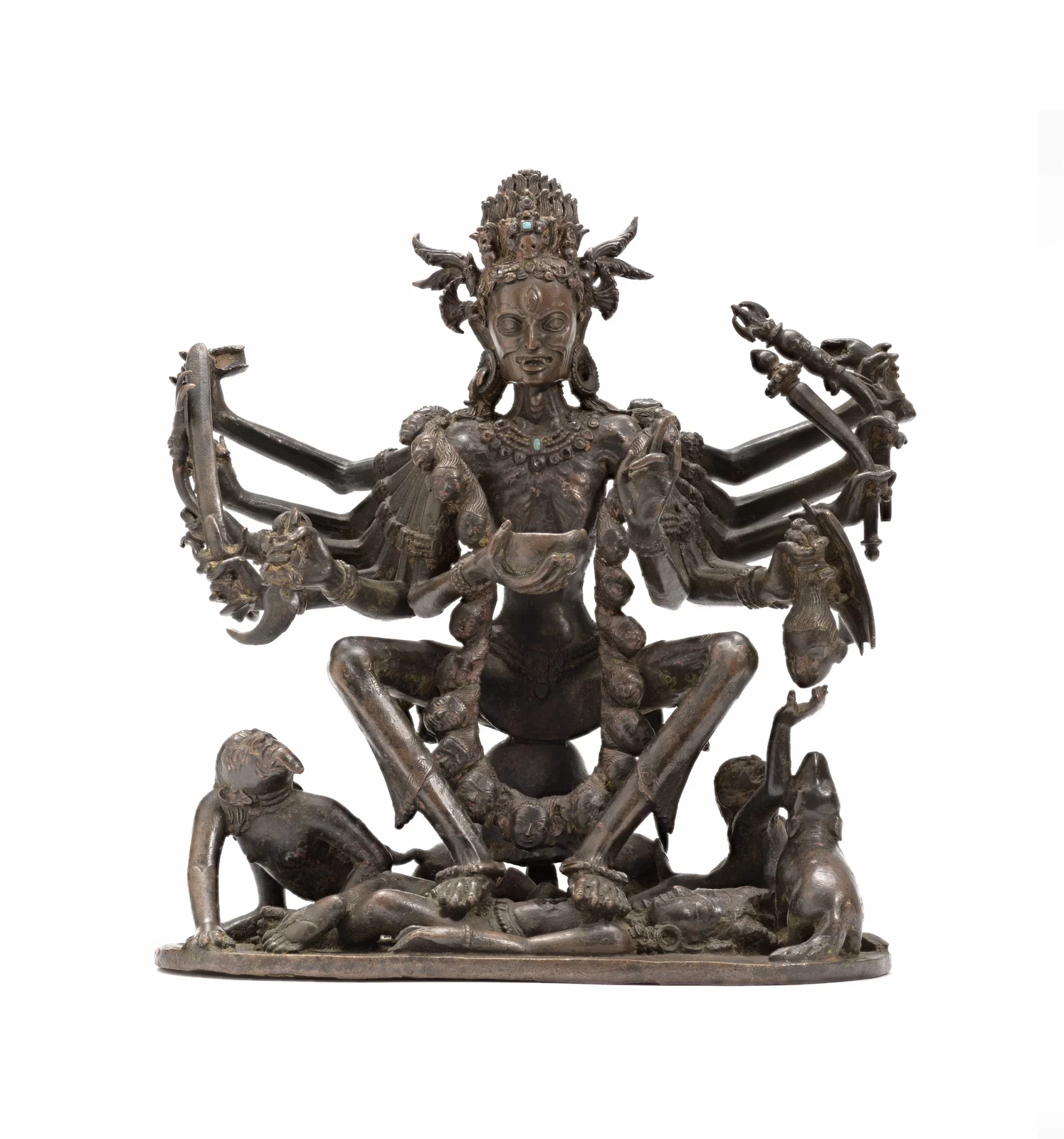
Copper sculpture of many-armed Chamunda above a reclining corpse, flanked near the base by two small humanlike ghouls; a jackal also sits at the right.
Nepal,14th century. LACMA identifies the two small attendants flanking Chamunda as piśācas. The central many-armed goddess and the jackal are separate figures; their anatomy is not attributed to the ghouls.
Overview
Piśāca is a hostile supernatural category directly named in Atharva-VedaBookV,hymn29. In the historical translation by William Dwight Whitney, edited by Charles Rockwell Lanman, the hymn addresses Agni as Jatavedas and invokes his restorative and destructive power. The beings are associated with consuming parts of a person and harming that person during eating, drinking or resting. The repeated aim is to defeat the hostile eater and restore the affected individual. This supplies a specific ritual context rather than a general cemetery-monster portrait.
Verse4 calls for Agni to attack the hostile being’s eyes, heart, tongue and teeth. Verse5 asks him to retrieve what the piśācas have taken, returning flesh and vital breath to the person’s body. Later verses seek bodily growth and continued life. These requests frame the affliction as loss followed by restoration. They do not offer a systematic anatomical description of every piśāca; named body parts appear within commands directed against an enemy. The hymn gives no fixed color, horns, wings or shape-shifting episode.
The contexts of injury extend across ordinary nourishment. Verses6–8 mention raw and cooked food, milk, prepared grain and drinking water. Verse9 includes harm by day or night, so darkness alone does not exhaust this witness’s setting. Verse10 characterizes the hostile being through flesh-eating, blood and damage to the mind, then invokes Agni, Indra’s thunderbolt and Soma against it. The closing verses offer fuel to Agni and demand that the eater abandon the person whose flesh it seeks. The ritual’s imagery should remain attributed to the hymn rather than turned into a documented biological or medical mechanism.
Whitney and Lanman’s edition also records textual variants and notes uncertainties in several translated terms. Those editorial discussions are distinct from the hymn’s own statements. A modern transcription of this historical scholarly edition supplies the present reading witness; it does not establish when every piśāca tradition began. The profile consequently retains the consuming, harming and expulsion motifs actually supported here, while leaving broader narrative courts, regional appearances and later possession stories for separately identified sources. This early ritual voice is more particular than an undifferentiated list of modern monster traits.
Origins & earliest records
South Asia; Atharva-VedaBookV,hymn29 ritual witness.
Records & interpretation
Identified primary passage directly read; sculpture and interpretive museum record distinguished where applicable.
Selected bibliography
Documented works and useful reading. This is not a list of every appearance.
- 01
Atharva-Veda Samhita, BookV,hymn29
Verses4–15; consuming, affliction, restoration and expulsion
- 02
Indian Myth and Legend: discussion of piśācas
Selected reading or object; bibliography is not exhaustive. Secondary links identify primary passages where a direct primary edition was not verified.
Family & connections
A source-supported family tree or inspiration record has not yet been compiled for this profile. Related reading below indicates a connection in subject matter, not a proven lineage or creative influence.
Primary records and illustrations
Atharva-Veda Samhita, Whitney translation and Lanman edition
Book V, hymn 29; historical English translation. Verses 4–10 and 12–15
Atharva-VedaV29 verses4–15 directly read in Whitney-Lanman 1905 historical translation; bodily consumption, food/drink contexts, day/night, restoration and invocations distinguished from editorial variant notes.
The hymn addresses Agni in a rite concerned with a person harmed by piśācas. It asks for what has been taken or consumed to be restored to the body, and names injury connected with different foods and drinking water. Later verses describe the hostile being through flesh-eating and blood-associated language, while invoking divine weapons against it. The closing requests turn again toward the person’s recovery and life. This is a specific ritual setting in which the creature category explains threatening loss and damage. It is not a neutral anatomical catalogue: the passage does not supply a standard face, number of limbs or cemetery silhouette. Its evidence concerns attributed harm and ritual response.
Encyclopedia background
An additional attributed reference, separate from the editorial profile above.
Read the open encyclopedia overview
Pishachas (Sanskrit: पिशाच, piśāca, IPA: [piɕaːt͡ɕɐ]) are flesh-eating demons or vampires from Indian religions, appearing in Hindu and Buddhist religions. Pishachas are malevolent beings who have often been referred to as the very manifestation of evil.
Text from Wikipedia contributors, “Pishacha”. CC BY-SA 4.0. Extracted introduction; formatting changed. Retrieved 5 October 2026. The source article may have changed since retrieval.
References
Sources supporting this profile. Linked pages have their own scope and editorial standards.
- Historical secondary overview citing primary passagesIndian Myth and Legend: discussion of piśācasResearch access: 2026-10-05
- Secondary referencePiśāca — contextual bibliographyResearch access: 2026-10-05
- Primary-text transcriptionAtharva-Veda Samhita, Whitney translation and Lanman edition — exact primary passageResearch access: 2026-10-05
Image credits
Historical sculpture photographCopper sculpture of many-armed Chamunda above a reclining corpse, flanked near the base by two small humanlike ghouls; a jackal also sits at the right.
Nepal,14th century. LACMA identifies the two small attendants flanking Chamunda as piśācas. The central many-armed goddess and the jackal are separate figures; their anatomy is not attributed to the ghouls.