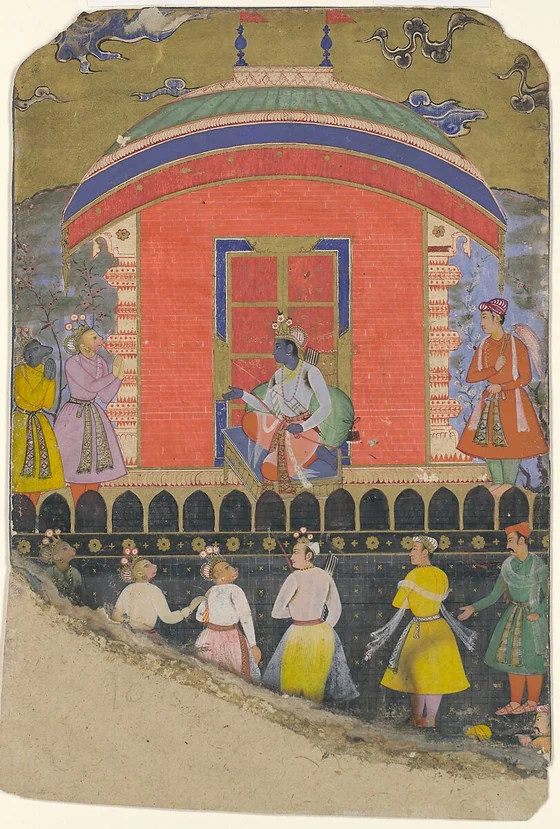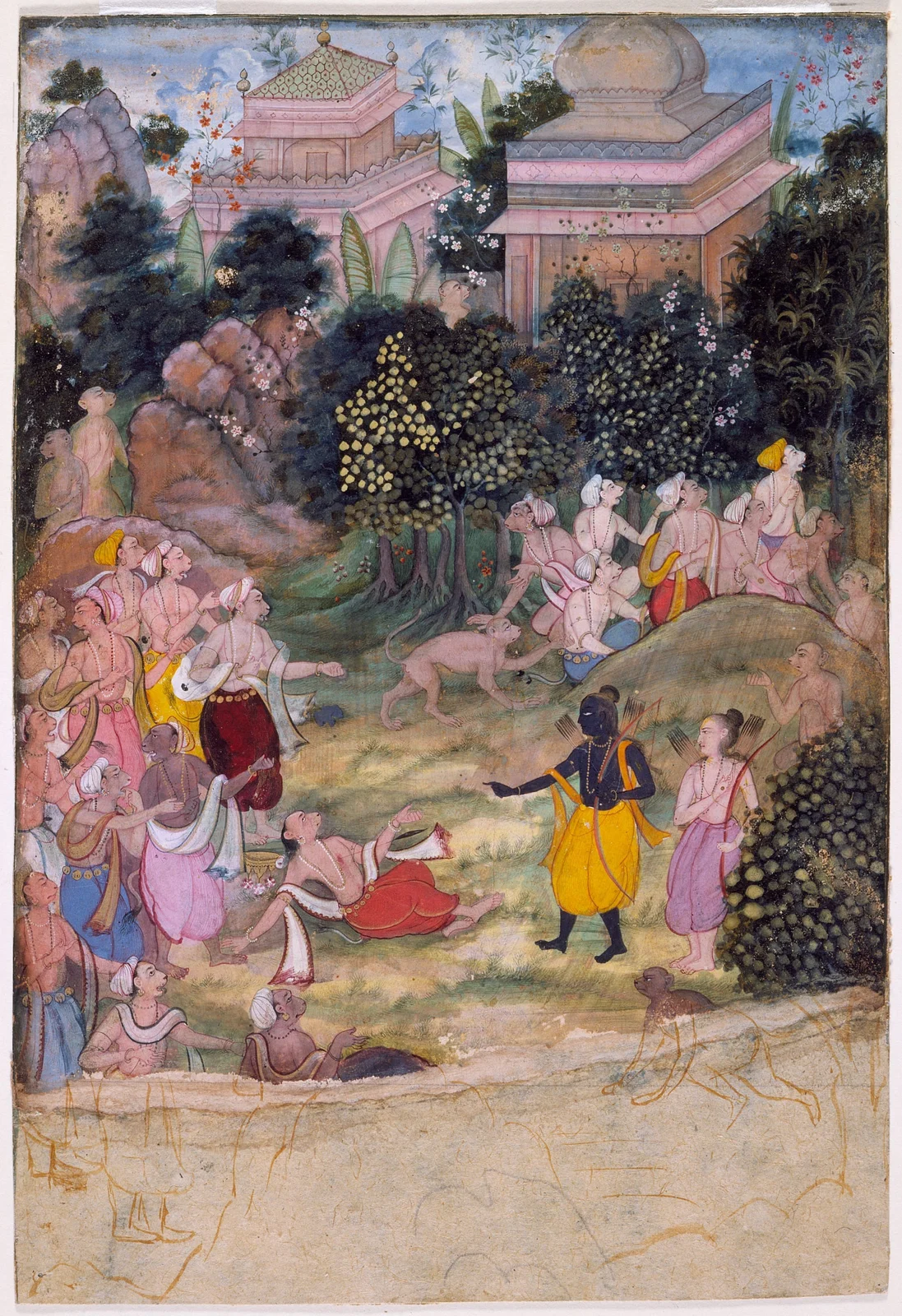
A reclining monkey king in red garments gestures toward dark-blue Rama with a bow, surrounded by distressed monkey courtiers amid trees and pink buildings; the damaged lower margin retains drawn outlines.
This circa 1595–1600 Mughal manuscript folio depicts the dying Vali before Rama. The museum identifies the surrounding monkeys’ agitated response; this is a separate illustrated Sanskrit manuscript witness, not an illustration commissioned for the later Griffith English translation.
Overview
The opening creation account makes Vali, rendered Bali by Griffith, Indra’s son and a protector of the forest hosts. Sugriva’s account describes him pursuing the demon Mayavi into a cave, after instructing his brother to watch the entrance. When blood emerges and Sugriva hears demons rather than Vali, he closes the cave and returns in grief.
Vali survives, breaks through the barrier and interprets the closure and Sugriva’s subsequent kingship as betrayal. He drives his brother into exile. Their opposed accounts remain part of the episode’s conflict, rather than an omniscient explanation that erases either speaker’s interpretation.
After Rama shoots him while he fights Sugriva, Vali questions the justice of being struck by a concealed outsider. The passage describes a broad chest, powerful arms, tawny eyes and a divine golden chain that still preserves his brilliance as he lies wounded. His accusation belongs to Vali’s speech within the epic’s argument.
Origins & earliest records
South Asian epic religious narrative
Records & interpretation
Actual Griffith canto passages directly read in the hosted complete edition.
Selected bibliography
Documented works and useful reading. This is not a list of every appearance.
- 01
The Ramayan of Valmiki
I.16; IV.9–10 and 17; printed title-page edition range, not epic composition date.
Family & connections
A source-supported family tree or inspiration record has not yet been compiled for this profile. Related reading below indicates a connection in subject matter, not a proven lineage or creative influence.
Primary records and illustrations
The Ramayan of Valmiki, Griffith translation
Hosted complete edition, printed title-page range 1870–1874. I.16; IV.9–10 and 17
Actual canto text read; speech attribution preserved. No creature illustration asserted.
References
Sources supporting this profile. Linked pages have their own scope and editorial standards.
- Historical primary epic translationGriffith, Ramayan — I.16; IV.9–10 and 17Research access: 2026-10-05
Image credits
Historical Ramayana narrative paintingA reclining monkey king in red garments gestures toward dark-blue Rama with a bow, surrounded by distressed monkey courtiers amid trees and pink buildings; the damaged lower margin retains drawn outlines.
This circa 1595–1600 Mughal manuscript folio depicts the dying Vali before Rama. The museum identifies the surrounding monkeys’ agitated response; this is a separate illustrated Sanskrit manuscript witness, not an illustration commissioned for the later Griffith English translation.