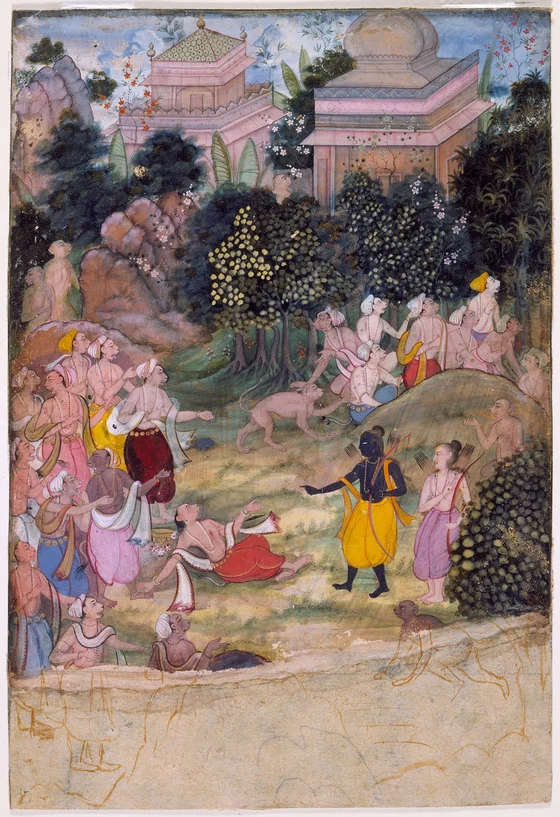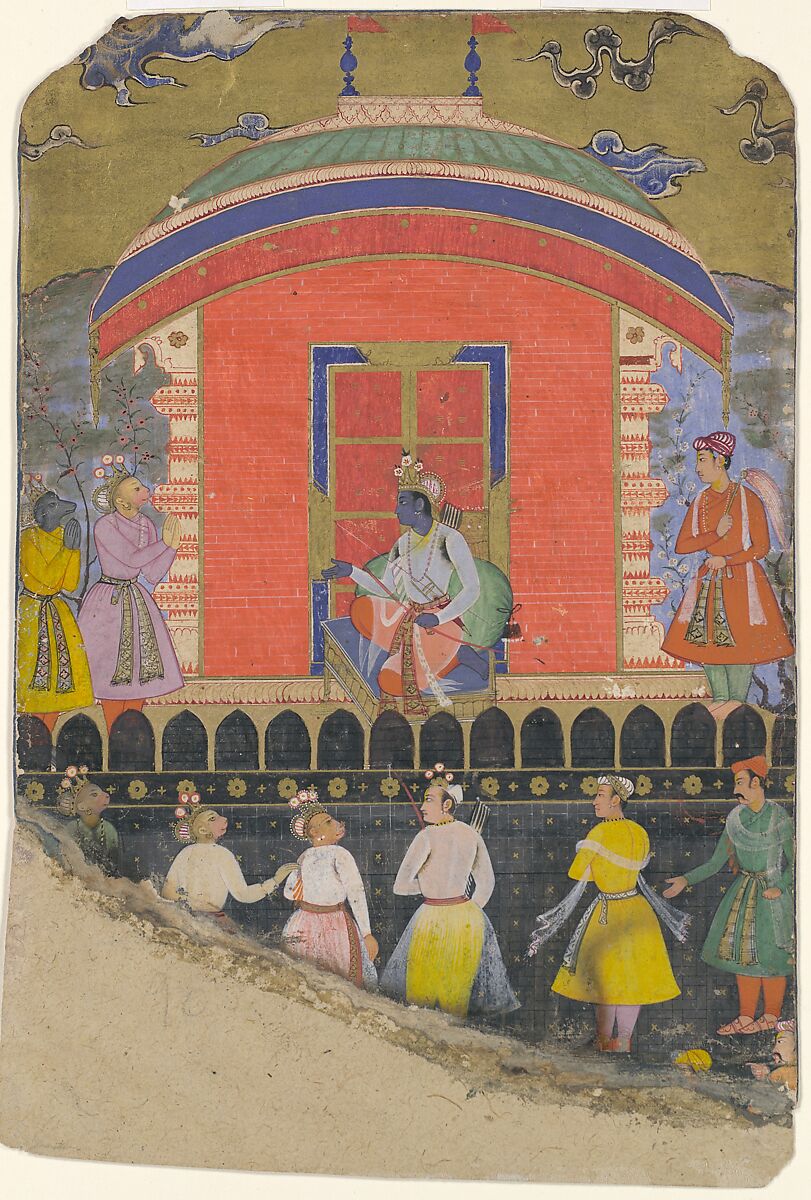
Jambavan, dark bear-headed king at far left in yellow robe, beside Sugriva before seated Rama, Ramayana folio ca.1605
Jambavan is the dark bear-headed figure in yellow at far left, beside the pink-robed monkey king Sugriva before Rama. The costumes and pavilion belong to this Mughal-era pictorial representation.
Overview
At the sea-crossing council, Jambavan says that in youth he circled Vishnu during the god’s cosmic stride. Age now limits his leap, and he declines to make the crossing himself. He also discourages Angada from risking the search party’s leader, then identifies Hanuman as its viable hope.
His recollection of Hanuman’s birth, childhood injury and divine protection prompts the younger hero’s great enlargement and leap. On the battlefield, Jambavan is later wounded, barely able to see and speak. Recognising Vibhishana by his voice, he first asks whether Hanuman survives.
The bear king explains that the army can recover if Hanuman lives, then gives precise directions toward a Himalayan mountain and its four healing herbs. Jambavan’s bodily weakness does not remove his narrative authority: memory, judgement and knowledge guide feats that he can no longer perform himself.
Origins & earliest records
South Asian epic religious narrative
Records & interpretation
Actual Griffith canto passages directly read in the hosted complete edition.
Selected bibliography
Documented works and useful reading. This is not a list of every appearance.
- 01
The Ramayan of Valmiki
IV.65–67; VI.74; printed title-page edition range, not epic composition date.
Family & connections
A source-supported family tree or inspiration record has not yet been compiled for this profile. Related reading below indicates a connection in subject matter, not a proven lineage or creative influence.
Primary records and illustrations
The Ramayan of Valmiki, Griffith translation
Hosted complete edition, printed title-page range 1870–1874. IV.65–67; VI.74
Actual canto text read; speech attribution preserved. No creature illustration asserted.
References
Sources supporting this profile. Linked pages have their own scope and editorial standards.
- Historical primary epic translationGriffith, Ramayan — IV.65–67; VI.74Research access: 2026-10-05
Image credits
Historical illustrationJambavan, dark bear-headed king at far left in yellow robe, beside Sugriva before seated Rama, Ramayana folio ca.1605
Jambavan is the dark bear-headed figure in yellow at far left, beside the pink-robed monkey king Sugriva before Rama. The costumes and pavilion belong to this Mughal-era pictorial representation.