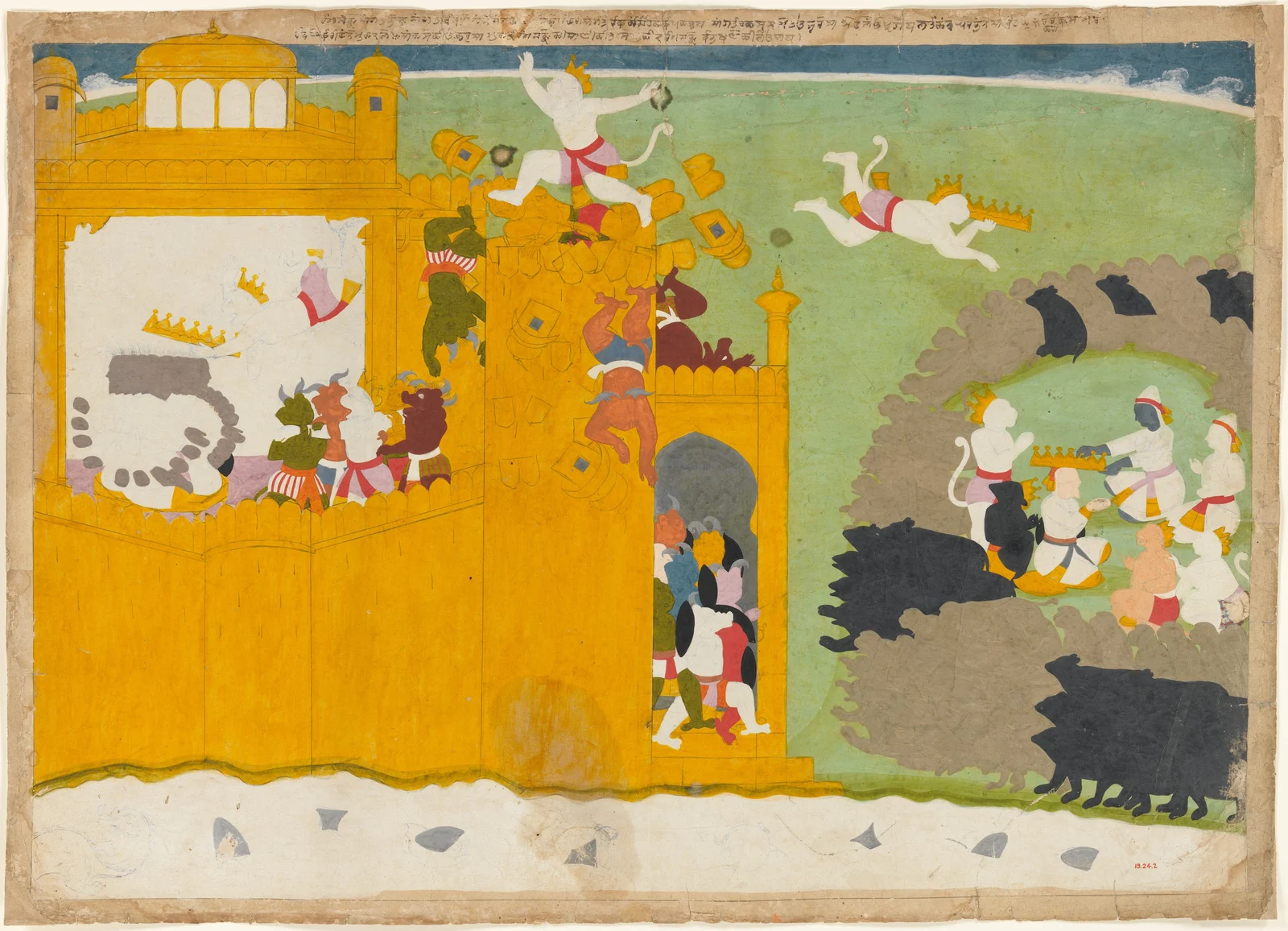
Partly finished painting showing white monkey warrior Angada repeatedly: inside a gold fortress, breaking its rampart, flying with a crown, and joining Rama’s group on the right; painted bears line the hillside.
Attributed to Manaku, ca.1725. Angada appears four times in this partly finished Siege of Lanka folio. The museum identifies the crown theft as an apparent artistic addition to the Ramayana episode; this is a pictorial telling, not universal anatomy.
Overview
At the search party’s council, Angada says he can attempt the leap toward Lanka but doubts his ability to return. Jambavan rejects the offer because the prince’s leadership is essential to the expedition. Angada replies that failing the mission would leave the company without hope.
The scene identifies him as Vali’s son and balances daring against responsibility for the group. At the later crossing, Sugriva orders Angada to support Lakshmana while Hanuman carries Rama. These are specific epic roles, rather than powers assigned indiscriminately to every vanara.
Angada becomes the vanaras’ defender when Vajradanshtra’s archery drives them back. The ensuing duel develops through changing weapons: his first thrown tree is stopped by arrows, a rock destroys the chariot, and a larger mass of stone temporarily fells the captain. Wounded in the thigh by the captain’s mace, Angada continues with fists and then with sword and shield. Both warriors collapse from exhaustion and blood loss before Angada recovers enough to behead his opponent.
Sugriva later sends him against Narantaka’s mounted charge. Angada faces the rider without a carried weapon, survives a dart that breaks against his chest and kills the horse with a blow. Narantaka briefly stuns him by striking his head, but Angada recovers and kills the prince with his fist. The victory brings a new danger: Devantaka, Trisiras and Mahodara attack together. Hanuman and Nila come to his aid. These battles present endurance and dependence on allies together, rather than an effortless or uniformly invulnerable hero.
Origins & earliest records
South Asian epic religious narrative
Records & interpretation
Actual Griffith canto passages directly read in the hosted complete edition.
Selected bibliography
Documented works and useful reading. This is not a list of every appearance.
- 01
The Ramayan of Valmiki
IV.65; VI.22; printed title-page edition range, not epic composition date.
- 02
The Ramayan of Valmiki — further episodes
VI.53–54; VI.69–70; complete cited passages directly read.
Family & connections
A source-supported family tree or inspiration record has not yet been compiled for this profile. Related reading below indicates a connection in subject matter, not a proven lineage or creative influence.
Primary records and illustrations
The Ramayan of Valmiki, Griffith translation
Hosted complete edition, printed title-page range 1870–1874. IV.65; VI.22
Actual canto text read; speech attribution preserved. No creature illustration asserted.
References
Sources supporting this profile. Linked pages have their own scope and editorial standards.
- Historical primary epic translationGriffith, Ramayan — IV.65; VI.22Research access: 2026-10-05
- Historical primary epic translationGriffith, Ramayan — VI.53–54; VI.69–70Research access: 2026-10-05
Image credits
Historical narrative paintingPartly finished painting showing white monkey warrior Angada repeatedly: inside a gold fortress, breaking its rampart, flying with a crown, and joining Rama’s group on the right; painted bears line the hillside.
Attributed to Manaku, ca.1725. Angada appears four times in this partly finished Siege of Lanka folio. The museum identifies the crown theft as an apparent artistic addition to the Ramayana episode; this is a pictorial telling, not universal anatomy.