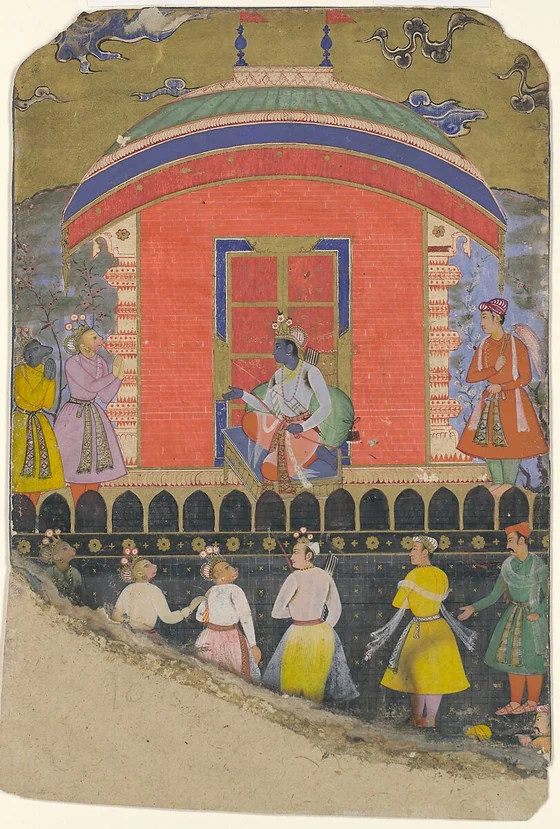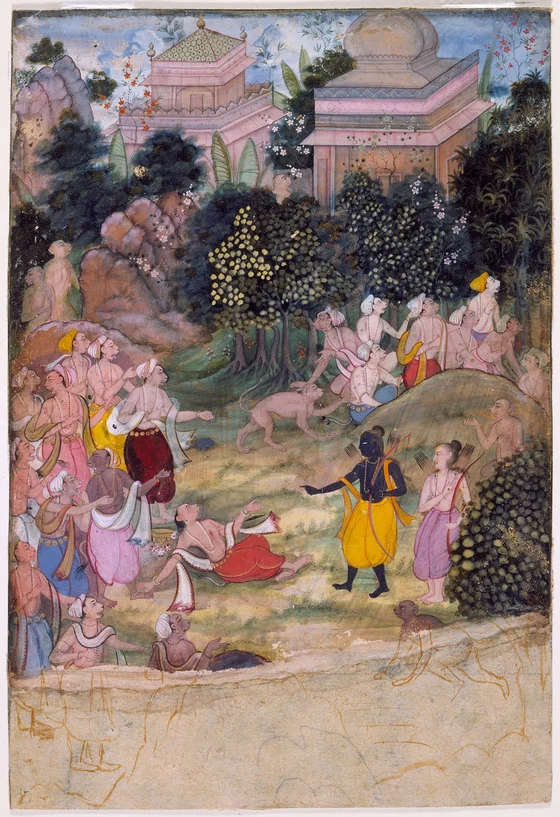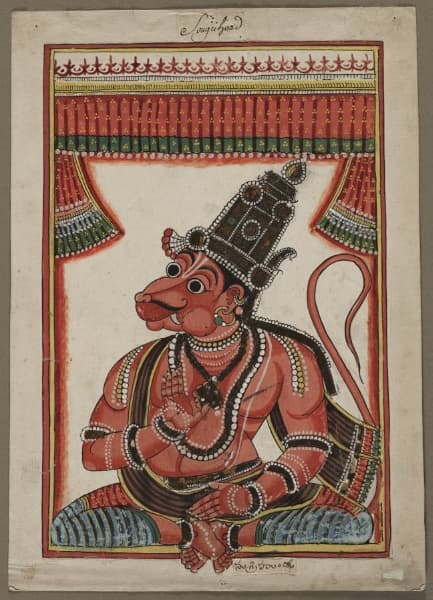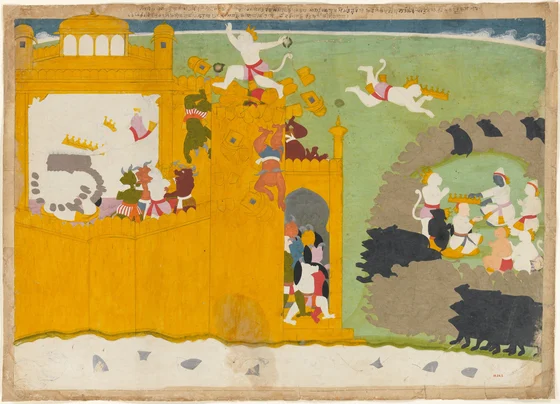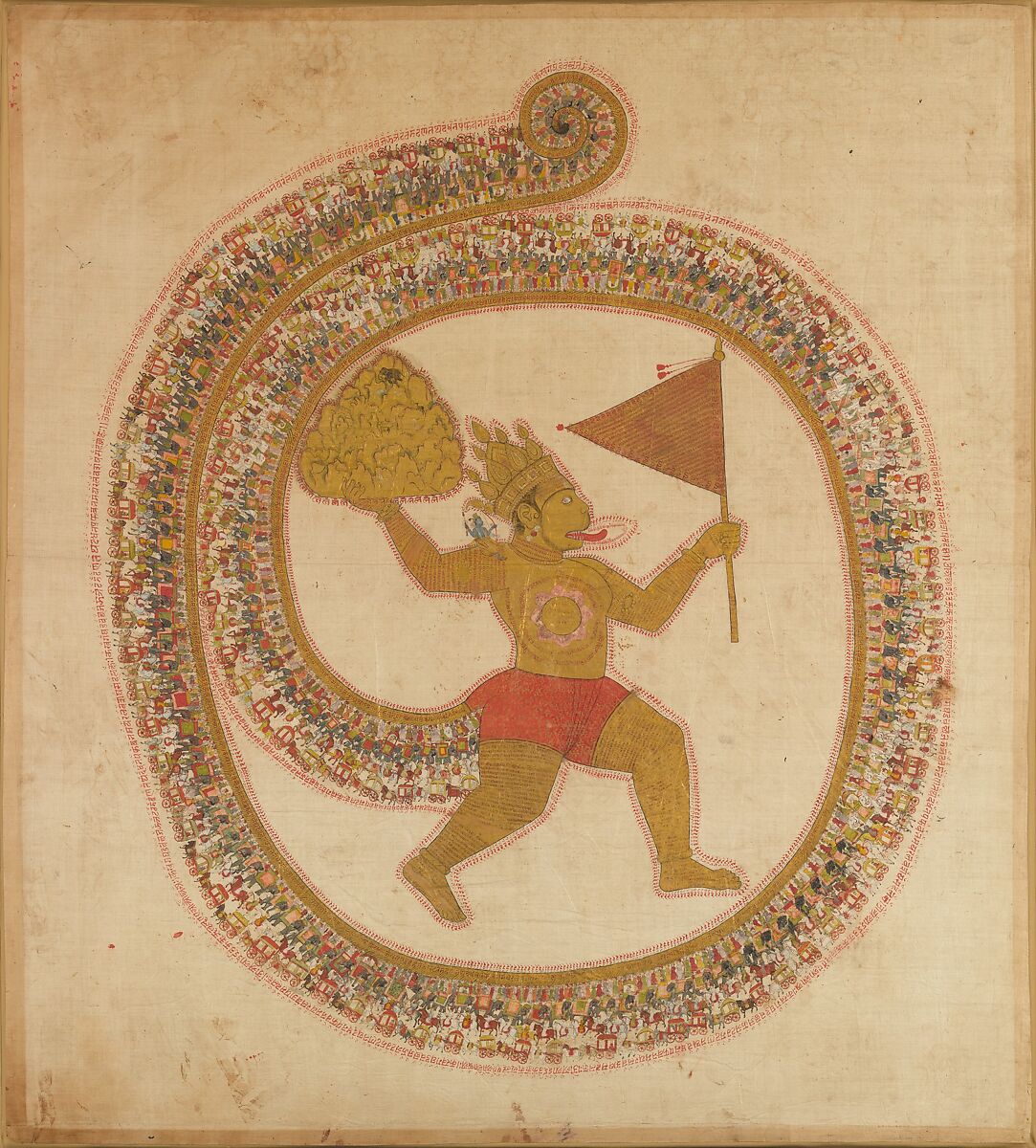
Hanuman carrying the medicinal mountain, anonymousRajasthan paintingca1800
Ca1800 Rajasthan devotional interpretation. Central Hanuman holds the medicinal peak and a banner; his looping tail carries the army. Tiny shoulder Rama is curator-identified. Met record labels this photograph Public Domain and permits unrestricted reuse. Museum57.70.6, donorEdwardM.Bratter is not painter.
Overview
Griffith’s Ramayana presents Hanumān as the Wind’s son and a leader among the vanaras created to assist Rama. Jambavan recalls his childhood leap toward the rising Sun, mistaken for fruit, and the thunderbolt that injures his cheek. The Wind’s withdrawal following the injury leads the gods to grant protections to the child. This is the selected epic account, not a date for the beginning of Hanuman worship.
When the search party reaches the sea, Jambavan calls on Hanuman’s strength and knowledge. He enlarges his body and leaps toward Lanka. The journey includes Mainaka’s offered rest, Surasa’s test and Simhika’s attempt to seize his shadow. His escape from Surasa combines an immense expansion with a sudden tiny form that enters and leaves her mouth, fulfilling the requirement without becoming her meal.
In the medicinal-herb episode, the wounded Jambavan treats Hanuman’s survival as the army’s remaining hope. Four luminous plants can remove arrows, restore life, heal wounds and recover bodily colour. When they hide from Hanuman, he tears off the mountain’s summit and carries it to the battlefield. Its fragrant herbs restore Rama, Lakshmana and the wounded or fallen vanaras. The scene joins immense physical power with a specific rescue task and should not be reduced to an ordinary monkey portrait.
At the walls of Lanka, Hanuman also reasons about concealment. He judges an open approach dangerous, waits until sunset, and reduces himself to the size of a cat before entering. The city’s guardian detects him despite that precaution. After she strikes his throat, he knocks her down; she subsequently recognises his victory as the omen Brahma had foretold. The sequence combines deliberate planning, bodily transformation and a confrontation with the personified city.
In the later battle against Dhumraksha, Hanuman first uses a rock to destroy the commander’s chariot. The rakshasa escapes that strike and wounds Hanuman’s face with a mace, but Hanuman then kills him with a mountain peak. His superhuman strength does not prevent the narrative from describing wounds and momentary setbacks.
Origins & earliest records
South Asian epic religious narrative
Records & interpretation
Actual Griffith canto passages directly read in the hosted complete edition.
Selected bibliography
Documented works and useful reading. This is not a list of every appearance.
- 01
The Ramayan of Valmiki
I.16; IV.66–67; V.1; VI.74; printed title-page edition range, not epic composition date.
- 02
The Ramayan of Valmiki — further episodes
V.2–3; VI.52; complete cited passages directly read.
Family & connections
A source-supported family tree or inspiration record has not yet been compiled for this profile. Related reading below indicates a connection in subject matter, not a proven lineage or creative influence.
Primary records and illustrations
The Ramayan of Valmiki, Griffith translation
Hosted complete edition, printed title-page range 1870–1874. I.16; IV.66–67; V.1; VI.74
Actual canto text read; speech attribution preserved. No creature illustration asserted.
References
Sources supporting this profile. Linked pages have their own scope and editorial standards.
- Historical primary epic translationGriffith, Ramayan — I.16; IV.66–67; V.1; VI.74Research access: 2026-10-05
- Historical primary epic translationGriffith, Ramayan — V.2–3; VI.52Research access: 2026-10-05
Image credits
Historical illustrationHanuman carrying the medicinal mountain, anonymousRajasthan paintingca1800
Ca1800 Rajasthan devotional interpretation. Central Hanuman holds the medicinal peak and a banner; his looping tail carries the army. Tiny shoulder Rama is curator-identified. Met record labels this photograph Public Domain and permits unrestricted reuse. Museum57.70.6, donorEdwardM.Bratter is not painter.