Útgarða-Loki
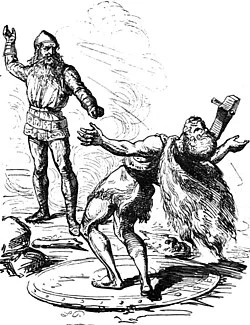
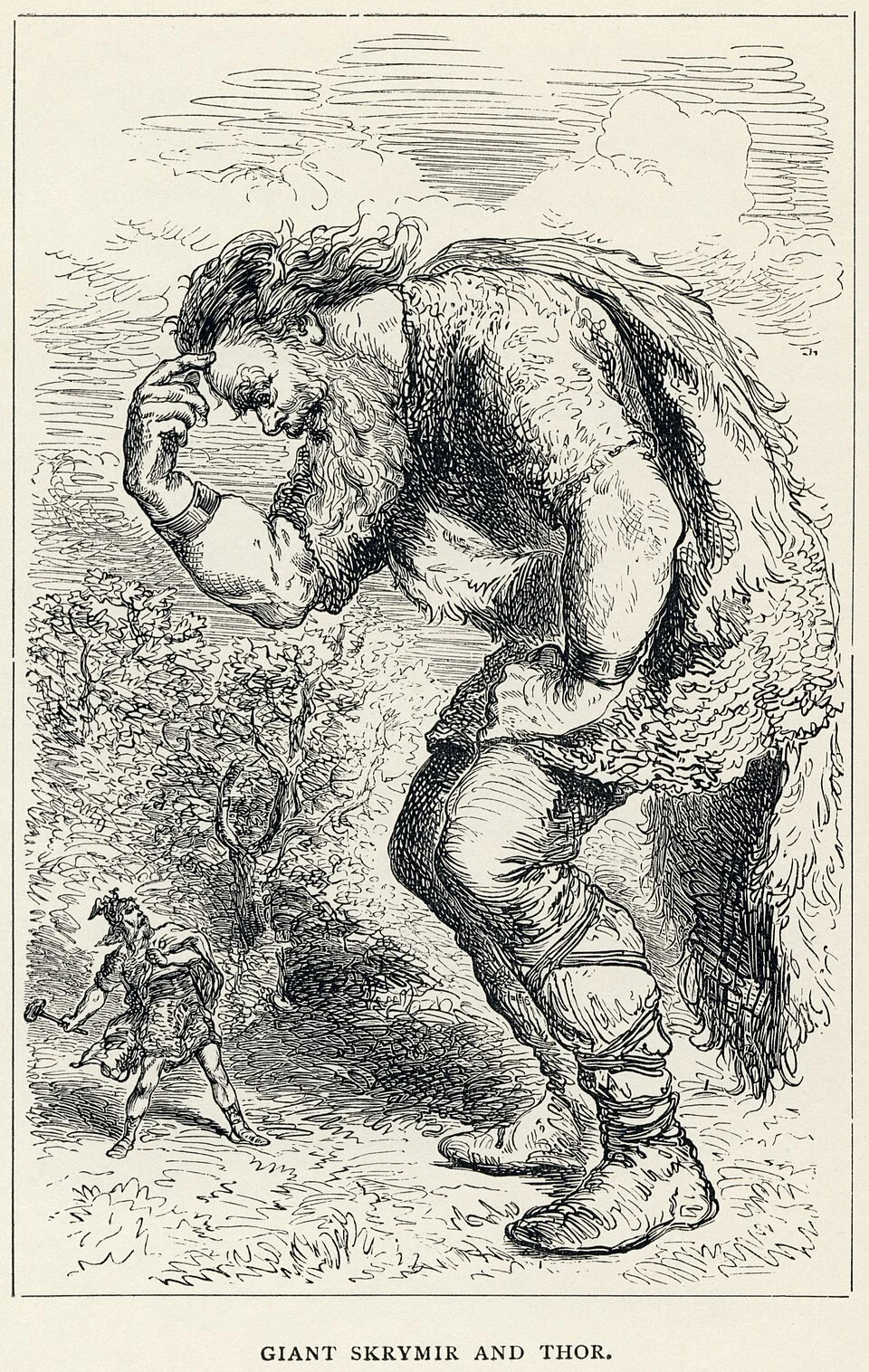
Louis Huard historical illustration of Giant Skrymir and Thor; the narrative identifies Skrymir as the guise of Utgarda-Loki. Published interpretation of that episode.
Overview
Before reaching Útgarðr, the travellers shelter inside what proves to be the giant Skrýmir's glove. Thor later strikes the sleeping giant with his hammer, but each blow seems barely noticed. At the stronghold, its ruler stages humiliating tests: Loki cannot out-eat Logi, Þjálfi cannot outrun Hugi, and Thor cannot empty a horn, raise a cat fully or defeat an old woman.
After escorting the visitors out, Útgarða-Loki explains the disguises. Logi was fire, Hugi was thought, the horn reached the sea, the cat was Jörmungandr and the wrestler was old age. The hammer blows had struck a concealed mountain. Thor's apparent failures actually display astonishing power, frightening the ruler. When Thor reaches for his hammer, the stronghold disappears. The story's deception is therefore exposed within the account, rather than left as straightforward evidence of weak gods.
Origins & earliest records
The early-thirteenth-century Prose Edda supplies the selected account, inspected in Anderson's 1901 edition of his 1879 translation. The narrator identifies the ruler with the earlier Skrýmir encounter through the final explanation. This profile retains that connection and does not confuse Útgarða-Loki with the visiting god Loki merely because their names share an element.
Records & interpretation
The account documents glove-sized shelter, staged contests and their eventual reinterpretation as illusions. Those are literary evidence for a giant illusion-maker and the story's construction. They are not measurements of a historical giant or independent confirmation of a disappearing fortress, and the disclosed disguises must not be catalogued as unrelated animal species.
In the literature
“Know, then, that I have deceived you with illusions.”
Fooling of Gylfe, chapter XIV, §§46–48; printed p. 125 · Rasmus B. Anderson
Utgard-Loke explains why the visitors appeared to lose his contests.
Selected bibliography
Documented works and useful reading. This is not a list of every appearance.
- 01
The Younger Edda
Fooling of Gylfe, chapter XIV, §§46–48, pp. 115–127. Selected inspected witness; bibliography is not exhaustive.
- 02
The Younger Edda — Fooling of Gylfe, chapter XIV, §§46–48
Chicago: Scott, Foresman and Company, 1901 selected edition; translation copyright 1879 and preface September 1879 appear in the inspected text. Rasmus B. Anderson’s English translation of the medieval Prose Edda, traditionally associated with Snorri Sturluson. The edition preserves different spelling conventions and has its own chapter and numbered-section sequence.
Family & connections
A source-supported family tree or inspiration record has not yet been compiled for this profile. Related reading below indicates a connection in subject matter, not a proven lineage or creative influence.
Located primary passages
Specific passages supporting details in this entry, grouped by their published witness.
The Younger Edda — Fooling of Gylfe, chapter XIV, §§46–48
Chicago: Scott, Foresman and Company, 1901 selected edition; translation copyright 1879 and preface September 1879 appear in the inspected text. Rasmus B. Anderson’s English translation of the medieval Prose Edda, traditionally associated with Snorri Sturluson. The edition preserves different spelling conventions and has its own chapter and numbered-section sequence.
- The travellers sleep in an enormous glove, fail to untie a provision bag and strike the seeming giant Skrymer. Utgard-Loke later identifies this preliminary encounter as his own illusion; no independent Skrymer subject is inferred from this account.
Fooling of Gylfe, chapter XIV, §§46–48; §46, pp. 115–119; Skrymer journey
- Loki loses an eating contest, Thjalfe loses races, and Thor fails to empty the horn, fully lift the cat or overcome the old woman Elle; they nevertheless receive hospitality overnight.
Fooling of Gylfe, chapter XIV, §§46–48; §47, pp. 119–125; hall contests
- Utgard-Loke reveals wildfire, thought, sea, Midgard-serpent and old age behind the contests and the deflected hammer blows, then disappears along with his hall as Thor attempts retaliation.
Fooling of Gylfe, chapter XIV, §§46–48; §48, pp. 125–127; revelation and vanished hall
Complete selected prose episodes read; quoted poetic extracts inspected but not used to invent earliest dates or a modern standardized taxonomy. Section numbers belong to this 1901 translation and can differ from other editions. Translator’s introductory racial and theological interpretations are not treated as source narrative.
Encyclopedia background
An additional attributed reference, separate from the editorial profile above.
Read the open encyclopedia overview
In Norse mythology, Útgarða-Loki (Anglicized as Utgarda-Loki, Utgard-Loki, and Utgardsloki) is the ruler of the castle Útgarðr in Jötunheimr. He is one of the jötnar and his name means literally "Loki of the Outyards" or "Loki of the Outlands", to distinguish him from Loki. He was also known as Skrýmir or Skrymir.
Text from Wikipedia contributors, “Útgarða-Loki”. CC BY-SA 4.0. Extracted introduction; formatting changed. Retrieved 5 October 2026. The source article may have changed since retrieval.
References
Sources supporting this profile. Linked pages have their own scope and editorial standards.
- Primary textAnderson's Younger Edda: Fooling of Gylfe, chapter XIV, §§46–48, pp. 115–127Research access: 2026-10-05
Image credits
Historical illustrationÚtgarða-Loki
Louis Huard historical illustration of Giant Skrymir and Thor; the narrative identifies Skrymir as the guise of Utgarda-Loki. Published interpretation of that episode.