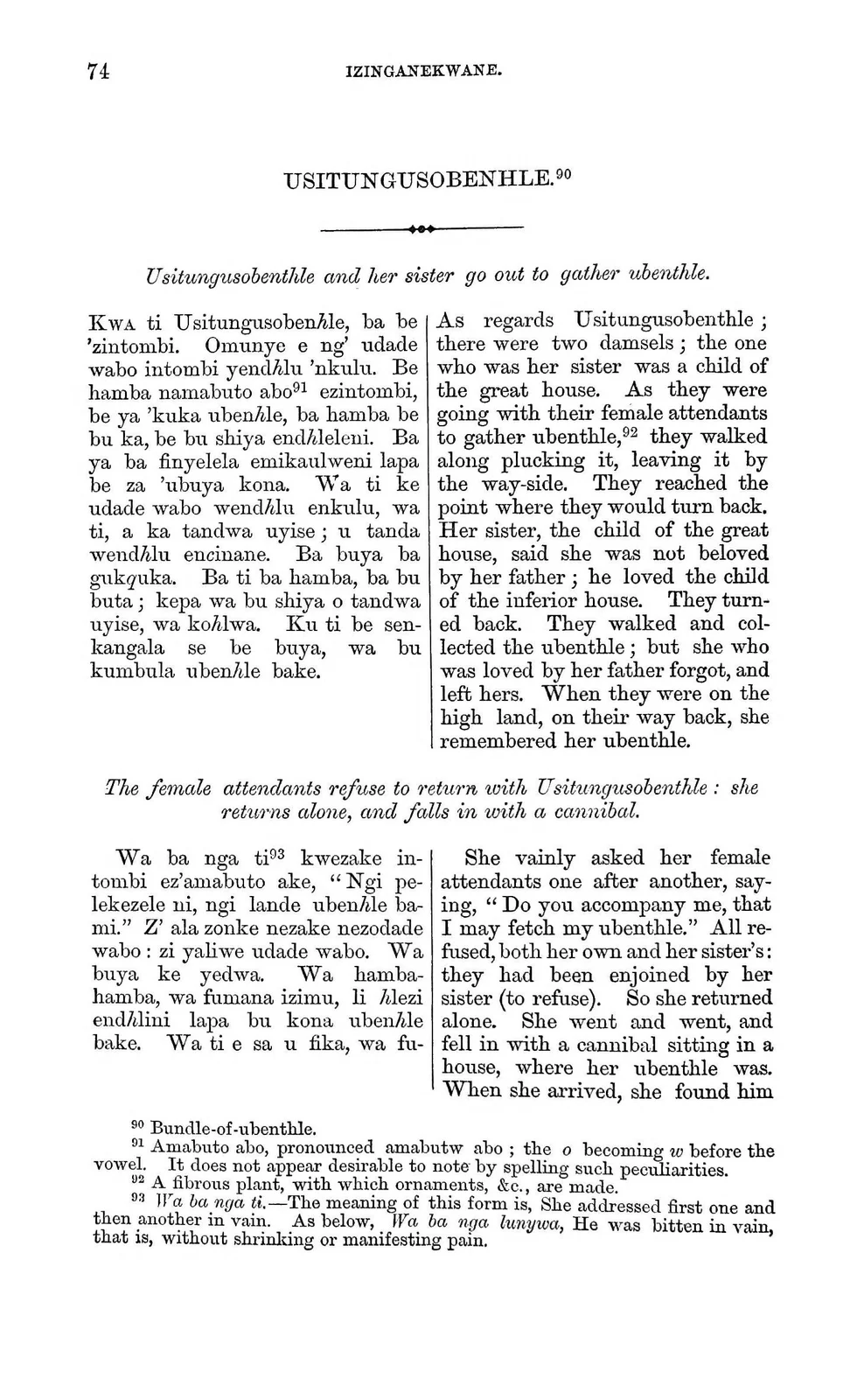
Usitungusobenthle in Callaway’s Two Tales: documentary text witness, Callaway 1868, printed page 74; documentary source-page facsimile
Opening of the first Usitungusobenthle tale; princess and sister gather ubenthle before their cannibal encounter. Individually inspected original bilingual Zulu/English scanned page; documentary text, no creature illustration claimed. Physical edition 1868; translator/editor distinguished from traditional narrators. Public-domain publication and expired Callaway lifetime.
Overview
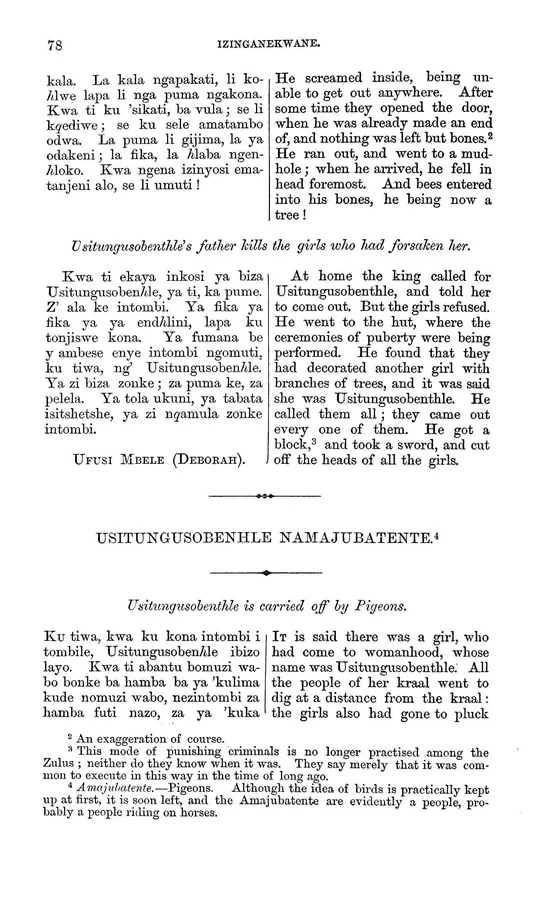
In Ufusi Mbele’s first tale, Usitungusobenthle is a king’s favoured daughter gathering ubenthle, a fibrous plant, with her sister and attendants. She leaves her bundles behind and returns alone because nobody will accompany her. A cannibal captures her in a bag and offers its singing voice as entertainment to her brothers. Her complaint about abandonment makes them recognize her, and they direct the captor toward the family home.
Her father sends him for water with a leaking vessel, giving time to release her and replace her with biting creatures. The substitution turns the bag against its owner rather than making Usitungusobenthle a permanently transformed animal. The family also discovers that the girls concealed her disappearance through a false account. The English narration leaves the captor reduced to bones, then has him run into a mud-hole and become a tree into whose bones bees enter. At home the father discovers another girl decorated to impersonate his daughter and beheads all the girls who concealed her disappearance. Callaway prints Ufusi Mbele’s name with Deborah; that contributor credit belongs to this first witness.
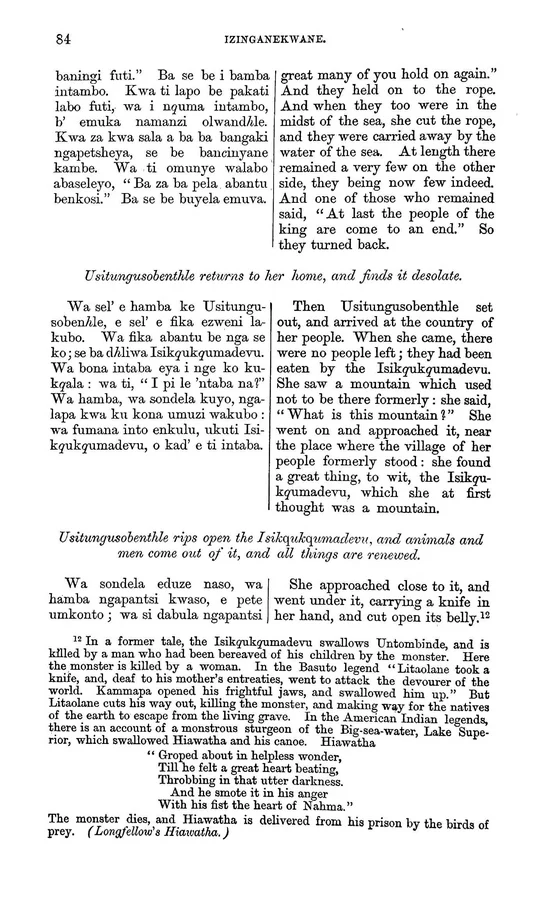
Ulutuli Dhladhla’s separate tale begins when Amajubatente fly away with a girl bearing the same name. She becomes their queen and has three children. The account moves from abducting birds to a household with human hunters, without explicitly narrating each form change. During a hunting expedition she has the children feign sickness and return home, then escapes with them. At the sea she names herself and commands the water to divide. She and the children pass through, while her pursuers remain across the water. She offers a rope crossing, cuts it repeatedly when groups attempt to follow and finally defeats the diminished army.
At home she finds the community gone and a new mountain-like bulk at its former site: Isikqukqumadevu has swallowed the inhabitants. She cuts its belly from beneath. A fowl, person, bullock, dog, goat and sheep emerge, followed by the other captives, greeting their renewed view of the world. Houses are rebuilt. This rescue completes the second witness; it is not appended as an undocumented later event in Deborah’s first account. The repeated name is therefore indexed through two separately credited stories.
Origins & earliest records
The selected bilingual account credits Ufusi Mbele (Deborah) and, for the separate second tale, Ulutuli Dhladhla (Usetemba). Callaway supplies its English translation and comparative notes. The printed credit is retained; his proposed historical explanations are distinct from the narrated events.
Records & interpretation
Complete selected bilingual narrative and closing contributor credit read: Usitungusobenthle, pp. 74–78, credit Ufusi Mbele (Deborah); Usitungusobenthle and the Amajubatente, pp. 78–85, credit Ulutuli Dhladhla (Usetemba).
In the literature
“was taken out by her father”
Usitungusobenthle, two distinct tales, printed p.76 · Henry Callaway
The princess is rescued from the cannibal’s bag in the first tale.
Selected bibliography
Documented works and useful reading. This is not a list of every appearance.
- 01
Nursery Tales, Traditions, and Histories of the Zulus, in Their Own Words, volume I
Usitungusobenthle, pp. 74–78, credit Ufusi Mbele (Deborah); Usitungusobenthle and the Amajubatente, pp. 78–85, credit Ulutuli Dhladhla (Usetemba).
- 02
Nursery Tales, Traditions, and Histories of the Zulus — Usitungusobenthle, two distinct tales
HenryCallaway, Nursery Tales, Traditions, and Histories of the Zulus, in Their Own Words, with a Translation into English, and Notes, VolumeI, Springvale,Natal:JohnA.Blair1868; bilingual Princeton scan. Printed pages and individual signatures retained; editorial English notes distinguished from attributed account. Full selected English narratives read in cached OCR, with named page pixels independently checked.
Family & connections
A source-supported family tree or inspiration record has not yet been compiled for this profile. Related reading below indicates a connection in subject matter, not a proven lineage or creative influence.
Located primary passages
Specific passages supporting details in this entry, grouped by their published witness.
Nursery Tales, Traditions, and Histories of the Zulus, in Their Own Words, volume I
HenryCallaway, Nursery Tales, Traditions, and Histories of the Zulus, in Their Own Words, with a Translation into English, and Notes, VolumeI, Springvale,Natal:JohnA.Blair1868; bilingual Princeton scan. Printed pages and individual signatures retained; editorial English notes distinguished from attributed account. Full selected English narratives read in cached OCR, with named page pixels independently checked.
- A favoured princess’s jealous sister causes attendants to leave her alone when she returns for gathered plants. A cannibal puts her in a bag; her brothers identify her voice, take him home and arrange recognition by her parents. Her father sends him to fetch water with a deliberately leaking calabash and substitutes biting animals for the girl. The trapped cannibal is reduced to bones yet runs into a mud-hole and becomes a bee-inhabited tree; the father kills the deceiving girls.
Usitungusobenthle, complete printed pp.74–78, signature UfusiMbele(Deborah)
- In the second separately credited tale the heroine is abducted by flying Amajubatente, marries their king and has three children. She escapes with them by feigned illness and defeats a pursuing army at the sea through repeated rope-cutting. Returning to her emptied home, she mistakes a swallowing monster for a new mountain, opens its belly with a knife and restores people and animals.
Contradictory bodily ending is kept as narrative rather than silently rationalised. No song or rite description excerpted. This Ufusi tale is not merged with Ulutuli’s flying-abduction account. Separate teller and episode retained. The named heroine does not imply the two tellings are sequential chapters of one biography.
References
Sources supporting this profile. Linked pages have their own scope and editorial standards.
- Attributed primary narrative with translation; digitized bilingual editionCallaway bilingual edition — Usitungusobenthle, pp. 74–78, credit Ufusi Mbele (Deborah); Usitungusobenthle and the Amajubatente, pp. 78–85, credit Ulutuli Dhladhla (Usetemba).Research access: 2026-10-05
Image credits
Historical text facsimileUsitungusobenthle in Callaway’s Two Tales: documentary text witness, Callaway 1868, printed page 74; documentary source-page facsimile
Opening of the first Usitungusobenthle tale; princess and sister gather ubenthle before their cannibal encounter. Individually inspected original bilingual Zulu/English scanned page; documentary text, no creature illustration claimed. Physical edition 1868; translator/editor distinguished from traditional narrators. Public-domain publication and expired Callaway lifetime.