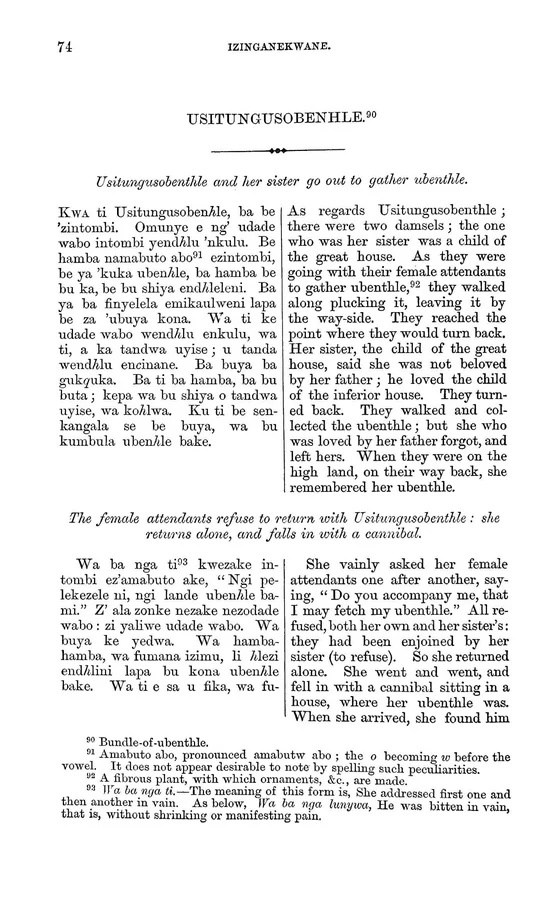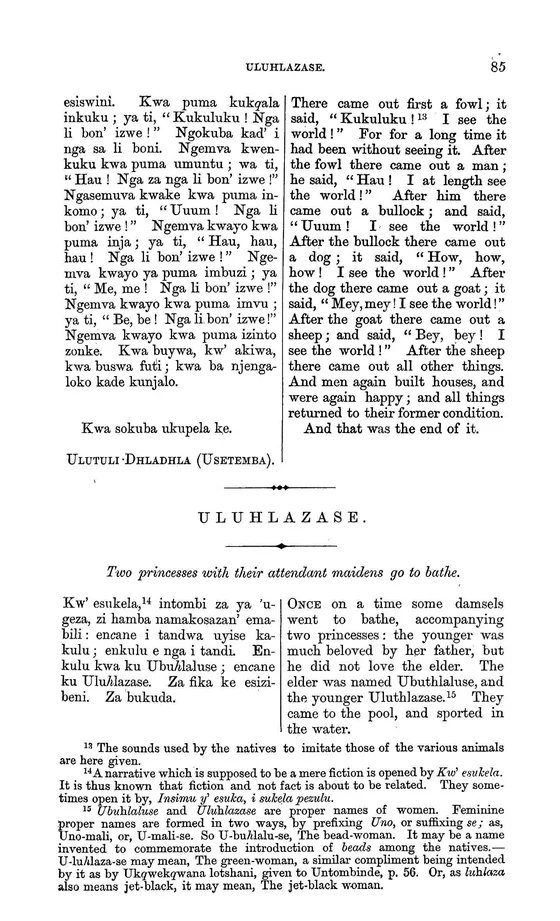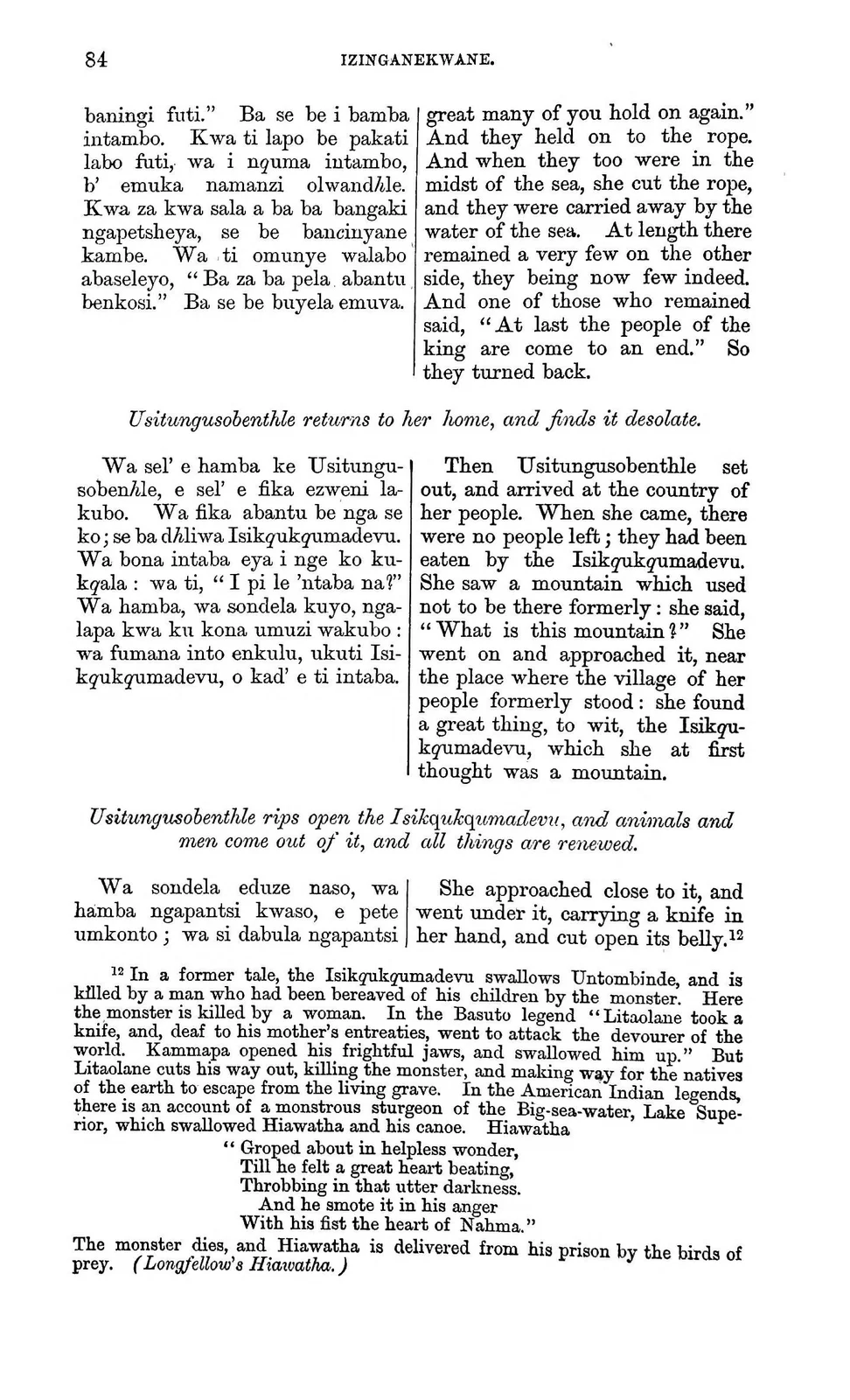
Isikqukqumadevu in Callaway’s Tales: documentary text witness, Callaway 1868, printed page 84; documentary source-page facsimile
First-account episode: the enormous named monster and the princess releasing those swallowed by cutting its belly. Individually inspected original bilingual Zulu/English scanned page; documentary text, no creature illustration claimed. Physical edition 1868; translator/editor distinguished from traditional narrators. Public-domain publication and expired Callaway lifetime.
Overview
Ulutuli Dhladhla’s Usitungusobenthle account introduces Isikqukqumadevu through an emptied homeland. The returning heroine sees what looks like a mountain that was not there before. On approaching the place where her village stood, she discovers the huge beast that swallowed its community. She cuts its belly open from below. A fowl comes out, followed by a person, bullock, dog, goat, sheep and then other captives, each celebrating a view of the world again. The living community rebuilds its houses. This witness supplies mountain-like bulk and a belly holding people and animals.
Unyaose Kciya’s Uluthlazase account instead places the named creature at a bathing pool. It takes the girls’ garments and returns them when asked. The younger princess refuses to ask and fights to recover her own garment. The struggle goes into the water and continues until both opponents are exhausted. Unable to overcome her, the monster goes to call others of its kind. Another animal warns the princess and urges her escape; that warning and assistance belong to the helper, not to Isikqukqumadevu.
After she reaches home, a false account of her absence is exposed. The chief’s men later enter the pool; the creature emerges angrily and is killed. Girls previously swallowed alive are released, and their fathers recognize and reclaim them. The closing description calls the beast hairless, long and large. It therefore supplies a particular bodily description alongside the earlier witness’s perceived mountain, rather than requiring every appearance to be drawn identically.
The edition credits the two accounts separately: Ulutuli Dhladhla for the sea-escape and village rescue, and Unyaose Kciya, called Sophia and Umkajosefa, for Uluthlazase. Callaway’s note 18 identifies the latter as an Ibakca woman, an important distinction within a Zulu-language collection. His comparisons to Kammapa and other swallowing creatures do not erase those credits or establish one shared individual. OCR spellings of dotted consonants vary; the named accounts and their page locations remain the basis of the identification.
Origins & earliest records
The selected bilingual account credits Ulutuli Dhladhla (Usetemba) for the first account; Unyaose Kciya (Sophia, Umkajosefa) for Uluthlazase. Callaway supplies its English translation and comparative notes. The printed credit is retained; his proposed historical explanations are distinct from the narrated events.
Records & interpretation
Complete selected bilingual narrative and closing contributor credit read: Usitungusobenthle and the Amajubatente, pp. 84–85; Uluthlazase, pp. 85–89, including final hairless/long/large description and note 18.
In the literature
“it was a long and large animal.”
Isikqukqumadevu in two distinct accounts, printed p.89 · Henry Callaway
The closing description belongs specifically to Unyaose’s Uluthlazase telling.
Selected bibliography
Documented works and useful reading. This is not a list of every appearance.
- 01
Nursery Tales, Traditions, and Histories of the Zulus, in Their Own Words, volume I
Usitungusobenthle and the Amajubatente, pp. 84–85; Uluthlazase, pp. 85–89, including final hairless/long/large description and note 18.
- 02
Nursery Tales, Traditions, and Histories of the Zulus — Isikqukqumadevu in two distinct accounts
HenryCallaway, Nursery Tales, Traditions, and Histories of the Zulus, in Their Own Words, with a Translation into English, and Notes, VolumeI, Springvale,Natal:JohnA.Blair1868; bilingual Princeton scan. Printed pages and individual signatures retained; editorial English notes distinguished from attributed account. Full selected English narratives read in cached OCR, with named page pixels independently checked.
Family & connections
A source-supported family tree or inspiration record has not yet been compiled for this profile. Related reading below indicates a connection in subject matter, not a proven lineage or creative influence.
Located primary passages
Specific passages supporting details in this entry, grouped by their published witness.
Nursery Tales, Traditions, and Histories of the Zulus, in Their Own Words, volume I
HenryCallaway, Nursery Tales, Traditions, and Histories of the Zulus, in Their Own Words, with a Translation into English, and Notes, VolumeI, Springvale,Natal:JohnA.Blair1868; bilingual Princeton scan. Printed pages and individual signatures retained; editorial English notes distinguished from attributed account. Full selected English narratives read in cached OCR, with named page pixels independently checked.
- The returning heroine finds her country empty and a monster she first mistakes for a mountain. She approaches underneath and cuts its belly with a knife. A fowl, man, bullock, dog, goat, sheep and other swallowed beings emerge; households and former conditions are restored.
Usitungusobenthle and the Amajubatente, printed pp.84–85 after full tale78–85
- The pool creature takes bathers’ clothes. Uluthlazase wrestles it, both rest exhausted, and another creature warns her away while it seeks reinforcements. After her return and punishment of deceiving girls, the father’s expedition kills it and swallowed girls emerge. The closing describes a hairless long large animal swallowing girls without eating them; note18 compares other tales and identifies the narrator as an Ibakca woman.
Uluthlazase, complete printed pp.85–89; note18 and Unyaose signature
Speaking animal exits are narrated, not a universal anatomical species description. This is Ulutuli’s separate account. Callaway’s note on supposed tale composition remains editorial comparison, not proof of transmission. Different rescue methods and narrators are not merged.
References
Sources supporting this profile. Linked pages have their own scope and editorial standards.
- Attributed primary narrative with translation; digitized bilingual editionCallaway bilingual edition — Usitungusobenthle and the Amajubatente, pp. 84–85; Uluthlazase, pp. 85–89, including final hairless/long/large description and note 18.Research access: 2026-10-05
Image credits
Historical text facsimileIsikqukqumadevu in Callaway’s Tales: documentary text witness, Callaway 1868, printed page 84; documentary source-page facsimile
First-account episode: the enormous named monster and the princess releasing those swallowed by cutting its belly. Individually inspected original bilingual Zulu/English scanned page; documentary text, no creature illustration claimed. Physical edition 1868; translator/editor distinguished from traditional narrators. Public-domain publication and expired Callaway lifetime.