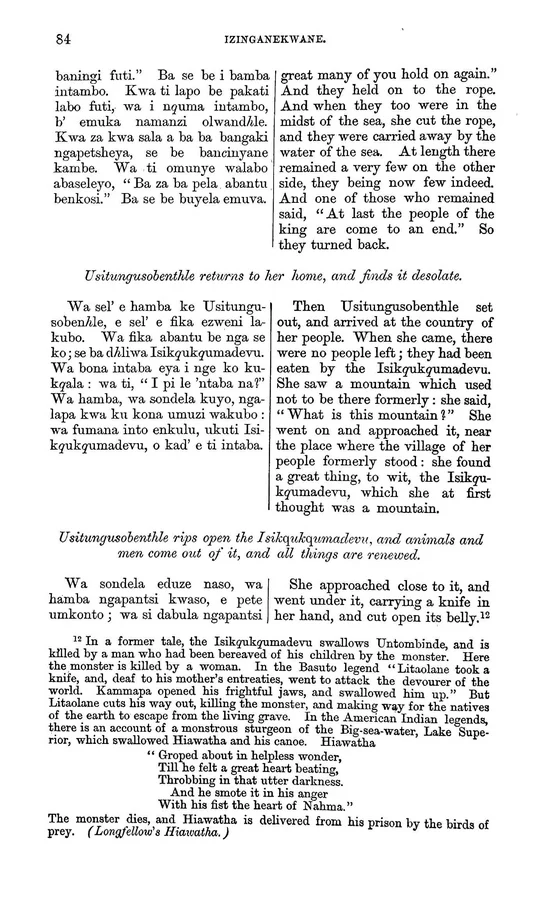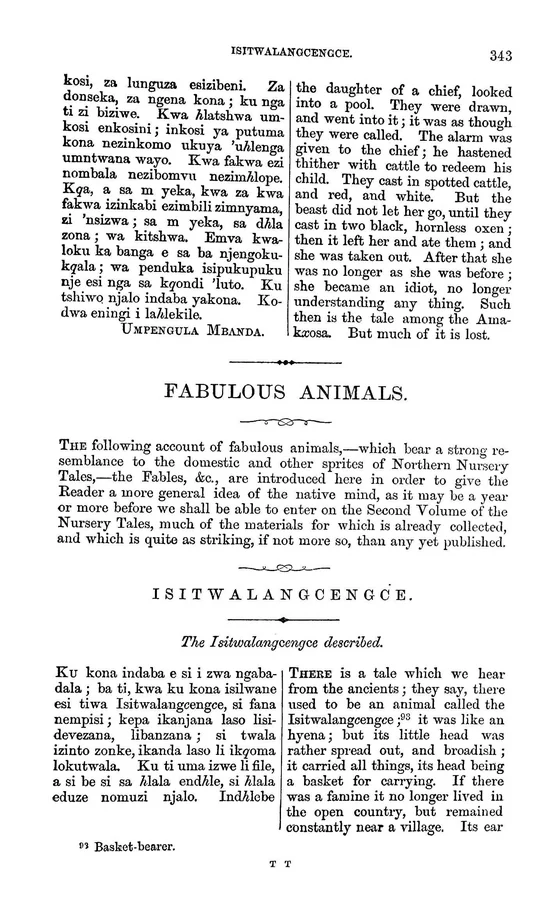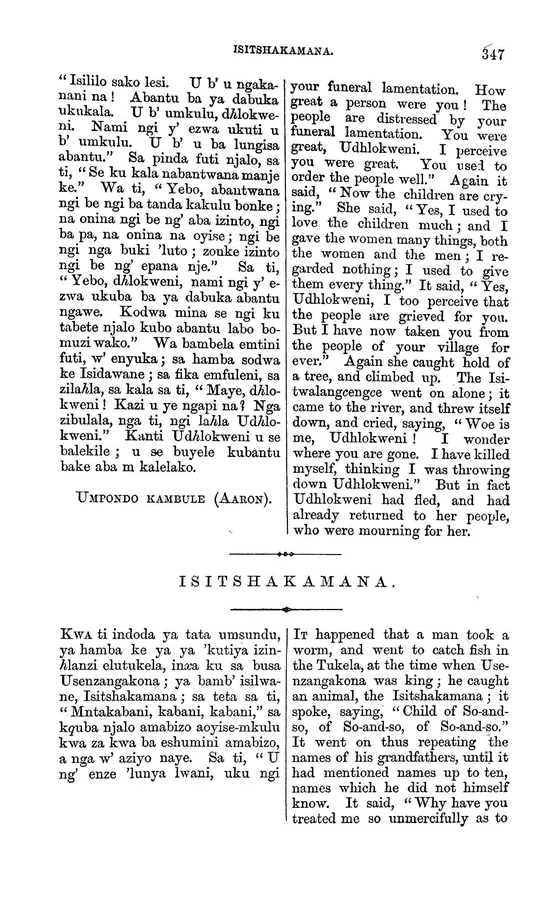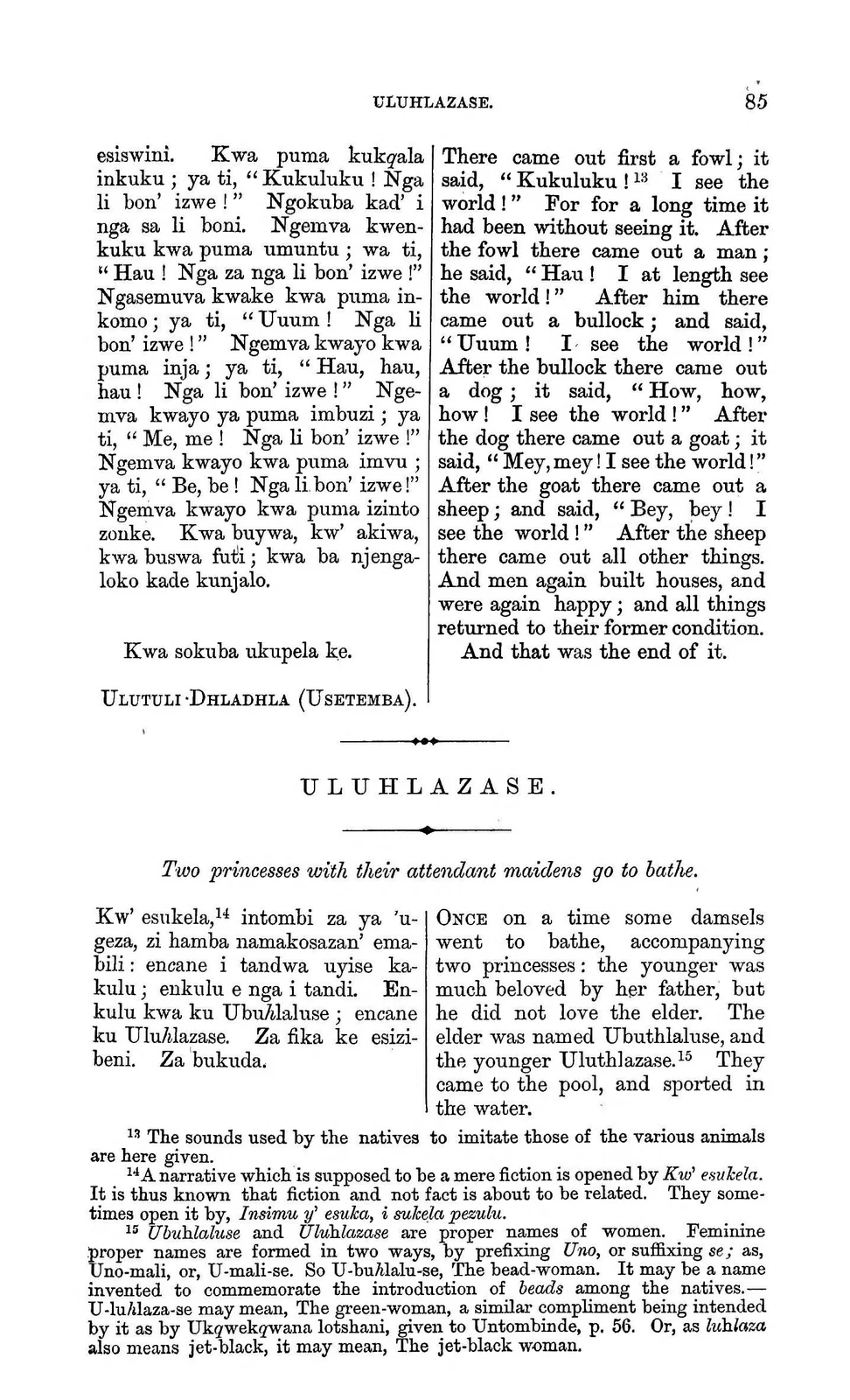
Uluthlazase: documentary text witness, Callaway 1868, printed page 85; documentary source-page facsimile
Lower-page Uluthlazase heading and two princesses bathing; upper text belongs to the preceding account. Individually inspected original bilingual Zulu/English scanned page; documentary text, no creature illustration claimed. Physical edition 1868; translator/editor distinguished from traditional narrators. Public-domain publication and expired Callaway lifetime.
Overview
Uluthlazase goes bathing with her elder sister Ubuthlaluse and attendant girls. Isikqukqumadevu takes their garments and hands them back to those who ask, but the younger princess refuses to make the request. The others abandon her after their attempts to persuade her fail. She seizes the creature to recover her garment and fights it, first at the bank and then beneath the water when it drags her into the pool.
Neither can defeat the other, and both eventually rest from exhaustion. In the morning the monster leaves to summon others of its kind. Another animal warns the girl, enabling her to take her garment and return home. Her companions have supplied a false account of her absence. After exposing their deception, her father gathers men, and she leads them to the pool. They kill the enraged creature when it comes out, releasing girls it swallowed earlier. The narrative ends with her governing and a celebration. Her strength and endurance are demonstrated by the struggle; no animal form or additional supernatural anatomy is assigned to her.
Origins & earliest records
The selected bilingual account credits Unyaose Kciya (Sophia, Umkajosefa), described by Callaway as an Ibakca woman. Callaway supplies its English translation and comparative notes. The printed credit is retained; his proposed historical explanations are distinct from the narrated events.
Records & interpretation
Complete selected bilingual narrative and closing contributor credit read: Uluthlazase, pp. 85–89; confrontation pp. 86–87, rescue and release pp. 88–89; contributor and note 18.
In the literature
“Then Uluthlazase the princess governed;”
Uluthlazase, printed p.89 · Henry Callaway
The ending explicitly gives the heroine governance after the rescue.
Selected bibliography
Documented works and useful reading. This is not a list of every appearance.
- 01
Nursery Tales, Traditions, and Histories of the Zulus, in Their Own Words, volume I
Uluthlazase, pp. 85–89; confrontation pp. 86–87, rescue and release pp. 88–89; contributor and note 18.
- 02
Nursery Tales, Traditions, and Histories of the Zulus — Uluthlazase
HenryCallaway, Nursery Tales, Traditions, and Histories of the Zulus, in Their Own Words, with a Translation into English, and Notes, VolumeI, Springvale,Natal:JohnA.Blair1868; bilingual Princeton scan. Printed pages and individual signatures retained; editorial English notes distinguished from attributed account. Full selected English narratives read in cached OCR, with named page pixels independently checked.
Family & connections
A source-supported family tree or inspiration record has not yet been compiled for this profile. Related reading below indicates a connection in subject matter, not a proven lineage or creative influence.
Located primary passages
Specific passages supporting details in this entry, grouped by their published witness.
Nursery Tales, Traditions, and Histories of the Zulus, in Their Own Words, volume I
HenryCallaway, Nursery Tales, Traditions, and Histories of the Zulus, in Their Own Words, with a Translation into English, and Notes, VolumeI, Springvale,Natal:JohnA.Blair1868; bilingual Princeton scan. Printed pages and individual signatures retained; editorial English notes distinguished from attributed account. Full selected English narratives read in cached OCR, with named page pixels independently checked.
- The favoured younger princess refuses to request her clothes from the Isikqukqumadevu, fights it into a pool and escapes after a warning from another animal. Her father discovers attendants’ false report, kills them and the elder princess, then leads an expedition that destroys the pool creature and releases its swallowed girls. Uluthlazase governs with the girls too young to have joined the deception.
Uluthlazase, complete printed pp.85–89, contributor and note18
Violent paternal punishment and source’s pride accusation are recorded literary actions, not endorsed conduct. Her pool struggle and release are distinct from Usitungusobenthle’s belly-cutting episode.
References
Sources supporting this profile. Linked pages have their own scope and editorial standards.
- Attributed primary narrative with translation; digitized bilingual editionCallaway bilingual edition — Uluthlazase, pp. 85–89; confrontation pp. 86–87, rescue and release pp. 88–89; contributor and note 18.Research access: 2026-10-05
Image credits
Historical text facsimileUluthlazase: documentary text witness, Callaway 1868, printed page 85; documentary source-page facsimile
Lower-page Uluthlazase heading and two princesses bathing; upper text belongs to the preceding account. Individually inspected original bilingual Zulu/English scanned page; documentary text, no creature illustration claimed. Physical edition 1868; translator/editor distinguished from traditional narrators. Public-domain publication and expired Callaway lifetime.