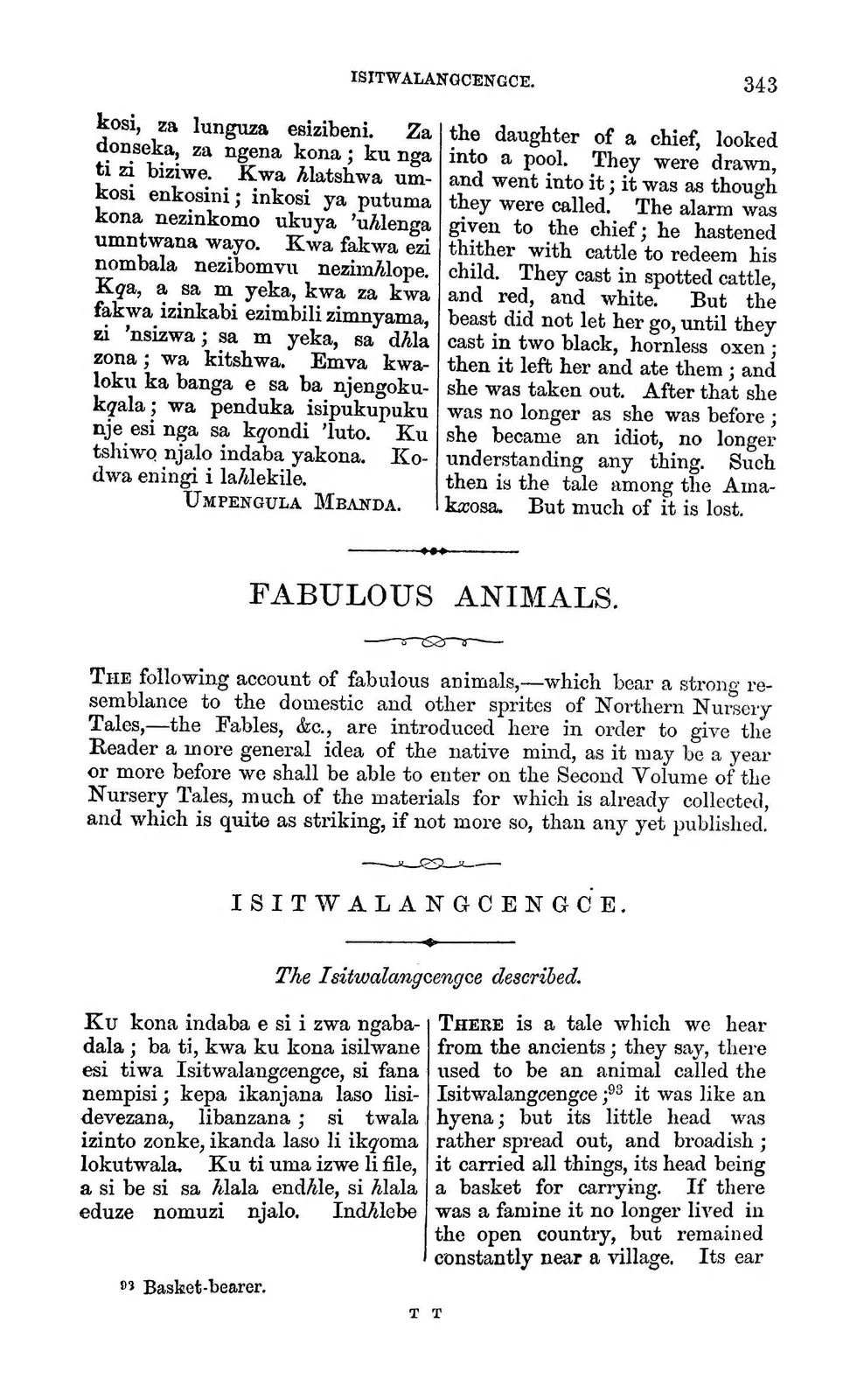
Isitwalangcengce: documentary text witness, Callaway 1868, printed page 343; documentary source-page facsimile
Lower-page Fabulous Animals heading, named Isitwalangcengce and its broad basket-like head. Upper text is a preceding tale. Individually inspected original bilingual Zulu/English scanned page; documentary text, no creature illustration claimed. Physical edition 1868; translator/editor distinguished from traditional narrators. Public-domain publication and expired Callaway lifetime.
Overview
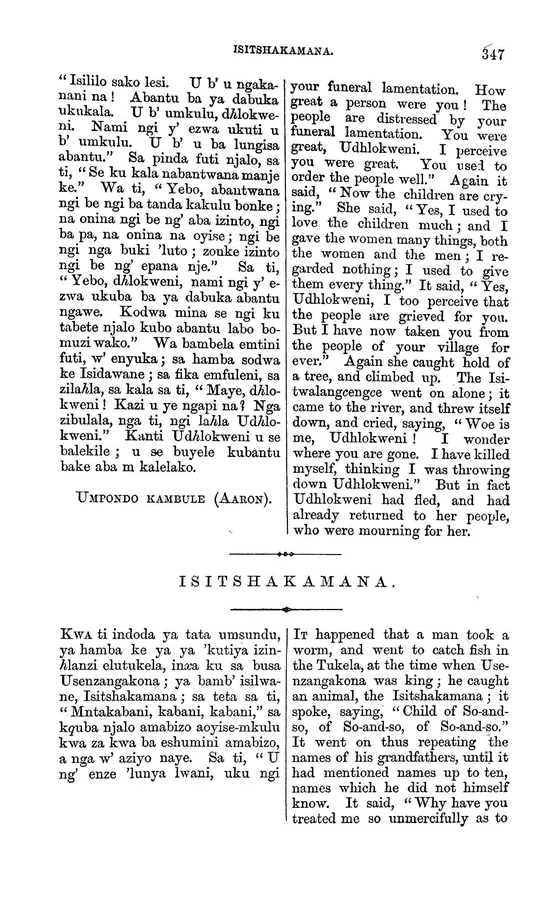
Umpondo Kambule relates an old account of Isitwalangcengce, a hyena-like creature with a spread, broad head serving as a carrying basket. During famine it leaves the open country and remains near a village. Its sharp hearing detects a slaughtered bullock and the exchange of meat between households. It waits beside doorways for children delivering portions, seizes them with the meat and throws them onto its head. At a rock it breaks the victim’s head and eats the brains, leaving the body. Callaway glosses the name as basket-bearer.
A sleeping adult is abducted too. The creature tells him that they will follow the rocky path, but their journey passes beneath trees. He breaks off branches, piling them beneath himself until they replace his weight. Catching an overhead tree, he leaves the moving basket and runs home. Isitwalangcengce empties only branches onto the rock and returns to look for him. The survivor’s account explains children disappearing between a call from one household and their expected arrival at another.
He proposes maintaining two paths and requesting the bush route, which provides branches and trees for escape. Other captives repeat the substitution until a heap of branches accumulates at the killing rock. Kambule closes by calling it an old fabulous tale now used to quiet crying children through the threat of being carried away. This explicitly reported storytelling use is distinct from the events within the tale.
The following Udhlokweni episode concerns a chief wife abducted on an apparent hyena’s head. Note 98 identifies that carrier as Isitwalangcengce or Isidawane. It detects and reverses her first tree escape, then comments on the funeral lamentation thundering from her community. She explains her kindness to adults and children and her generosity with possessions. A second tree escape succeeds. The carrier goes alone to the river, throws itself down and laments that it has killed itself while intending to throw down Udhlokweni; she has already returned to the people mourning her. That speech is preserved as the creature’s lament, rather than supplying an independently narrated resurrection or certain death.
Origins & earliest records
The selected bilingual text credits Umpondo Kambule (Aaron). Henry Callaway supplies the English translation and comparative notes. His volume preface describes contributions offered by readers in his village after the first part appeared; the selected credit is preserved rather than assigning the whole corpus to one unnamed narrator.
Records & interpretation
Complete selected account and closing contributor credit read in the bilingual OCR: Fabulous Animals: Isitwalangcengce, pp. 343–346; The History of Udhlokweni, pp. 346–347, including identification note 98.
In the literature
“its head being a basket for carrying”
Isitwalangcengce described, printed p.343 · Henry Callaway
The basket-head description in Umpondo Kambule(Aaron)’s account.
Selected bibliography
Documented works and useful reading. This is not a list of every appearance.
- 01
Nursery Tales, Traditions, and Histories of the Zulus, in Their Own Words, volume I
Fabulous Animals: Isitwalangcengce, pp. 343–346; The History of Udhlokweni, pp. 346–347, including identification note 98.
- 02
Nursery Tales, Traditions, and Histories of the Zulus, Volume I
Henry Callaway, Nursery Tales, Traditions, and Histories of the Zulus, Volume I, Springvale, Natal: John A. Blair, 1868; bilingual Zulu/English edition, selected Princeton scan. Complete individual accounts read; narrator credits retained at section boundaries.
Family & connections
A source-supported family tree or inspiration record has not yet been compiled for this profile. Related reading below indicates a connection in subject matter, not a proven lineage or creative influence.
Located primary passages
Specific passages supporting details in this entry, grouped by their published witness.
Nursery Tales, Traditions, and Histories of the Zulus, in Their Own Words, volume I
Henry Callaway, Nursery Tales, Traditions, and Histories of the Zulus, Volume I, Springvale, Natal: John A. Blair, 1868; bilingual Zulu/English edition, selected Princeton scan. Complete individual accounts read; narrator credits retained at section boundaries.
- The animal resembles a hyena but has a broad, spread-out little head used as a carrying basket. During famine it approaches villages, intercepts children carrying portions of slaughtered cattle, carries them to a rock and eats their brains, leaving their bodies.
- A carried man loads branches onto the basket-head and escapes into an overhead tree without lightening the burden conspicuously. He recommends a wooded alternative to the rock-path; children repeat the trick. The narrator identifies this as an old fabulous story then used to quiet crying children.
The Isitwalangcengce outwitted / Many escape by a stratagem, printed pp.344–346
- A hyena-like abductor carries the generous chief wife Udhlokweni, catches her first tree-climbing escape attempt, and hears her community’s lament. She escapes at a second tree and returns to her people. The beast throws itself into a river and laments that it has killed itself instead of throwing down its captive. Footnote98 names Isitwalangcengce or Isidawane.
The attributed old tale is not a zoological specimen report; Callaway’s cross-cultural comparisons are editorial, not a proved identity. Successful evasion does not kill the beast. The closing attribution applies to this account, separate from the preceding shadow appendix. The self-killing statement is the beast’s speech, not independently confirmed observed death. This distinct episode is not merged with the preceding child-escape sequence.
References
Sources supporting this profile. Linked pages have their own scope and editorial standards.
- Attributed primary account with translation; digitized bilingual editionCallaway bilingual edition — Fabulous Animals: Isitwalangcengce, pp. 343–346; The History of Udhlokweni, pp. 346–347, including identification note 98.Research access: 2026-10-05
Image credits
Historical text facsimileIsitwalangcengce: documentary text witness, Callaway 1868, printed page 343; documentary source-page facsimile
Lower-page Fabulous Animals heading, named Isitwalangcengce and its broad basket-like head. Upper text is a preceding tale. Individually inspected original bilingual Zulu/English scanned page; documentary text, no creature illustration claimed. Physical edition 1868; translator/editor distinguished from traditional narrators. Public-domain publication and expired Callaway lifetime.