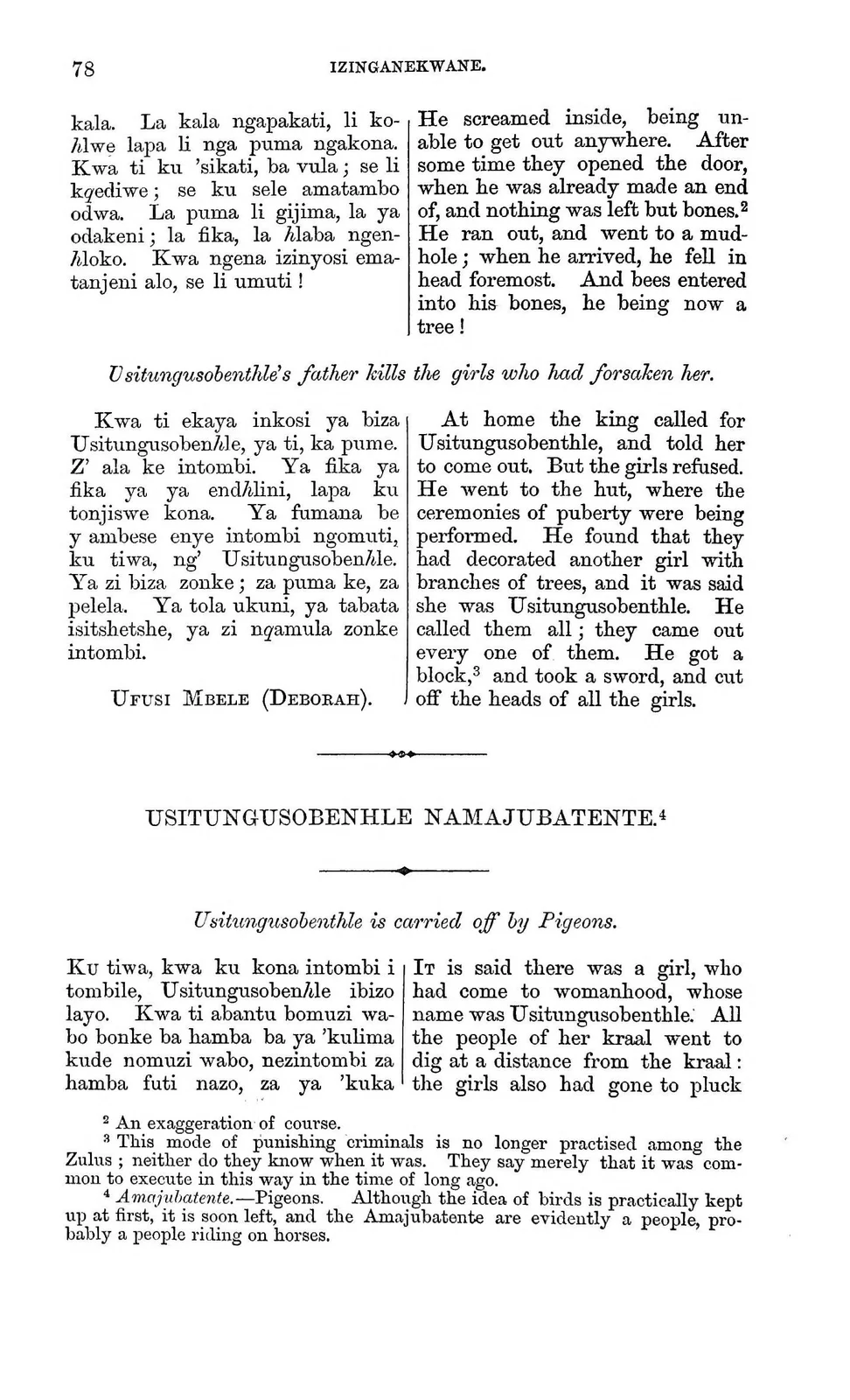
Amajubatente: documentary text witness, Callaway 1868, printed page 78; documentary source-page facsimile
Lower-page heading and opening of Usitungusobenthle and the Amajubatente. Editorial note cautions that these Pigeons are treated as people in the narrative. Individually inspected original bilingual Zulu/English scanned page; documentary text, no creature illustration claimed. Physical edition 1868; translator/editor distinguished from traditional narrators. Public-domain publication and expired Callaway lifetime.
Overview
The Amajubatente arrive while Usitungusobenthle is alone at home and carry her flying through the air. Passing the fields where her mother works, they suspend the girl above her, moving her back and forth just beyond rescue. Her mother follows them weeping. At dusk they perch with the captive in a tree while the mother lies beneath it; during the night they depart for their own country. The opening thus gives concrete bird behaviour, not merely a metaphorical name.
In their country they make Usitungusobenthle queen, and her husband, himself an Ijubatente, fathers three children. The subsequent household is narrated with royal authority, hunting parties, attendants and armies. To escape, the queen instructs her children to feign illness while hunting: the eldest pretends an injury, the next a stomach pain and the youngest a headache. Their father sends each home, allowing all three to rejoin her. She packs her possessions and leaves with them before the old woman watching the household notices.
The watcher’s shouted warning reaches the hunters, but the first three men who repeat it are killed for supposedly devising ill fortune for the king’s children. A fourth persuades the king to return and listen. After confirming the departure, he musters an army described as many thousands strong and joins the pursuit. This violent suppression of warnings belongs to the narrated royal household; the account supplies no bird anatomy for its soldiers.
At the sea Usitungusobenthle commands the water to divide and crosses with her children. The pursuing Amajubatente reach the opposite bank but do not fly across. She offers a long plaited rope and pulls groups into midstream, then cuts it with a sharp stone. Three groups are swept away, while she pretends distress or claims the rope slipped. The few survivors turn back. Her subsequent return home leads to a separate encounter with Isikqukqumadevu, which has swallowed her community.
Callaway notes the tension between the flying pigeon-like opening and the later human actions. He proposes that the story might remember horsemen carrying away a girl, but the contributor’s narrative does not establish that explanation or explicitly transform the birds into men. The profile retains both phases without supplying pigeon-headed warriors or turning the editor’s conjecture into recorded history.
Origins & earliest records
The selected bilingual account credits Ulutuli Dhladhla (Usetemba), as credited in the selected OCR. Callaway supplies its English translation and comparative notes. The printed credit is retained; his proposed historical explanations are distinct from the narrated events.
Records & interpretation
Complete selected bilingual narrative and closing contributor credit read: Usitungusobenthle and the Amajubatente, pp. 78–85; abduction pp. 78–79, human household and pursuit pp. 80–84; editorial notes 4 and 7.
In the literature
“they carried her flying through the air”
Usitungusobenthle and the Amajubatente, printed p.79 · Henry Callaway
The opening explicitly describes flight, before later human-like kingship and pursuit.
Selected bibliography
Documented works and useful reading. This is not a list of every appearance.
- 01
Nursery Tales, Traditions, and Histories of the Zulus, in Their Own Words, volume I
Usitungusobenthle and the Amajubatente, pp. 78–85; abduction pp. 78–79, human household and pursuit pp. 80–84; editorial notes 4 and 7.
- 02
Nursery Tales, Traditions, and Histories of the Zulus — Usitungusobenthle and the Amajubatente
HenryCallaway, Nursery Tales, Traditions, and Histories of the Zulus, in Their Own Words, with a Translation into English, and Notes, VolumeI, Springvale,Natal:JohnA.Blair1868; bilingual Princeton scan. Printed pages and individual signatures retained; editorial English notes distinguished from attributed account. Full selected English narratives read in cached OCR, with named page pixels independently checked.
Family & connections
A source-supported family tree or inspiration record has not yet been compiled for this profile. Related reading below indicates a connection in subject matter, not a proven lineage or creative influence.
Located primary passages
Specific passages supporting details in this entry, grouped by their published witness.
Nursery Tales, Traditions, and Histories of the Zulus, in Their Own Words, volume I
HenryCallaway, Nursery Tales, Traditions, and Histories of the Zulus, in Their Own Words, with a Translation into English, and Notes, VolumeI, Springvale,Natal:JohnA.Blair1868; bilingual Princeton scan. Printed pages and individual signatures retained; editorial English notes distinguished from attributed account. Full selected English narratives read in cached OCR, with named page pixels independently checked.
- Amajubatente carry Usitungusobenthle flying away, perch in a tree, then take her to their country. She becomes their queen and bears three children by an Ijubatente husband. She and the children deceive a hunting party and escape; after repeated mistaken killings of warning hunters, an army pursues. She crosses a divided sea and tricks pursuers with a repeatedly cut rope until survivors turn back. She then liberates her own people from a separate swallowing creature.
Usitungusobenthle and the Amajubatente, complete printed pp.78–85; notes4/7
The main story explicitly begins with flight and perching, while editor note4 glosses pigeons and hypothesises human riders later. That hypothesis is not an actual transformation or a substitute for the narrated opening. No invocation copied.
References
Sources supporting this profile. Linked pages have their own scope and editorial standards.
- Attributed primary narrative with translation; digitized bilingual editionCallaway bilingual edition — Usitungusobenthle and the Amajubatente, pp. 78–85; abduction pp. 78–79, human household and pursuit pp. 80–84; editorial notes 4 and 7.Research access: 2026-10-05
Image credits
Historical text facsimileAmajubatente: documentary text witness, Callaway 1868, printed page 78; documentary source-page facsimile
Lower-page heading and opening of Usitungusobenthle and the Amajubatente. Editorial note cautions that these Pigeons are treated as people in the narrative. Individually inspected original bilingual Zulu/English scanned page; documentary text, no creature illustration claimed. Physical edition 1868; translator/editor distinguished from traditional narrators. Public-domain publication and expired Callaway lifetime.