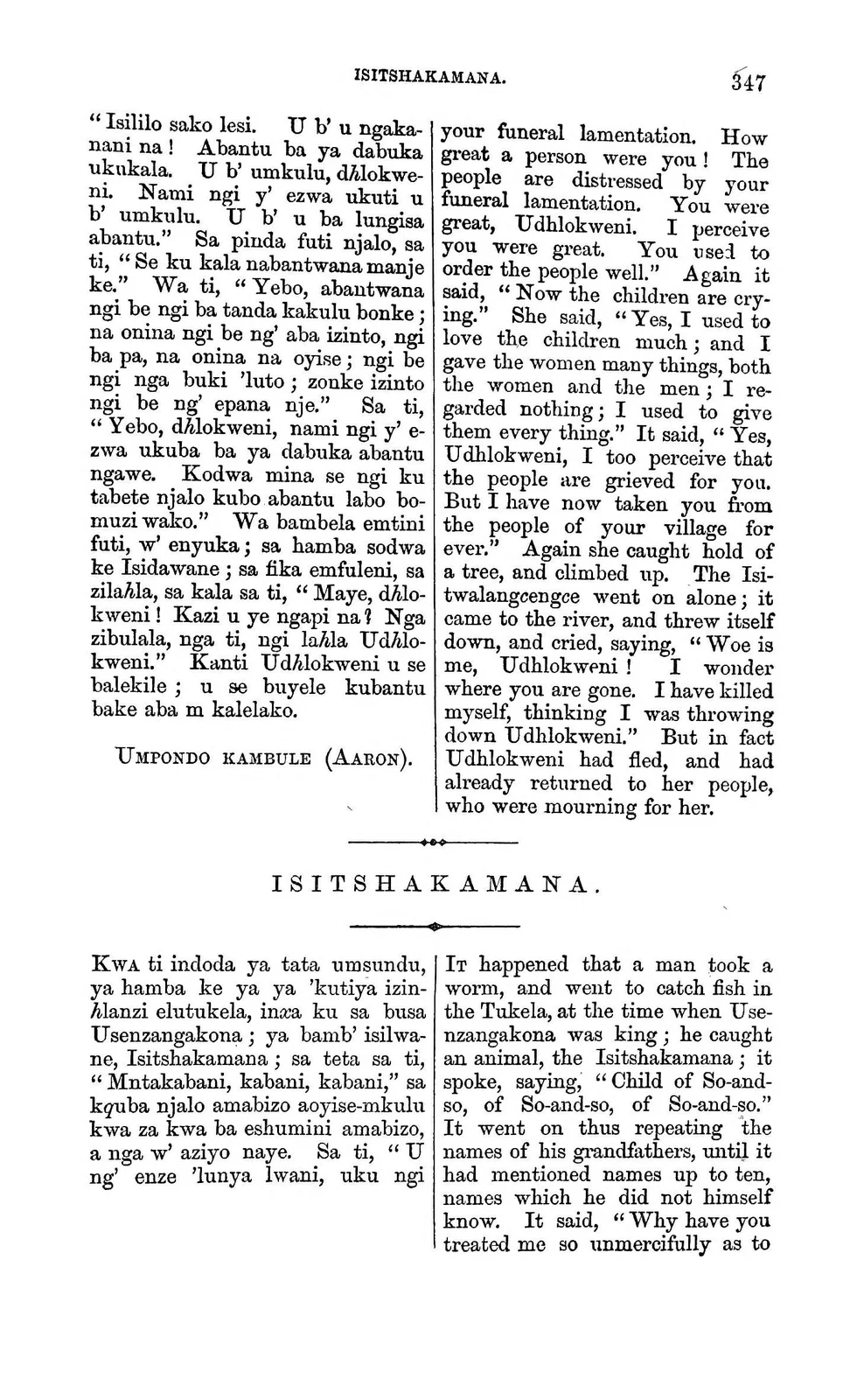
Isitshakamana: documentary text witness, Callaway 1868, printed page 347; documentary source-page facsimile
Lower-page named Isitshakamana encounter: fisher and ten grandfather names. Upper text concludes the preceding account. Individually inspected original bilingual Zulu/English scanned page; documentary text, no creature illustration claimed. Physical edition 1868; translator/editor distinguished from traditional narrators. Public-domain publication and expired Callaway lifetime.
Overview
The narrator places the encounter at the Tukela during Usenzangakona’s reign. A man fishing with a worm catches Isitshakamana, which addresses him through a succession of ancestral names reaching ten generations, including names he does not know himself. It protests at being removed from its pool, explaining that it lives there continually and fears the sun. The man meets its gaze and flees.
At home he reports that the creature’s eyes, nostrils, ears and mouth are clustered in one place, and that its eyes still seem to watch him. Attempts to hide beneath a pot, blankets or in a grain-storage hole do not remove that feeling. He eventually dies, attributing his overwhelming fear to the creature’s knowledge of generations beyond his father and grandfather’s memory. The closing description calls it small and round, about the size of a child not yet walking, moving on its buttocks. The narrator also mentions a living man named after the encounter’s year; that namesake is not the creature.
Origins & earliest records
The selected bilingual text credits Umpondo Kambule (Aaron). Henry Callaway supplies the English translation and comparative notes. His volume preface describes contributions offered by readers in his village after the first part appeared; the selected credit is preserved rather than assigning the whole corpus to one unnamed narrator.
Records & interpretation
Complete selected account and closing contributor credit read in the bilingual OCR: Isitshakamana, pp. 347–349; complete encounter, bodily description and namesake distinction.
In the literature
“it walked on its buttocks”
Isitshakamana conclusion, printed p.349 · Henry Callaway
Reported locomotion of the infant-sized pool creature; not the human namesake.
Selected bibliography
Documented works and useful reading. This is not a list of every appearance.
- 01
Nursery Tales, Traditions, and Histories of the Zulus, in Their Own Words, volume I
Isitshakamana, pp. 347–349; complete encounter, bodily description and namesake distinction.
- 02
Nursery Tales, Traditions, and Histories of the Zulus, Volume I
Henry Callaway, Nursery Tales, Traditions, and Histories of the Zulus, Volume I, Springvale, Natal: John A. Blair, 1868; bilingual Zulu/English edition, selected Princeton scan. Complete individual accounts read; narrator credits retained at section boundaries.
Family & connections
A source-supported family tree or inspiration record has not yet been compiled for this profile. Related reading below indicates a connection in subject matter, not a proven lineage or creative influence.
Located primary passages
Specific passages supporting details in this entry, grouped by their published witness.
Nursery Tales, Traditions, and Histories of the Zulus, in Their Own Words, volume I
Henry Callaway, Nursery Tales, Traditions, and Histories of the Zulus, Volume I, Springvale, Natal: John A. Blair, 1868; bilingual Zulu/English edition, selected Princeton scan. Complete individual accounts read; narrator credits retained at section boundaries.
- A fisherman catches the pool-dwelling creature in the Tukela during the narrated reign of Usenzangakona. It protests exposure to sunlight and recites ten ancestral names unknown to the man. He flees but cannot stop seeing its gaze despite a pot, blankets and a cooled corn-hole; he dies describing his fear.
- The reported creature is small, round, infant-sized and moves on its buttocks. The account dates the encounter by Ujobe’s human child, named Usitshakamana, who is said to be grey-haired with grandchildren at the time of telling.
The text does not describe bodily consumption. Eyes, nostrils, ears and mouth are together in one place, not a stated single eye. The human namesake and his descendants are not the pool creature’s family or transformed bodies.
References
Sources supporting this profile. Linked pages have their own scope and editorial standards.
- Attributed primary account with translation; digitized bilingual editionCallaway bilingual edition — Isitshakamana, pp. 347–349; complete encounter, bodily description and namesake distinction.Research access: 2026-10-05
Image credits
Historical text facsimileIsitshakamana: documentary text witness, Callaway 1868, printed page 347; documentary source-page facsimile
Lower-page named Isitshakamana encounter: fisher and ten grandfather names. Upper text concludes the preceding account. Individually inspected original bilingual Zulu/English scanned page; documentary text, no creature illustration claimed. Physical edition 1868; translator/editor distinguished from traditional narrators. Public-domain publication and expired Callaway lifetime.