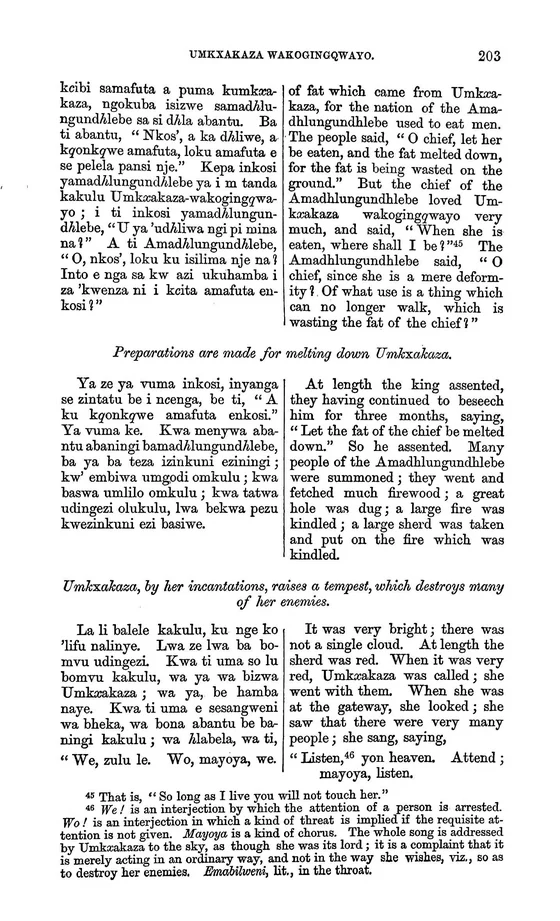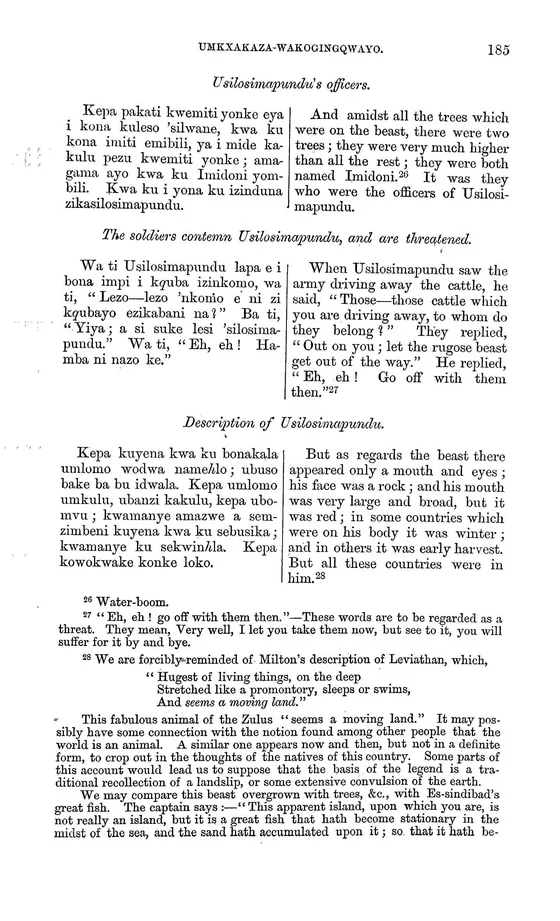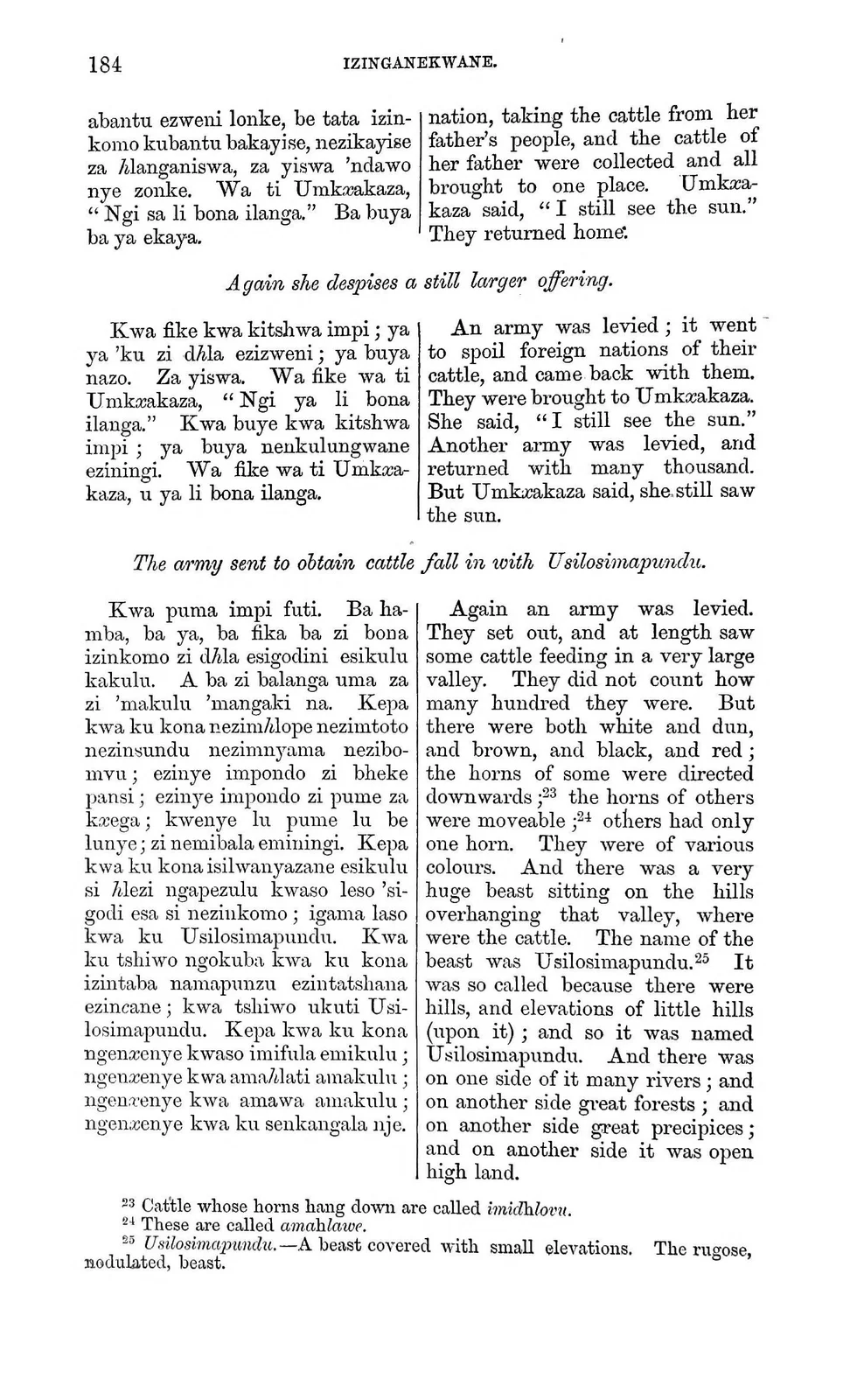
Usilosimapundu: documentary text witness, Callaway 1868, printed page 184; documentary source-page facsimile
Named landscape-bodied beast with rivers, forests, cliffs, hills and cattle. Individually inspected original bilingual Zulu/English scanned page; documentary text, no creature illustration claimed. Physical edition 1868; translator/editor distinguished from traditional narrators. Public-domain publication and expired Callaway lifetime.
Overview
Usilosimapundu overlooks a valley filled with cattle when soldiers searching for an immense ceremonial offering discover it. The beast’s name is glossed as a rugose or nodulated beast: hills and little elevations rise upon it. Rivers, forests, precipices and open high country occupy different sides of its body. Only its mouth and eyes are directly visible, its face resembles a rock, and its broad mouth is red. Different countries on its body experience winter and early harvest. Two especially tall Imidoni trees serve as its officers.
The soldiers drive off its cattle despite its challenge. Their dust finally obscures the sun, fulfilling the princess’s father’s rash promise. Much later, while the villagers are away, thunder and earth movement announce the beast at the settlement’s entrance. Two detached leaves from its trees compel the princess Umkxakaza to cook, grind corn and eat. They carry household goods and food to Usilosimapundu, which swallows the vessels, coverings and spoon along with their contents, without chewing. They clear the whole enormous village, yet it remains unsatisfied.
Umkxakaza dresses in her brass ornaments and mounts the beast. It runs away with her. Her father’s army pursues, but their spears fall into pools, rocks, grass and forest rather than injuring it. When it allows her to descend for a farewell, the army surrounds her; the beast breaks through, recovers her and leaves. Her family follows until exhausted. It gives her mother maize and sugarcane and permits one final parting.
Finally it leaves Umkxakaza in a furnished cave beside a tobacco garden, far from home. It explicitly frames this as retaliation: her father stole its cattle and has now lost the daughter whose marriage would have brought him cattle. The princess’s subsequent encounters and eventual return are later stages of her own story. The beast is not killed in this ending, and Callaway’s suggested landslip and world-animal comparisons remain editorial interpretations.
Origins & earliest records
The selected bilingual account credits Lydia. Henry Callaway translates and annotates it; contributor, translation and comparative commentary are distinct layers.
Records & interpretation
Complete selected narrative read, including its ending and contributor credit: Umkxakaza-wakogingqwayo, complete pp. 181–217; Usilosimapundu episode pp. 184–198, bodily description pp. 184–185 and name note 25.
In the literature
“his face was a rock”
Umkxakaza-wakogingqwayo, printed p.185 · Henry Callaway
The face belongs to the huge beast whose body bears whole landscapes.
Selected bibliography
Documented works and useful reading. This is not a list of every appearance.
- 01
Nursery Tales, Traditions, and Histories of the Zulus, in Their Own Words, volume I
Umkxakaza-wakogingqwayo, complete pp. 181–217; Usilosimapundu episode pp. 184–198, bodily description pp. 184–185 and name note 25
- 02
Nursery Tales, Traditions, and Histories of the Zulus, VolumeI — Umkxakaza-wakogingqwayo
Henry Callaway, Nursery Tales, Traditions, and Histories of the Zulus, VolumeI, Springvale,Natal:JohnA.Blair1868. Complete English narrative columns of Umkxakaza-wakogingqwayo printed181–217 independently read; selected bilingual Cornell page images, signature Lydia on217 visually checked. Editorial comparative notes distinguished, not all independently sourced works therein inspected.
Family & connections
A source-supported family tree or inspiration record has not yet been compiled for this profile. Related reading below indicates a connection in subject matter, not a proven lineage or creative influence.
Located primary passages
Specific passages supporting details in this entry, grouped by their published witness.
Nursery Tales, Traditions, and Histories of the Zulus, VolumeI — Umkxakaza-wakogingqwayo
Henry Callaway, Nursery Tales, Traditions, and Histories of the Zulus, VolumeI, Springvale,Natal:JohnA.Blair1868. Complete English narrative columns of Umkxakaza-wakogingqwayo printed181–217 independently read; selected bilingual Cornell page images, signature Lydia on217 visually checked. Editorial comparative notes distinguished, not all independently sourced works therein inspected.
- An army seeking cattle encounters an immense beast carrying hills, rivers, forests, precipices and country on its body. Its rocklike face shows mouth and eyes; different parts of its territory have different seasons. Soldiers dismiss its challenge and drive off its cattle.
- The beast reaches the emptied royal town with thunder and ground movement. Two Imidoni leaves enter the princess’s house and compel food preparation. The beast swallows baskets, food, vessels and the town’s household contents without chewing, then takes the princess on its body.
- Pursuers exhaust their spears against its terrain without injury. It permits a farewell but recaptures the princess when her people try to shelter her. Her mother follows longest and receives food before leaving. The beast deposits the princess in a furnished distant cave, describing her removal as revenge for the king’s cattle seizure.
This is not empirical geology. Callaway’s Milton, world-animal and landslip comparisons are his editorial hypotheses, not the narrator’s demonstrated origin. Its action follows theft of its cattle. The leaves’ coercion and destruction of property are not erased; the princess is not said to become an organ of its body. No stated death or defeat of Usilosimapundu. It gives shelter and provisions but deliberately separates her from home; subsequent half-bodied people are different characters.
References
Sources supporting this profile. Linked pages have their own scope and editorial standards.
- Attributed primary narrative with translation; digitized bilingual editionCallaway bilingual edition — Umkxakaza-wakogingqwayo, complete pp. 181–217; Usilosimapundu episode pp. 184–198, bodily description pp. 184–185 and name note 25Research access: 2026-10-05
Image credits
Historical text facsimileUsilosimapundu: documentary text witness, Callaway 1868, printed page 184; documentary source-page facsimile
Named landscape-bodied beast with rivers, forests, cliffs, hills and cattle. Individually inspected original bilingual Zulu/English scanned page; documentary text, no creature illustration claimed. Physical edition 1868; translator/editor distinguished from traditional narrators. Public-domain publication and expired Callaway lifetime.