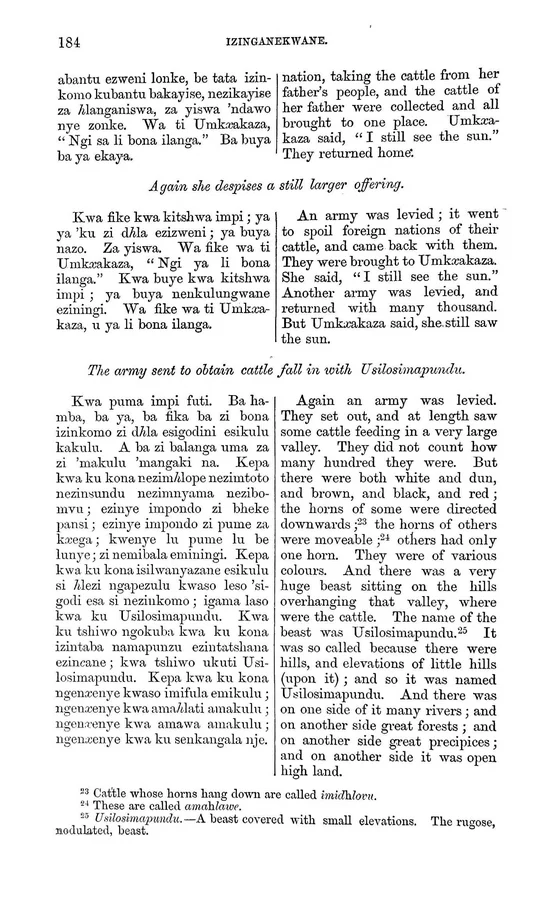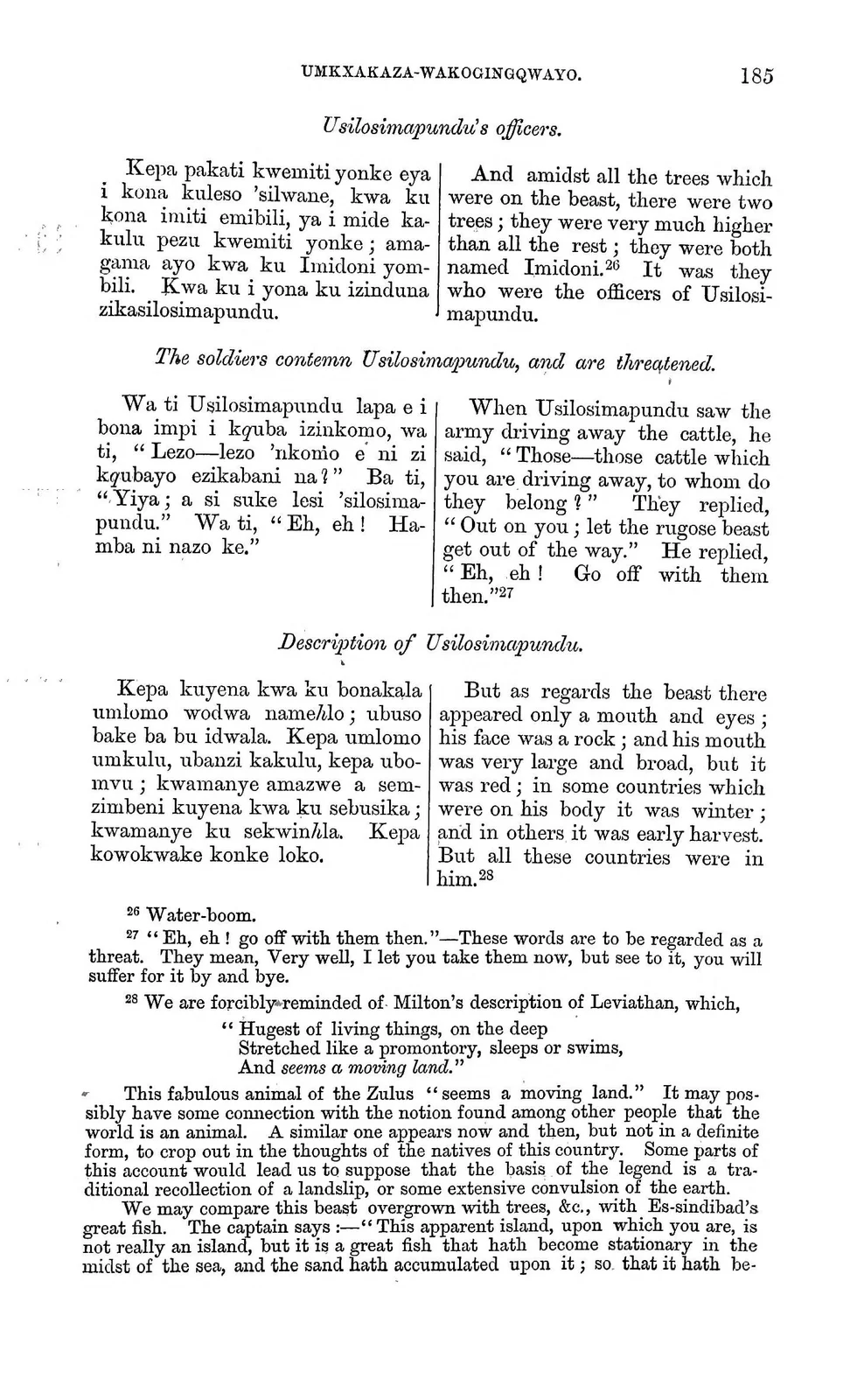
Imidoni Officers of Usilosimapundu: documentary text witness, Callaway 1868, printed page 185; documentary source-page facsimile
Two named Imidoni trees described as officers of Usilosimapundu; a narrative witness rather than a botanical photograph. Individually inspected original bilingual Zulu/English scanned page; documentary text, no creature illustration claimed. Physical edition 1868; translator/editor distinguished from traditional narrators. Public-domain publication and expired Callaway lifetime.
Overview
The Imidoni are the two trees that stand above all the other trees growing on Usilosimapundu. The narrative expressly calls them its officers. After the beast reaches Umkxakaza’s village, two leaves break from these trees and enter the house where the princess and her sister are staying. They send the sister to fetch water, where she becomes unable to depart. They then overrule the princess’s objections about her rank and ceremonial restrictions.
The leaves order her to light a fire, cook corn and grind it. One cuts her long nails with a knife; another demonstrates grinding before making her continue. They help carry a milk calabash that ordinarily needs three people, cover the food baskets and take the provisions to their master. Later they empty the houses, carrying vessels, mats and food to the village entrance. Two leaves jump into beer pots and emerge after emptying them, then carry those pots to the swallowing beast.
This is a collective profile for the two officers and their leaf agents, rather than a separate identity for every detached leaf. The account makes their speech, movement and household work explicit. The trees’ names are botanical-looking, but Callaway’s short English water-boom gloss does not establish a modern scientific species identification.
Origins & earliest records
The selected bilingual account credits Lydia. Henry Callaway translates and annotates it; contributor, translation and comparative commentary are distinct layers.
Records & interpretation
Complete selected narrative read, including its ending and contributor credit: Umkxakaza-wakogingqwayo, complete pp. 181–217; trees and note 26 p. 185, active leaves pp. 188–193.
In the literature
“One of the leaves took a knife”
Umkxakaza-wakogingqwayo, printed p.190 · Henry Callaway
A speaking leaf cuts the princess’s long nails during enforced food preparation.
Selected bibliography
Documented works and useful reading. This is not a list of every appearance.
- 01
Nursery Tales, Traditions, and Histories of the Zulus, in Their Own Words, volume I
Umkxakaza-wakogingqwayo, complete pp. 181–217; trees and note 26 p. 185, active leaves pp. 188–193
- 02
Nursery Tales, Traditions, and Histories of the Zulus, VolumeI — Umkxakaza-wakogingqwayo
Henry Callaway, Nursery Tales, Traditions, and Histories of the Zulus, VolumeI, Springvale,Natal:JohnA.Blair1868. Complete English narrative columns of Umkxakaza-wakogingqwayo printed181–217 independently read; selected bilingual Cornell page images, signature Lydia on217 visually checked. Editorial comparative notes distinguished, not all independently sourced works therein inspected.
Family & connections
A source-supported family tree or inspiration record has not yet been compiled for this profile. Related reading below indicates a connection in subject matter, not a proven lineage or creative influence.
Located primary passages
Specific passages supporting details in this entry, grouped by their published witness.
Nursery Tales, Traditions, and Histories of the Zulus, VolumeI — Umkxakaza-wakogingqwayo
Henry Callaway, Nursery Tales, Traditions, and Histories of the Zulus, VolumeI, Springvale,Natal:JohnA.Blair1868. Complete English narrative columns of Umkxakaza-wakogingqwayo printed181–217 independently read; selected bilingual Cornell page images, signature Lydia on217 visually checked. Editorial comparative notes distinguished, not all independently sourced works therein inspected.
- Two unusually tall Imidoni trees stand on the beast and are identified as its officers. Two leaves detach and enter the royal house, sending Ubalatusi for water where she becomes unable to leave. They compel the princess to prepare food and one cuts her nails before demonstrating grinding.
- A leaf carries food to the beast, and the pair remove household property throughout the village. They leave the princess’s small ornament pot and initially two beer pots; then each enters one beer pot, leaving both empty, and delivers the vessels to the beast to swallow.
The account identifies trees as officers and shows leaves acting; it does not explicitly turn each tree into a human or name the leaves individually. Water-boom is the edition’s gloss, not a independently verified modern species. Their service is active coercion and removal, not decorative tree cover alone. No claim that they are biologically the beast’s offspring, or that their final destruction is narrated.
References
Sources supporting this profile. Linked pages have their own scope and editorial standards.
- Attributed primary narrative with translation; digitized bilingual editionCallaway bilingual edition — Umkxakaza-wakogingqwayo, complete pp. 181–217; trees and note 26 p. 185, active leaves pp. 188–193Research access: 2026-10-05
Image credits
Historical text facsimileImidoni Officers of Usilosimapundu: documentary text witness, Callaway 1868, printed page 185; documentary source-page facsimile
Two named Imidoni trees described as officers of Usilosimapundu; a narrative witness rather than a botanical photograph. Individually inspected original bilingual Zulu/English scanned page; documentary text, no creature illustration claimed. Physical edition 1868; translator/editor distinguished from traditional narrators. Public-domain publication and expired Callaway lifetime.