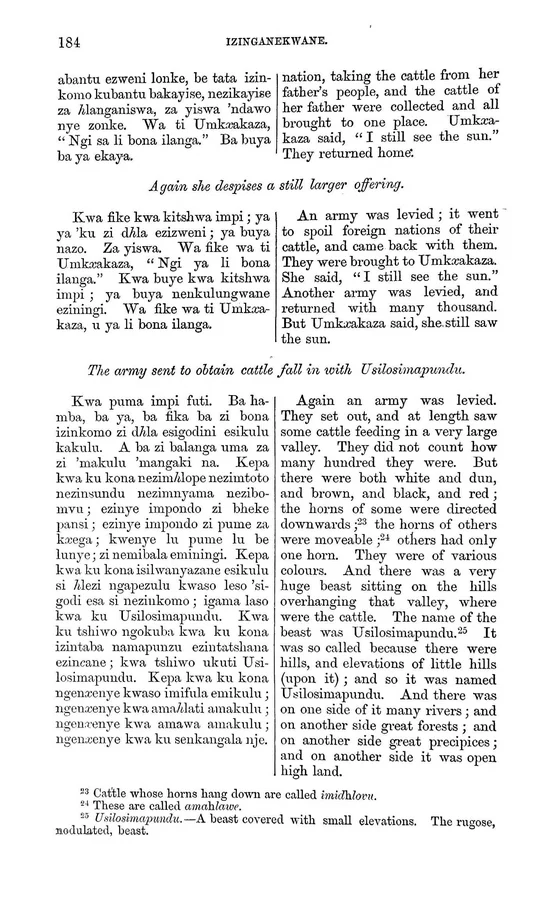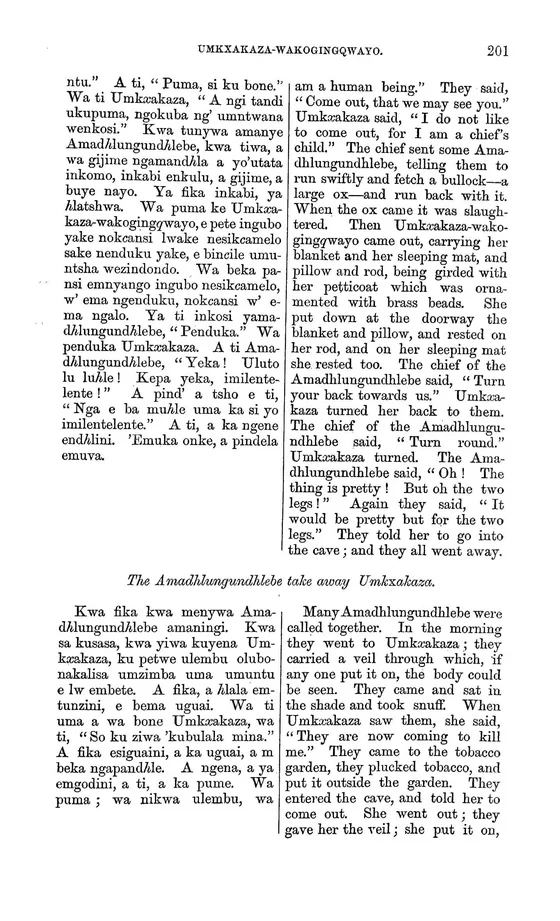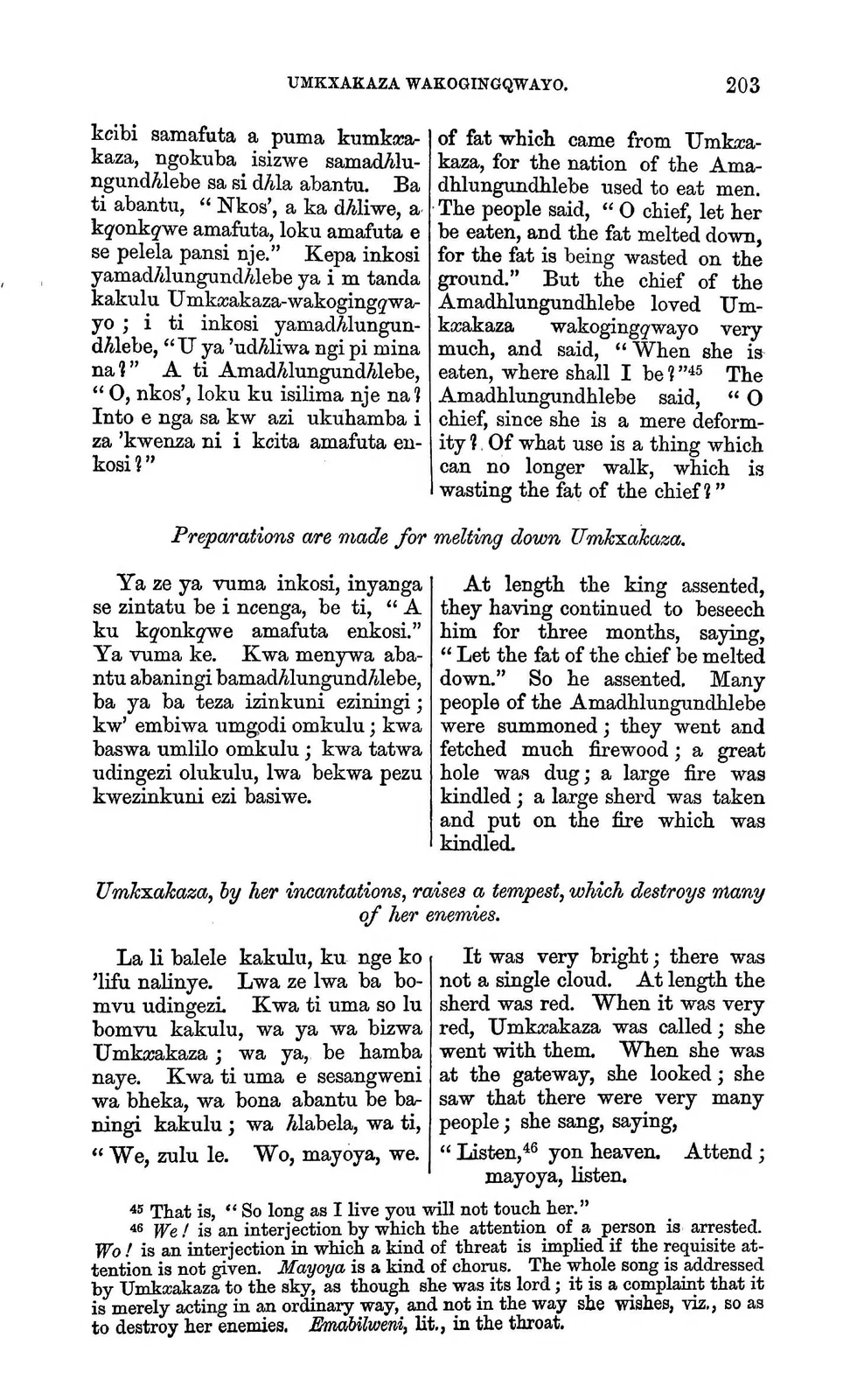
Umkxakaza-wakogingqwayo: documentary text witness, Callaway 1868, printed page 203; documentary source-page facsimile
Named princess and her storm incantation in the cooking-threat episode. Individually inspected original bilingual Zulu/English scanned page; documentary text, no creature illustration claimed. Physical edition 1868; translator/editor distinguished from traditional narrators. Public-domain publication and expired Callaway lifetime.
Overview
Umkxakaza-wakogingqwayo is a king’s daughter named after an army’s rattling weapons and rolling slain. Her father promises cattle numerous enough to darken the sun when she comes of age. She refuses increasingly large offerings until soldiers steal Usilosimapundu’s herd and its dust fulfills the promise. The offended landscape-bodied beast later abducts her, despite her family’s pursuit, and leaves her in a distant cave. Its revenge concerns the cattle her father might otherwise receive at her marriage.
Amadhlungundhlebe discover her there, finding her two-sided body strange. Their chief shelters her, but she becomes so fat that she cannot walk and his people decide to kill her for her fat. Twice she sings to the sky while they prepare a heated sherd. Storms destroy their apparatus and kill captors; the second kills their chief. The survivors stop feeding her adequately, which enables her to become mobile and escape. Back home, she reveals herself to her grieving mother and her return is celebrated.
A later king sends an old man who changes into a beautiful frog and draws her away. Reverting to human form, he attempts to surrender her to wild beasts. She commands her head to open, stores her possessions inside it and climbs a tree whose branches close behind her. Her head remains enormously enlarged. The envoy delivers her to his king, where only the king’s sister warmly defends and befriends her.
While bathing together, she opens her head again, takes out the stored goods and restores its ordinary size. Her friend embraces her, and their laughter sends them rolling in the mud until they must bathe again. Umkxakaza gives her one of her own garments. She tells her friend the complete story and her name. The household now recognizes the woman it previously called Ukandakulu, or Big-head; she marries the king and returns to her family for the marriage arrangements. The envoy is executed for his treachery. The account distinguishes the princess’s own storm and head-opening powers from the beast’s landscape body and the envoy’s frog form.
Origins & earliest records
The selected bilingual account credits Lydia. Henry Callaway translates and annotates it; contributor, translation and comparative commentary are distinct layers.
Records & interpretation
Complete selected narrative read, including its ending and contributor credit: Umkxakaza-wakogingqwayo, complete pp. 181–217; storm-song pp. 203–207, head transformation pp. 212–216, conclusion p. 217.
In the literature
“Her head closed and was small again.”
Umkxakaza-wakogingqwayo, printed p.215 · Henry Callaway
After releasing stored possessions, the princess’s enlarged head returns to its earlier size.
Selected bibliography
Documented works and useful reading. This is not a list of every appearance.
- 01
Nursery Tales, Traditions, and Histories of the Zulus, in Their Own Words, volume I
Umkxakaza-wakogingqwayo, complete pp. 181–217; storm-song pp. 203–207, head transformation pp. 212–216, conclusion p. 217
- 02
Nursery Tales, Traditions, and Histories of the Zulus, VolumeI — Umkxakaza-wakogingqwayo
Henry Callaway, Nursery Tales, Traditions, and Histories of the Zulus, VolumeI, Springvale,Natal:JohnA.Blair1868. Complete English narrative columns of Umkxakaza-wakogingqwayo printed181–217 independently read; selected bilingual Cornell page images, signature Lydia on217 visually checked. Editorial comparative notes distinguished, not all independently sourced works therein inspected.
Family & connections
A source-supported family tree or inspiration record has not yet been compiled for this profile. Related reading below indicates a connection in subject matter, not a proven lineage or creative influence.
Located primary passages
Specific passages supporting details in this entry, grouped by their published witness.
Nursery Tales, Traditions, and Histories of the Zulus, VolumeI — Umkxakaza-wakogingqwayo
Henry Callaway, Nursery Tales, Traditions, and Histories of the Zulus, VolumeI, Springvale,Natal:JohnA.Blair1868. Complete English narrative columns of Umkxakaza-wakogingqwayo printed181–217 independently read; selected bilingual Cornell page images, signature Lydia on217 visually checked. Editorial comparative notes distinguished, not all independently sourced works therein inspected.
- A princess insists on her father’s promise of cattle numerous enough to darken the sun. Raids culminate in theft from Usilosimapundu. Its retaliatory invasion compels her domestic work and carries her away; her mother’s final farewell precedes abandonment in a supplied distant cave.
- The half-bodied Amadhlungundhlebe receive and fatten her but plan her killing. Her storm appeals defeat two attempts; subsequent reduced food lets her recover mobility and escape. She finds her mourning parents, reveals herself and is welcomed home.
- A distant suitor’s envoy lures her in frog form, then becomes a man and betrays her in a forest. She stores possessions inside her opening head and hides above wild beasts. Its enlarged appearance brings rejection at the suitor’s village, but his sister protects and befriends her; in private she releases her possessions and resumes her earlier head size.
- The sister presents the transformed-back princess to the people; the king reverses his rejection. The treacherous envoy is killed. The princess revisits her father with the bridegroom’s cattle, marriage payments are completed and she rules prosperously with her husband.
The cattle obscure sunlight with dust, not a literal celestial eclipse. Her original human parents and sister remain distinct from later hosts. No song formula copied. The chief’s affectionate child designation is not her biological origin, and escape is not achieved by killing every survivor. Ukandakulu is a situational name for the same princess, not an independent species or another woman. Enlarged head is her protective transformation, not congenital anatomy. The sister’s acceptance precedes restored beauty and the king’s change of mind. No unmentioned children or biological kinship with the suitor’s sister invented.
References
Sources supporting this profile. Linked pages have their own scope and editorial standards.
- Attributed primary narrative with translation; digitized bilingual editionCallaway bilingual edition — Umkxakaza-wakogingqwayo, complete pp. 181–217; storm-song pp. 203–207, head transformation pp. 212–216, conclusion p. 217Research access: 2026-10-05
Image credits
Historical text facsimileUmkxakaza-wakogingqwayo: documentary text witness, Callaway 1868, printed page 203; documentary source-page facsimile
Named princess and her storm incantation in the cooking-threat episode. Individually inspected original bilingual Zulu/English scanned page; documentary text, no creature illustration claimed. Physical edition 1868; translator/editor distinguished from traditional narrators. Public-domain publication and expired Callaway lifetime.