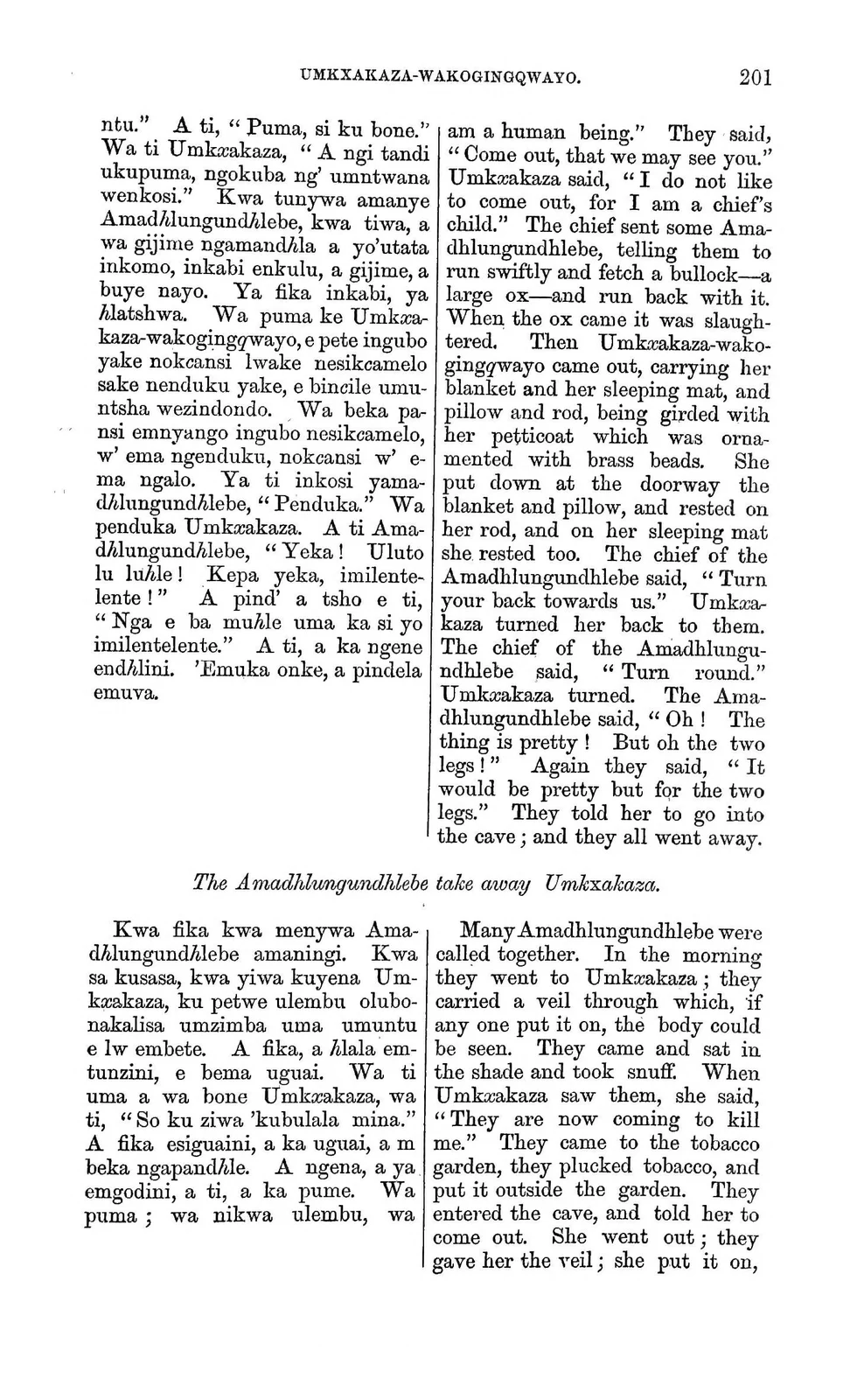
Amadhlungundhlebe: documentary text witness, Callaway 1868, printed page 201; documentary source-page facsimile
Captivity episode naming the captors and their chief calling the two-legged princess deformed. Full half-body description continues on the next page. Individually inspected original bilingual Zulu/English scanned page; documentary text, no creature illustration claimed. Physical edition 1868; translator/editor distinguished from traditional narrators. Public-domain publication and expired Callaway lifetime.
Overview
After Usilosimapundu leaves Umkxakaza in a cave, strange visitors approach by leaps, collect tobacco and flee at the sight of her hands. They are Amadhlungundhlebe, described as possessing only one side of a body, compared with an ox divided lengthwise. They regard her two hands and two legs as defects, reversing her own initial fear of their appearance. Their chief questions her, provides a slaughtered ox and eventually takes her into a large settlement resembling her father’s.
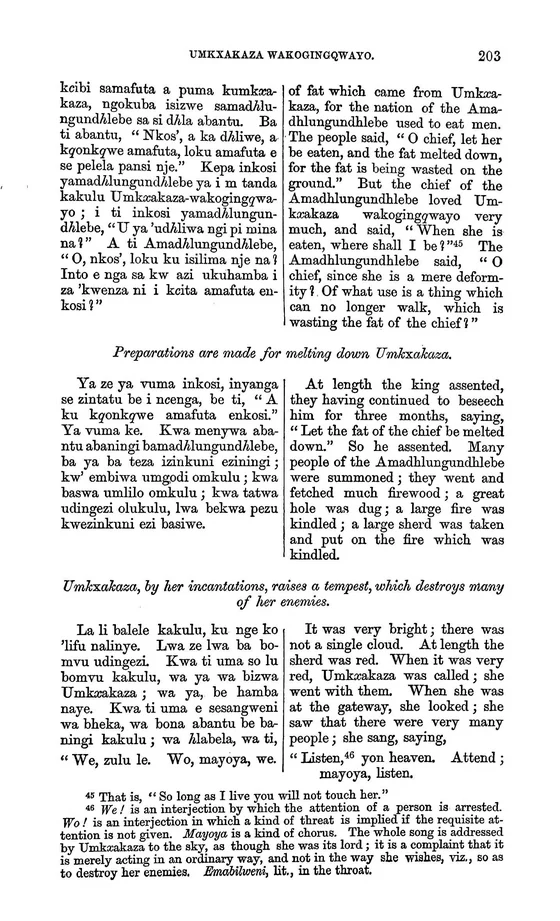
The chief treats her as his child and feeds her until she can scarcely walk. Fat left where she sits is drunk by him. His people urge him to kill her and render it down, and after three months he agrees. They prepare a pit, fire and red-hot sherd. On the way to it she sings to the sky, bringing clouds, rain and thunder that quench and break the sherd and kill some of her escort while sparing her.
A second attempt tries to prevent her singing by carrying her straight to the heated sherd. She sings again, and the resulting storm kills the chief and many others. The remnant decides to deprive her of food rather than touch her. Losing the excess weight enables her to leave with her belongings and eventually return home. Callaway compares other half-person traditions in note 43; those comparisons do not make this group an alias for the Hausa giantess or Sierra Leone bridegroom.
Origins & earliest records
The selected bilingual account credits Lydia. Henry Callaway translates and annotates it; contributor, translation and comparative commentary are distinct layers.
Records & interpretation
Complete selected narrative read, including its ending and contributor credit: Umkxakaza-wakogingqwayo, complete pp. 181–217; Amadhlungundhlebe pp. 198–207, half-body description pp. 201–202.
In the literature
“were like one side”
Umkxakaza-wakogingqwayo, printed p.202 · Henry Callaway
The narrator describes the Amadhlungundhlebe’s form through a comparison with one half of a divided animal.
Selected bibliography
Documented works and useful reading. This is not a list of every appearance.
- 01
Nursery Tales, Traditions, and Histories of the Zulus, in Their Own Words, volume I
Umkxakaza-wakogingqwayo, complete pp. 181–217; Amadhlungundhlebe pp. 198–207, half-body description pp. 201–202
- 02
Nursery Tales, Traditions, and Histories of the Zulus, VolumeI — Umkxakaza-wakogingqwayo
Henry Callaway, Nursery Tales, Traditions, and Histories of the Zulus, VolumeI, Springvale,Natal:JohnA.Blair1868. Complete English narrative columns of Umkxakaza-wakogingqwayo printed181–217 independently read; selected bilingual Cornell page images, signature Lydia on217 visually checked. Editorial comparative notes distinguished, not all independently sourced works therein inspected.
Family & connections
A source-supported family tree or inspiration record has not yet been compiled for this profile. Related reading below indicates a connection in subject matter, not a proven lineage or creative influence.
Located primary passages
Specific passages supporting details in this entry, grouped by their published witness.
Nursery Tales, Traditions, and Histories of the Zulus, VolumeI — Umkxakaza-wakogingqwayo
Henry Callaway, Nursery Tales, Traditions, and Histories of the Zulus, VolumeI, Springvale,Natal:JohnA.Blair1868. Complete English narrative columns of Umkxakaza-wakogingqwayo printed181–217 independently read; selected bilingual Cornell page images, signature Lydia on217 visually checked. Editorial comparative notes distinguished, not all independently sourced works therein inspected.
- Visitors discover the princess in a tobacco-garden cave, initially fleeing her displayed hands. They proceed by leaps and eventually bring her to their chief. Their half-body form is contrasted with her two legs and hands, making her seem anomalous to them.
- The chief loves the princess and calls her his child, housing and feeding her. As she becomes too heavy to walk, the man-eating community urges him to allow her killing for her fat, and repeated pressure eventually gains his assent.
- Two attempts to heat a sherd for killing the princess fail when her appeal brings destructive storms. The second storm kills their chief and many people; a remnant chooses food deprivation instead. Reduced feeding lets her regain mobility, take her possessions and escape.
Callaway’s comparisons with other half-men traditions are editorial and do not establish a shared historical origin. No specific modern community is equated with these fictional beings. Calling her his child is an adopted or affectionate position in this episode, not biological paternity. His affection does not prevent eventual agreement to killing. The entire people is not annihilated. Storm appeals are paraphrased without song wording, and no real weather-control efficacy is asserted.
References
Sources supporting this profile. Linked pages have their own scope and editorial standards.
- Attributed primary narrative with translation; digitized bilingual editionCallaway bilingual edition — Umkxakaza-wakogingqwayo, complete pp. 181–217; Amadhlungundhlebe pp. 198–207, half-body description pp. 201–202Research access: 2026-10-05
Image credits
Historical text facsimileAmadhlungundhlebe: documentary text witness, Callaway 1868, printed page 201; documentary source-page facsimile
Captivity episode naming the captors and their chief calling the two-legged princess deformed. Full half-body description continues on the next page. Individually inspected original bilingual Zulu/English scanned page; documentary text, no creature illustration claimed. Physical edition 1868; translator/editor distinguished from traditional narrators. Public-domain publication and expired Callaway lifetime.