A sourced illustration has not yet been added. This gap is included in the coverage record.
Overview
A distant king hears of Umkxakaza’s beauty and sends an old man to fetch her. At her father’s gate the envoy turns into a beautiful, glistening frog. Its appearance draws the princess and the whole household to watch. When it hops out, she insists on following to see where it goes. Her father sends twenty people carrying provisions and her belongings, but eventually only she continues with the frog.
When they are alone it becomes an old man again. Asked how it had been a frog, he says simply that he became one; he supplies no external curse or borrowed skin. He leads her into a forest, abandons the path and whistles for beasts, apparently unwilling to deliver so beautiful a woman to another man. She hides her possessions in her magically opened head and climbs above the closing branches. The arriving beasts seize and scratch the envoy, who sends them away with a promise of something tomorrow.
He finally brings her to the king, commenting on her enlarged head without admitting its cause. After she removes her possessions and tells the king’s sister the story, the narrative ends with his execution for those practices. The beasts called by his whistle are one summoned company in this episode; the story does not name each as a distinct supernatural species.
Origins & earliest records
The selected bilingual account credits Lydia. Henry Callaway translates and annotates it; contributor, translation and comparative commentary are distinct layers.
Records & interpretation
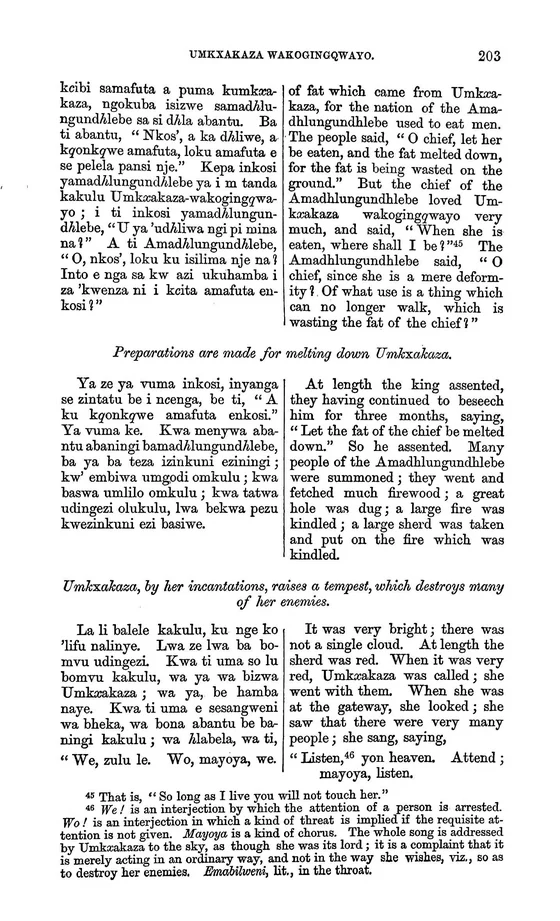
Complete selected narrative read, including its ending and contributor credit: Umkxakaza-wakogingqwayo, complete pp. 181–217; frog and treachery pp. 210–213, envoy’s death p. 217.
In the literature
“the frog turned into a man.”
Umkxakaza-wakogingqwayo, printed p.211 · Henry Callaway
The envoy resumes human form after leading the princess away.
Selected bibliography
Documented works and useful reading. This is not a list of every appearance.
- 01
Nursery Tales, Traditions, and Histories of the Zulus, in Their Own Words, volume I
Umkxakaza-wakogingqwayo, complete pp. 181–217; frog and treachery pp. 210–213, envoy’s death p. 217
- 02
Nursery Tales, Traditions, and Histories of the Zulus, VolumeI — Umkxakaza-wakogingqwayo
Henry Callaway, Nursery Tales, Traditions, and Histories of the Zulus, VolumeI, Springvale,Natal:JohnA.Blair1868. Complete English narrative columns of Umkxakaza-wakogingqwayo printed181–217 independently read; selected bilingual Cornell page images, signature Lydia on217 visually checked. Editorial comparative notes distinguished, not all independently sourced works therein inspected.
Family & connections
A source-supported family tree or inspiration record has not yet been compiled for this profile. Related reading below indicates a connection in subject matter, not a proven lineage or creative influence.
Located primary passages
Specific passages supporting details in this entry, grouped by their published witness.
Nursery Tales, Traditions, and Histories of the Zulus, VolumeI — Umkxakaza-wakogingqwayo
Henry Callaway, Nursery Tales, Traditions, and Histories of the Zulus, VolumeI, Springvale,Natal:JohnA.Blair1868. Complete English narrative columns of Umkxakaza-wakogingqwayo printed181–217 independently read; selected bilingual Cornell page images, signature Lydia on217 visually checked. Editorial comparative notes distinguished, not all independently sourced works therein inspected.
- A distant chief sends an old man to obtain the princess. At her village he changes into a bright frog, draws her into following and resumes human shape once her companions fall behind. In a forest he abandons the entrusted mission, summons beasts and seeks to keep her from the intended suitor.
- The princess hides while his summoned beasts tear him; he placates them and survives that encounter. She rejoins him with enlarged head, and he delivers her to the chief while blaming her appearance. After her eventual revelation, the old man is killed for his conduct.
He is a human envoy with deliberate frog transformation; no outside spell, frog species or universal FrogPrince identification established. His summons is not copied. The forest mauling is not the stated death; his final killing occurs at the narrative conclusion. Calling the beasts his children does not establish actual parentage.
References
Sources supporting this profile. Linked pages have their own scope and editorial standards.
- Attributed primary narrative with translation; digitized bilingual editionCallaway bilingual edition — Umkxakaza-wakogingqwayo, complete pp. 181–217; frog and treachery pp. 210–213, envoy’s death p. 217Research access: 2026-10-05
Image credits
A sourced illustration has not yet been added. This gap is included in the coverage record.