Unanana-bosele: documentary text witness, Callaway 1868, printed page 332; documentary source-page facsimile
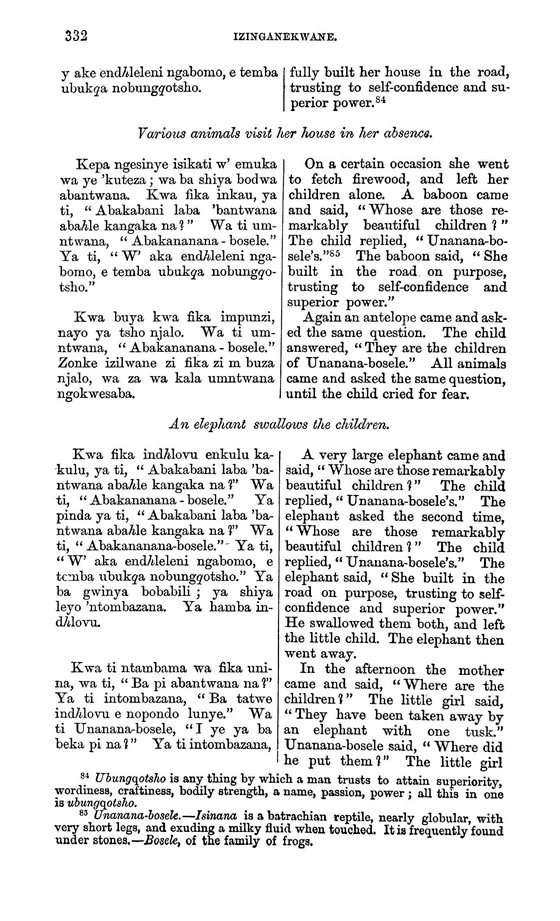
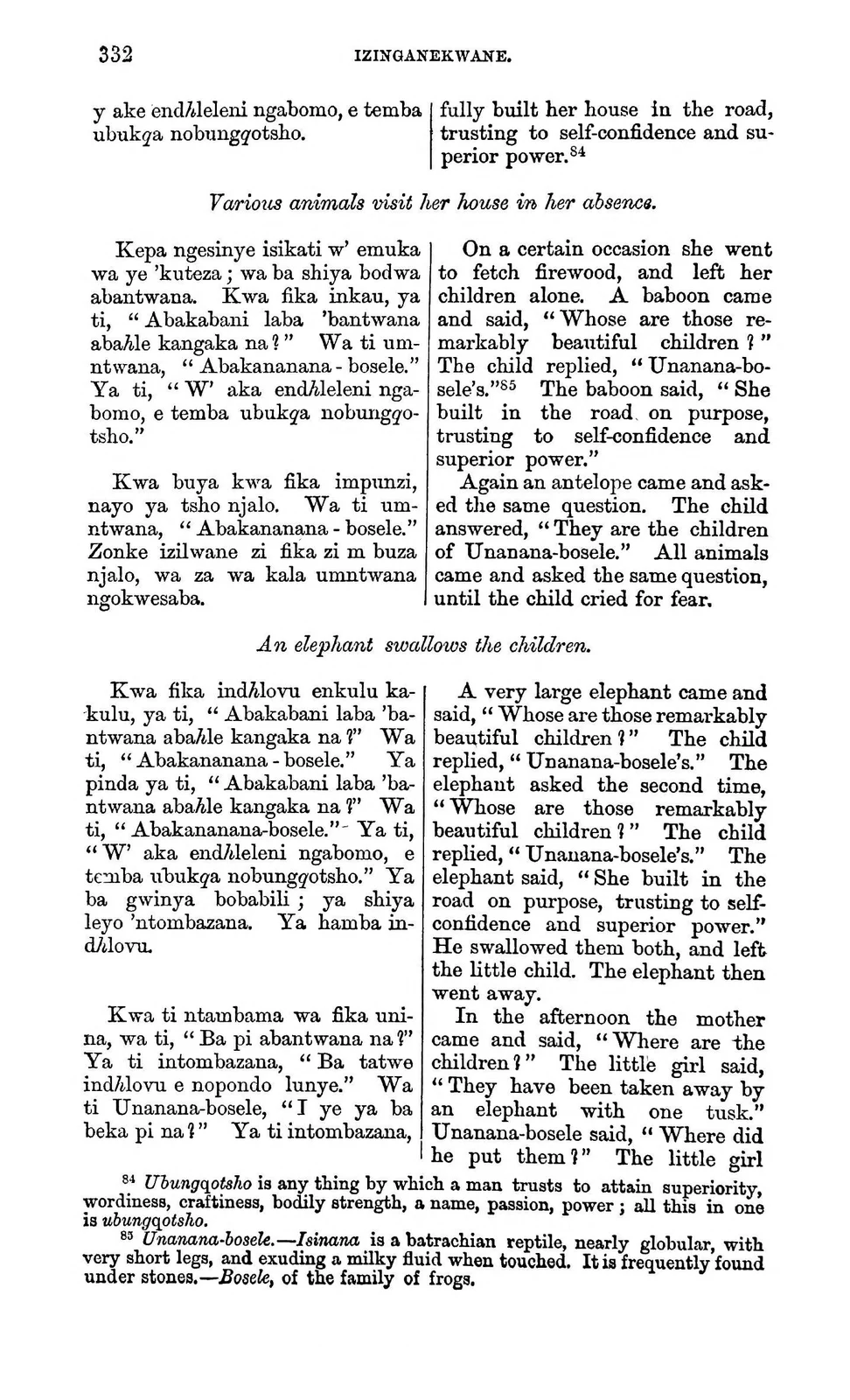
Unanana-bosele episode: visiting animals and the elephant swallowing her children while she is absent. Individually inspected original bilingual Zulu/English scanned page; documentary text, no creature illustration claimed. Physical edition 1868; translator/editor distinguished from traditional narrators. Public-domain publication and expired Callaway lifetime.
Overview
Unanana-bosele has two young children and another child who stays with them. The opening explains that she deliberately built her house in the road, trusting her confidence and power. While she gathers firewood, a baboon, an antelope and successive animals question the young companion about the children. A very large one-tusked elephant ultimately swallows the two, leaving their companion to tell the mother. Unanana-bosele asks where the children were put and whether they are dead; the girl knows only that they were eaten.
After resting overnight, she grinds maize and carries a large pot containing it with amasi. An antelope and leopard direct her toward tall trees and white stones. She follows the same directions from the other animals and finds the elephant lying beneath the trees. It tries to make her continue along the route as though the quarry were elsewhere. She recognizes it, stands still and repeats her request a third time. The elephant then seizes and swallows her.
Its stomach is an inhabited country with forests, great rivers, high ground, rocks and villages, as well as people, dogs and cattle. Her children are alive but have eaten nothing. She feeds them amasi and teaches them that consuming the elephant’s flesh will harm it rather than them. She kindles a large fire, cuts and roasts the liver, then eats with them. The other captives follow her example. Outside, the elephant complains of stomach pain; after a long time it dies.
She divides the body with a blade and cuts a rib with an axe. A cow, a goat, a dog and laughing people emerge into daylight. Freed captives give her cattle, goats and sheep. She returns home with her children and the livestock, delighting the girl who thought her dead. Callaway’s note 85 gives a frog-related explanation of her name, while Lydia’s narrated episode presents the household mother and her rescue without an enacted frog transformation.
Origins & earliest records
The selected bilingual account credits Lydia (Umkasetemba). Henry Callaway translates and annotates it; contributor, translation and comparative commentary are distinct layers.
Records & interpretation
Complete selected narrative read, including its ending and contributor credit: Unanana-bosele, pp. 331–335; name gloss in note 85, p. 332.
In the literature
“The elephant can be eaten.”
Unanana-bosele, printed p.334 · Henry Callaway
The mother’s reassurance starts collective consumption and eventual liberation.
Selected bibliography
Documented works and useful reading. This is not a list of every appearance.
- 01
Nursery Tales, Traditions, and Histories of the Zulus, in Their Own Words, volume I
Unanana-bosele, pp. 331–335; name gloss in note 85, p. 332
- 02
Nursery Tales, Traditions, and Histories of the Zulus, Volume I — Unanana-bosele
Henry Callaway, Nursery Tales, Traditions, and Histories of the Zulus, Volume I, Springvale, Natal: John A. Blair,1868; bilingual edition, selected Princeton scan. Complete Umamba321–331 and Unanana-bosele331–335 read; both end with Lydia(Umkasetemba).
Family, evolution & connections
Unanana-bosele’s two children in Callaway’s tale
Opening household description, pp. 331–333, not a genealogy of all later people encountered.
Scroll sideways to see all branches. With a keyboard, focus the tree and use the arrow keys.
- Two unnamed young children
Two children explicitly assigned to the named mother. Children’s names, sexes and father are unstated. The third child staying with them is excluded because parentage is not stated. Animal-helper “mother” addresses do not establish ancestry.
Two unnamed children of Unanana-bosele (Callaway)
The opening gives Unanana-bosele two young children. A third child stays with them but is not explicitly identified as her offspring. Her “mother” address to animal helpers is not recorded as biological parentage.
Located primary passages
Specific passages supporting details in this entry, grouped by their published witness.
Nursery Tales, Traditions, and Histories of the Zulus, in Their Own Words, volume I
Henry Callaway, Nursery Tales, Traditions, and Histories of the Zulus, Volume I, Springvale, Natal: John A. Blair,1868; bilingual edition, selected Princeton scan. Complete Umamba321–331 and Unanana-bosele331–335 read; both end with Lydia(Umkasetemba).
- The mother has deliberately built in a path, described as relying on superior power. After the elephant takes her two children she prepares maize and amasi, carries a knife and follows directions from successive animals. She recognises the elephant’s evasive answers, persists, is swallowed, feeds her children and initiates the captives’ eating of the monster.
Unanana-bosele, printed pp.331–334; maternal search and interior rescue
- After the elephant dies she opens it, cutting a rib with an axe as well as using a knife. The liberated people reward her with cattle, goats and sheep. She returns wealthy with her two children and finds the young minder still at home, relieved because she had thought the mother dead. Lydia(Umkasetemba) is the closing contributor.
Unanana-bosele, printed p.335; liberation, wealth and homecoming
The editor’s frog-related name gloss in note85 does not make the mother a literal transformed frog. Animals addressed as mother are not therefore her biological parents. The young minder remains a distinct third child, not one of the swallowed pair. The final text does not explain where the newly mentioned axe came from.
References
Sources supporting this profile. Linked pages have their own scope and editorial standards.
- Attributed primary narrative with translation; digitized bilingual editionCallaway bilingual edition — Unanana-bosele, pp. 331–335; name gloss in note 85, p. 332Research access: 2026-10-05
Image credits
Historical text facsimileUnanana-bosele: documentary text witness, Callaway 1868, printed page 332; documentary source-page facsimile
Unanana-bosele episode: visiting animals and the elephant swallowing her children while she is absent. Individually inspected original bilingual Zulu/English scanned page; documentary text, no creature illustration claimed. Physical edition 1868; translator/editor distinguished from traditional narrators. Public-domain publication and expired Callaway lifetime.